




Before The Seed of the Sacred Fig starts, a message appears on screen, telling us the film was made secretly. Then another message appears: “When there is no way, a way will be made.” The determination and courage of filmmaker Mohammad Rasoulof are undeniable, even if the result can be unwieldy.
When Rasoulof premiered his movie at the Cannes Film Festival this past summer, he had just fled Iran after being sentenced to eight years in prison. (He now resides in Germany.) The Seed of the Sacred Fig is just one of several films the director has made that are outwardly critical of Iran’s theocratic regime, but it might now be the most well-known thanks to its post-Cannes buzz and its selection as Germany’s entry for Best International Feature Film at the Academy Awards.
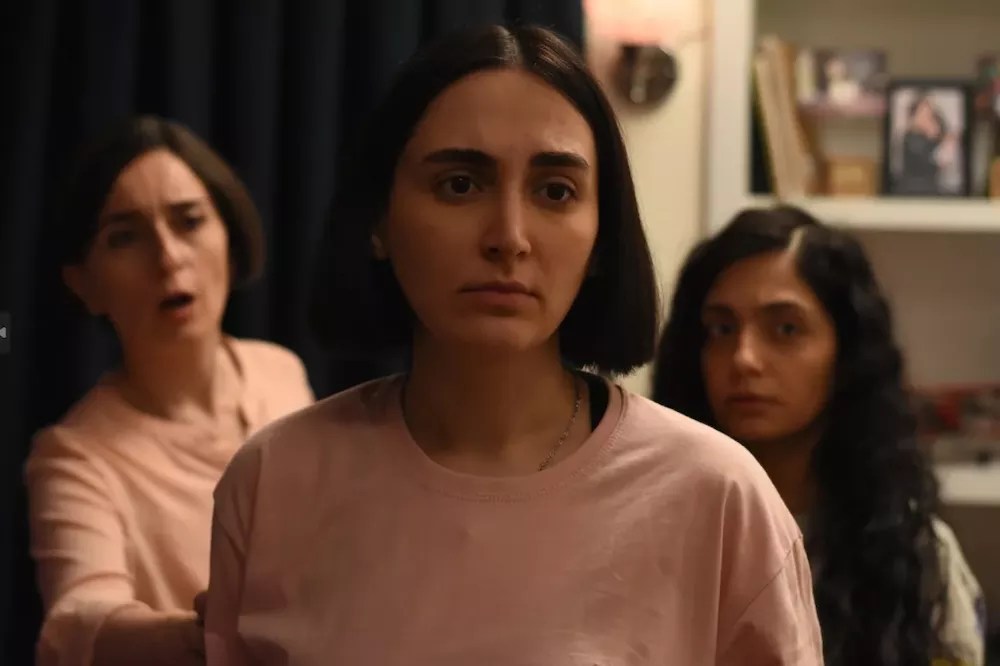
The film tells the story of a family in Iran: Iman (Missagh Zareg), his wife Najmeh (Soheila Golestani), and their daughters Sana (Setareh Maleki) and Rezvan (Masha Rostami). Iman, the patriarch of the family, has just received a promotion as a judge’s investigator in the Revolutionary Court. This position opens up a world of possibility for the family, but invites increased scrutiny as well. We follow the family as their bonds slowly begin to disintegrate under the pressure and pervasive nature of their country’s government. When a gun that Iman is given at work for protection goes missing, the family will never be the same again.
The Seed of the Sacred Fig is both a gripping work of political dissidence and an imperfect film. The emotional impact of seeing real footage of protests in Iran is unshakable, especially when you know of Rasoulouf’s own harrowing escape, adding to the tension and sense of unease the filmmaker keeps ratcheting up until the last frames. However, as the film switches gears towards the second act, the pacing and writing take a turn for the clunkier. The allegorical tale of Iman and the women he tries to suppress clearly operates as a metaphor for Iran and the country’s treatment of women, but at a narrative cost. It’s understandable why the film needs to operate as a blunt object – but in the service of the larger message, some technical finesse is lost. Pacing towards the second half of the film is stiff, and there is no room for deeper character exploration beyond the roles each family member must play in the allegory.
These are small complaints, however. It is evident that the sum is greater than the parts of The Seed of the Sacred Fig, which manages to remain engrossing and compelling throughout its two and a half hour runtime, even with the clunkier bits present. It’s worth watching just to be a witness to the transgressive and courageous possibilities of the medium.
Neon releases The Seed of the Sacred Fig in theatres in late November. Catch up with all of The Austin Chronicle‘s Austin Film Festival coverage.
This article appears in October 25 • 2024.