

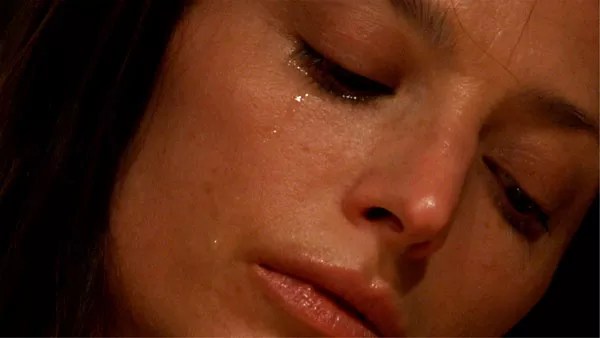
Filmmaker Robert Greene found himself in the midst of an irresistible creative convergence. From his catbird seat as next-door neighbor and friend to the actor Brandy Burre (formerly of The Wire), he’d watched her struggle with the predictable identity issues that happen when a working actor transitions to suburban mom. Then her relationship with Tim, the father of her two children, blew up, forcing her to retool for re-entering the working actor’s world. Perfect material for Greene, who’d long been keen to make a film that explored the relationship between “acting” and “being yourself” in a documentary.
“What basically happened,” he says, “was that my formal ideas about the roles we play happened to match the internal struggle Brandy was just about to turn into a very external struggle, and I just happened to have my cameras rolling, perhaps egging her on – or at least finding visual ways to help her express her tumult.” Voilà. Actress turned out to be a highly constructed, stylized scofflaw of a doc, at once transparent and opaque – Was Brandy acting for the camera? – with an essence-nailing, double-whammy of a title.
Austin Chronicle: Please describe your film.
Robert Greene: What gives the film its peculiar vibe is that so much is totally traditional in terms of Maysles-like [fly-on-the-wall] observation, but because we set you up to distrust the authenticity of everything you see, the viewer is made to question things that are clearly happening and real. Motivations and emotions then become more complex, and everything has this vague ambiguity, which I think illuminates Brandy’s experience in an interesting way. But to me these techniques are more truthful, not less. I really don’t mind bending or breaking any and all rules, but with a story like this and the real experiences of people so close to me being portrayed, this was not the film to simply “break the rules” with. I wanted all the weird contradictions, inherent manipulations, and inevitable distortions of the documentary process to be visible, but it also was an excellent vehicle for exploring the complex person I had in front of the camera. In the end, the film is about the roles we play and how we can get trapped when we simply perform the black-and-white version of ourselves that society sometimes demands.
Some have described the film as a documentary/fiction hybrid but I like to think of it as the most honest documentary of the year. Sure, I’m very interested in film language and how modes of storytelling register to audiences. I think I saw Brandy’s story as a kind of real-life melodrama – she’s a very theatrical person, as are many performers – and so at some point I started to think of the film as a Douglas Sirk-like observational documentary. There’s a lot of contradiction in there, of course, but to me this kind of mixing of the hyper-expressive and the observational lets us get at some other kinds of truths. Also, I think many questions people have when they sit down and watch a nonfiction film – Why are they allowing such intimacy? Who is exploiting whom? How is the director manipulating the scenes? – these are often hidden in documentaries and we just happen to be reveling in them, turning the contradictions and all the thorny questions into part of the story (without me explicitly onscreen).
AC: Did you worry about making a film about friends?
RG: I was very worried, and I continue to be. I didn’t have Brandy or Tim sign release forms until they watched the film. … Tim still doesn’t like to talk about the film. Brandy loves it.
Actress screens Wed., Feb. 11, 7:30pm, at the Marchesa Hall & Theatre, and will be followed by a Skype interview with the director.
This article appears in February 6 • 2015.