

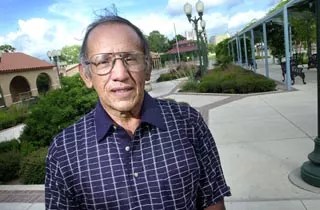
It’s easy to pick out Sabino and Lori C-Renteria’s house on Haskell Street, a few blocks south of Plaza Saltillo — it’s the one whose fence is covered with political campaign signs showing the residents’ yellow-dog dedication. Obviously absent are placards from the races of the Renterias’ former friends and current rivals in El Concilio — Marcos de Leon and Gavino Fernandez — who, aside from de Leon’s one term as a Travis Co. commissioner, have spent decades trying and failing at the local ballot box. El Concilio’s leaders say they effectively represent a “coalition” of Eastside neighborhoods, although the organization’s actual membership has always been a bit vague.
The Renterias’ interest and involvement in the community, most notably within their United East Austin Coalition and in projects like Saltillo and the East Cesar Chavez neighborhood plan, is amplified in part by their disgust with Fernandez and El Concilio, whom they believe have done more harm than good in East Austin. The couple maintains a folder stuffed with articles, some of them yellowed with age, detailing decades worth of political controversy surrounding El Concilio and its leaders, among them longtime guiding force Paul Hernandez, de Leon, and Fernandez. The dossier also contains anti-El Concilio letters and souvenirs of past conflicts — like a December 2000 press release blaming Fernandez and his allies for trying to stall approval of the ECC plan by asking the council to maintain industrial zoning in the area. “These groups have stopped progress in our area for too long,” Sabino Renteria wrote. Added Lori Renteria: El Concilio “doesn’t work for the community — they work the community when there’s something in it for them.”
Whatever its motives, El Concilio has displayed a remarkable tendency to get in the way of efforts both good and bad, drawing attention to itself without necessarily improving the lot of either Hispanics or the neighborhoods. For example, there was Fernandez’s recent electoral challenge to incumbent Council Member Raul Alvarez, probably the most sympathetic potential ally El Concilio has ever had at City Hall. Or the group’s opposition to a free neighborhood clinic or its protesting then-Council Member Gus Garcia at his 2000 farewell party at Fiesta Gardens or befriending controversial (and now convicted) land developer Barry Gillingwater.
Despite Fernandez and El Concilio being given opportunities for leadership on various public projects — like Saltillo and the Holly neighborhood plan — the coalition continues to complain about being neglected and shut out of the process. It was Cap Metro’s catering (and alleged favoritism) to El Concilio that led the Renterias and other ECC members themselves to complain about being shut out of the Saltillo project, leading to internal finger-pointing and a community firefight that Cap Metro managed to cool before it got totally out of control.

Ray Ramirez of Con Ganas — his self-founded nonprofit neighborhood-improvement organization incorporated in 2000 — resigned from the ECC team and began working with Fernandez during the initial Saltillo discussions. “There’s a sort of mentality in our community that there’s certain groups and political alignments,” Ramirez said recently. “[But] then the masses of the people are ‘none of the above.'” These include Anglos who have moved to the community in the past decade, immigrants from Mexico and Central America, and apolitical young people and families. Ramirez says he’d like to see some new blood among the community activists; with Saltillo, he says, “I thought, here we are again, we’re trying to get something going, but somehow it’s always the same people. There’s so many others out there.”
Sabino Renteria’s sister, PODER leader Susana Almanza, is an occasional ally of El Concilio and a constant front-row observer of Eastside politics. Though she acknowledges that some of her brother’s and sister-in-law’s complaints about El Concilio are valid — including questions about the group’s legitimacy (even she’s not sure who belongs to El Concilio besides Fernandez and a handful of his closest friends), she agrees with Fernandez on issues like closing the Holly Power Plant and combating gentrification and remains hesitant to completely disregard him and his allies — like La Prensa Editor and Publisher Cathy Vasquez-Revilla. “We always say we don’t agree 100% with El Concilio or Cathy, but there are issues we do agree on,” Almanza explains.
In the last decade, El Concilio’s force has been diminished by Paul Hernandez’s illness (lingering aftereffects of a brain aneurysm he suffered in the Nineties), the death last year of longtime Holly neighborhood leader Robert Donley, de Leon’s loss of his elected post to Margaret Gomez in 1994 (and subsequent losses in City Council and state legislative races), and now Fernandez’s arrest on drug and assault charges. But doubts about El Concilio’s grassroots effectiveness might be due to cultural differences, Almanza suggests that many East Austin residents won’t hold or attend a community meeting until there’s a crisis, though she expects that to change given the flurry of redevelopment. “We’re going to have to be right there all the time and have the community very well educated about the issues,” she says.
After years of conflict, particularly with El Concilio, Capital Metro has waded very carefully into Eastside politics with the Saltillo project. “When we had the community meetings, we heard that not one individual speaks for East Austin,” says the agency’s Dianne Mendoza. Yet leaders of both ECC and El Concilio tend to position themselves as the community voice, as do others on the margins. Political gadfly Gus Peña — a frequent citizen communicator at city, county, and school-board meetings, his young son inevitably in tow — pressured Cap Metro to include him on the Saltillo review team after it had already formed. Peña often claims to represent thousands of people as the leader of a group called East Austin Concerned Hispanics. “I told [Peña] I wanted to see their database,” recalls Sam Archer of Cap Metro. “He never provided it to me. He never produced anything except public-info requests for what happened during the meetings leading up to the solicitation for the master plan.” (Recently Peña spent some time in jail on charges that he violated his probation on a theft charge; District Judge Mike Lynch ruled that Peña could continue serving his probation, and Peña was released June 4.)
But Cap Metro and the city know better than to exclude any Eastside voice from Saltillo, lest they draw angry picketers and protests, even though this means the Saltillo project will itself become a venue for community bickering. Fernandez, for the moment at least, is out of the picture, but the larger conflicts remain; the Renterias continue to do battle with Vasquez-Revilla and at times with Almanza. “She’s fighting the revolution that never happened.” Sabino Renteria says of his sister. She could do it more effectively without El Concilio, he says. “I’ve told her many times she’s making a mistake.”
Almanza feels the same way about the Renterias. “If you don’t agree with them 100%, then you won’t be in the picture,” she says of their divergent paths through Eastside politics. “It’s not easy.” 
This article appears in June 27 • 2003.