

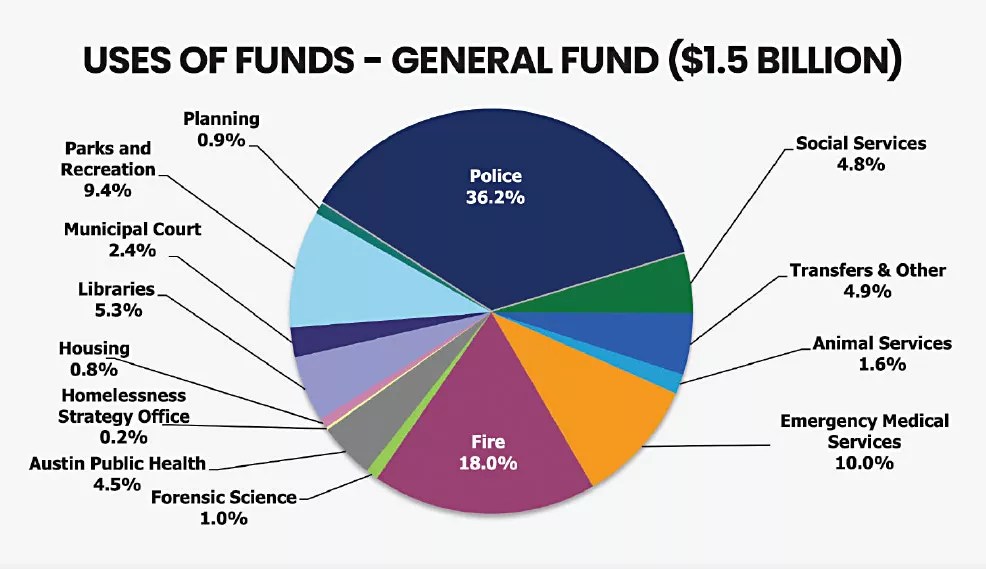
A remarkable thing happened last week. With our financial future uncertain, with declining sales tax revenue, with Donald Trump eliminating millions of dollars that help provide services to citizens, Austin’s City Council approved a budget which not only protects programs but actually strengthens the safety net.
Advocates like Equity Action’s Savannah Lee are calling it the most significant investment in the community in many years.
“This is a moment when things are dark, when programs are losing funding, when ICE is in our communities and folks are walking around scared and nervous,” Lee said. “We could either shrink from that and get smaller, or we could make a choice that this is the rainy day, this is the difficult moment, and we have to meet the moment. And I think everybody was ready to meet that moment together. When everything else around us started to fall apart, Austin showed up for itself.”
The $6.3 billion budget was approved on a 10-1 vote, with Council Member Marc Duchen voting no. To raise the money necessary to fund the budget, Council voted earlier this month to hold a tax rate election in November. The TRE will ask residents to increase property taxes by 5 cents on each $100 of property value. If the TRE passes, the average homeowner’s tax bill will rise $300 next year.
If approved, the extra money will provide $110 million for dozens of community priorities, some of them innovative ideas fully articulated only in recent years, others just nuts-and-bolts governance. The funding would implement the Homeless Strategy Office’s plan to get people off the streets. It would allow the Austin Fire Department to continue sending four, rather than three, firefighters per truck to emergencies. It would build out the program providing mental health responders, rather than police, for some 911 calls. It would continue the city’s highly praised Family Stabilization Grant program. It would support parks. It would provide a cost-of-living pay increase to city employees who can’t work from home. It would save vaccine programs threatened by Trump’s cuts. It would provide money for programs addressing housing affordability, trauma recovery, domestic violence, climate resilience, and much else.
Several Council members celebrated the budget’s passing in press releases. José Velásquez said it reflects the belief that governments can, and should, be a force for good. “We are redefining what essential services mean to this city,” Velásquez said. “These are not only investments, but commitments to the communities we were elected to serve.”
Lone dissenter CM Duchen sent out a press release warning that raising taxes will make Austin less affordable. It was his central message through the monthlong budget process. Duchen repeatedly pointed out that Travis County and the Austin Independent School District are also planning to raise taxes next year. He succeeded in getting some citizens to oppose the new taxes at meetings before Council. After the budget passed, he reiterated his belief that the city has a structural budget problem – that it spends more than it brings in – and that a successful TRE won’t fix it. “I believe the budget my colleagues passed this afternoon is little more than a Band-Aid, and that we’ll be forced to address this problem again in the near future,” Duchen said.
“We are redefining what essential services mean to this city. These are not only investments, but commitments to the communities we were elected to serve.” – District 3 Council Member José Velásquez
Despite his doubts, Duchen did support a 2-cent TRE to fund AFD, wildfire mitigation, and parks in the weeks leading up to the budget vote, as Council considered an increase of between 1 and 8 cents. Mayor Kirk Watson supported a 3.5-cent TRE, focused on implementing the city’s homeless response plan. Two groups of CMs – Zo Qadri, Mike Siegel, Paige Ellis, and Krista Laine on the one hand, and Ryan Alter, Vanessa Fuentes, José Velásquez, and Chito Vela on the other – pushed TREs of 5.75 and 6.75 cents, respectively.
Council settled on a 5-cent TRE the weekend before the vote. As final debate got underway last Wednesday, Mayor Watson urged Council to keep the process orderly and comprehensible. Sure enough, things quickly got fractious. Council took repeated breaks through Wednesday night and Thursday morning to clarify which programs they were haggling over. Council members Laine and Ellis sharpened their focus on keeping the city’s funding reserves, its money in the bank, at rates high enough to weather future financial storms. By Thursday afternoon, a variety of Fuentes’ priorities – several focused on assistance to elderly Austinites – were reassigned one-time, rather than ongoing, funding. That got Council to the 5-cent standard.
Afterward, Mayor Watson said there are things in the budget he wouldn’t have included, but that he’s very pleased with its emphasis on homelessness. “Cities including Dallas and Denver both have about 20 to 30 city employees involved in street outreach and encampment management, while Austin has two,” Watson wrote in his Watson Wire newsletter. “With the new budget, we’ll have 12 city employees dedicated to addressing encampments. … It will make a world of difference in getting homeless people off the street in a very short period of time.”
CM Alter told the Chronicle that now it’s up to voters to decide, through the November TRE, what comes next. “We’ve had this big public conversation, and we’ve put forward a budget that we think is really impactful. But in this particular instance, the public gets to weigh in and say, ‘Yes, this is what we want,’ or ‘No, it’s not.’ And that’s different from our usual budgeting. We have not really ever had the public be able to weigh in like that. So that’s an interesting nuance here – we’re going to get to see what is important to people.”
This article appears in August 22 • 2025.
