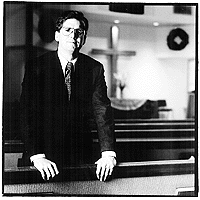
 Jim Rigby, pastor of St. Andrew’s Presbyterian Church photograph by Laura Skelding |
and family values, another religious organization has come along with a
rejoinder: Chill, for Pete’s sake.
This new voice that’s struggling to be heard above the fray is the Texas Faith
Network, made up of mainstream Christians and Jews from both clergy and lay
walks of life. The group’s list of objectives reads like a modern-day credo for
the Boy Scouts of America — that is, to promote compassion, fairness and
equity, and freedom and justice for all. Beyond the clich�s, the group
holds fast to a reality-based mission: to provide an alternative voice to the
platform of religious right captain Pat Robertson and his 700 Club.
The faith network is a young spin-off of the Texas Freedom Network, which
Cecile Richards founded last year to counter the Christian Coalition’s take on
public education and civil liberties. Richards’ group attracted so many men and
women of the cloth that it seemed a good idea to splinter off into a
faith-based organization that would appeal to middle-of-the-roaders of all
political persuasions. The group’s first and most recent claim to fame was its
well-publicized plea to Texas churches and synagogues to stop the distribution
of Christian Coalition voter guides.
“That’s not to say we’re trying to shut out the Christian Coalition,” says
Richards, the daughter of former Texas Governor Ann Richards. “To their credit,
they have organizational capabilities that rival any political group in this
country.”
One Texas Faith Network leader, the Rev. Larry Bethune of University Baptist
Church, says his group’s greatest challenge is simply to be heard. “For too
long the religious right and the Christian Coalition have been the only voice
— and the noisiest voice,” he says.
“Progressive” would be another word to describe the Texas Faith Network,
particularly when you have a Presbyterian minister like Jim Rigby going against
the grain of that old-time religion. “I want women to have a choice, and I want
gays and lesbians to be safe, and I want textbooks to go uncensored,” says
Rigby, pastor of St. Andrew’s Presbyterian Church.
“It’s not enough to say the religious right is wrong,” Rigby continues. “What
we want to do is help people focus on the positive principles of democracy. We
need to be asking ourselves how an atheist, a Baptist, a Catholic, and a
Christian Scientist can live in the same community and get along.
“I don’t think that the people involved with groups like the American Family
Association are bad people, necessarily,” Rigby says of another conservative
group. “But I do think they have bad thoughts. There have been a lot of people
hurt by their actions. There was a kid out in Pflugerville, for example, who
was told she was going to hell because she was Jewish and not a Christian.
Things like that stay with a child for a long, long time.”
Wyatt Roberts, the director of the American Family Association of Texas, isn’t
so willing to tip-toe around his opinion of Rigby and his group. “I am shocked
that these ministers would align themselves with sex shop owners,” says
Roberts. He claims the First Amendment Coalition of Texas — supporters of both
the Freedom Network and the Faith Network — is just a fancy name for a
pornography PAC because it’s opposed to regulations banning the sale of
sexually explicit materials. “It’s unfortunate that their rhetoric doesn’t
reflect what most mainstream, God-fearing Texans are all about,” Roberts
says.
Richards dismisses Roberts’ declaration that pornography pushers are fueling
the mainstream religious movement. Texans, while very conservative, grew up on
Populist thought, the kind that doesn’t fancy people like Roberts telling them
how to behave or be damned, Richards says.
This article appears in December 27 • 1996 and December 27 • 1996 (Cover).