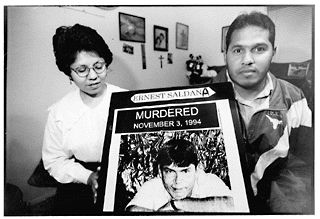
 Denise Guerrero and Cruz Salda�a hold a memorial plaque of their brother, Ernest Salda�a, who was beaten to death in 1994. |
1994, on his mother’s birthday, Ernest Salda�a was beaten, stomped, and kicked to
death by a trio of hooligans who stole the money from his disability check that
he had cashed that day. Salda�a, 32, was mentally disabled as a result
of an automobile accident 14 years earlier. He was also gay.
His killers, who reportedly shouted “Joto! Joto!,” (Spanish slang for
faggot) during the attack, are now serving out lengthy prison sentences. “They
knew Ernest from the neighborhood and they knew he was gay,” says
Salda�a’s sister, Denise Guerrero. “They came to Ernest’s house acting
like his best friend, and then they stomped him and killed him.”
The homophobic nature of the murder was never addressed during the homicide
trials, but his family decided to speak out in defense of their gay son and
brother. Working with the Lesbian/Gay Rights Lobby of Texas (LGRL), the family
had hoped the brutal killing would lead to passage of a stronger hate crime
bill in the 1995 Texas Legislature. It didn’t. The measure failed by two votes,
but is now back for round two this legislative session.
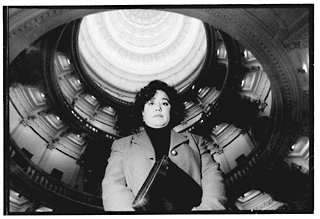 Dianne Hardy-Garcia of the Lesbian/Gay Rights Lobby of Texas is working for passage of a stronger hate crimes bill |
the same margin,” says Dianne Hardy-Garcia, executive director of LGRL, who has
enlisted a wider network of organizations to support the bill, which is being
carried by Sen. Rodney Ellis and Rep. Scott Hochberg, both Houston Democrats.
Since the bill failed to win the needed votes two years ago, seven other gay
men have been murdered across Texas, three of them in the Austin area. Last
summer was an especially trying one for local gay activists. Three men were
killed within weeks of each other in unrelated homicides. The first death in
July involved a 10-year government employee, Bruce Becker, 36, who police say
was beaten and stabbed by a man he had befriended on the Drag and taken to his
home (see related story).
That same month, Pablo Zuniga, 31, was found fatally stabbed on Town Lake’s
north shore, just southeast of the Four Seasons Hotel, on a trail where gay men
cruise for sex partners.
In August, David Johnson, 37, was seen leaving an Austin bar on Red River with
a man he had met that night. He was found dead the next morning about a mile
from his home in Wimberley.
In the case of Zuniga, who was deaf and unable to speak, police arrested and
charged 21-year-old Charles Edward Lowery, whose murder trial is pending.
Lowery’s attorney, Chris Gunter, doesn’t dispute that his client stabbed
Zuniga, but he says he did so in self-defense. He says Lowery, who lived in an
apartment near Town Lake, was sitting on a park bench smoking a cigarette when
Zuniga “appeared out of nowhere” and tried to grab his cigarette. “My guy kind
of shoos him away,” Gunter says, and Zuniga returned and placed a knife under
Lowery’s chin. It was then that Lowery took his own knife and stabbed Zuniga in
the chest, Gunter says. Police say Zuniga was found with his pants unzipped,
his genitals exposed, and his pockets turned inside out. There was no weapon
found near the body. Lowery turned himself in to police Sept. 13, more than a
month after the killing.
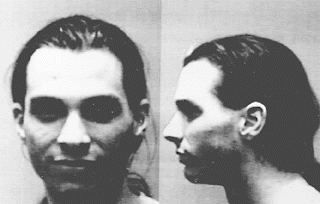 Charles Edward Lowery stands accused of killing Pablo Zuniga |
skinny little hippie who watches Star Trek at night and then goes down
to the river to smoke a cigarette.”
In Hays County, sheriff’s detectives say robbery was the motive behind the
beating death of David Johnson. The suspect, Jayson Perry Hawkins, 21, was a
singer in a New Braunfels-based band — Stigma — that had performed the night
of August 9 at the Blue Flamingo on Red River Street here in Austin. According
to Detective Mitchell Johnson, the two had left the bar in a taxi on the way to
Johnson’s home in Wimberley, south of Austin. The cab driver told investigators
that once in Wimberley, the two got out of the cab and began walking. The next
morning, Johnson’s body was found in the middle of Gold Rush Road. His head had
been smashed by a rock weighing between 30 to 40 pounds.
Johnson was known as a bit of a loner who lived on his father’s property in a
rural section of Wimberley. He worked as a volunteer at the San Marcos Public
Library for two years — first as part of his community service restitution for
a drunk driving conviction. Then, once he’d served his time at the library,
Johnson decided to continue working there on a volunteer basis, says his
supervisor Diane Insley. Johnson “was very talkative and friendly,” she says.
“He had a big grin and nice teeth. He just looked like a Texan.”
All told, 22 gay men have been murdered across the state since 1988. In
overall hate crimes, which include crimes based on sexual orientation, race,
ethnicity, and religion, 1,600 have been recorded since 1992, with 15.7%
involving crimes against lesbians and gays. And needless to say, the number
doesn’t include the victims who never report the crimes.
“Texas has always been willing to enhance penalties for many, many types of
crimes — until it comes to lesbians and gays,” Hardy-Garcia says. “It hurts me
to the core to know that people don’t believe we deserve to have the same
rights.”
What makes the murders of gay men difficult to generate sympathy and outrage
in the heterosexual world is an age-old, blame-the-victim mentality. Many of
the men were killed by strangers they met at a bar, an adult video store, or
while cruising parks or other areas where gay men converge.
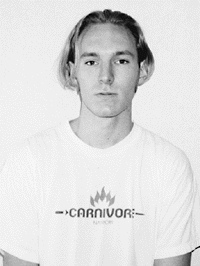 Jayson Perry Hawkins is charged with the murder of David Johnson |
Hardy-Garcia. “The pick-up issue is a result of our culture. It’s not safe to
be gay, so they go to these clubs, or go to parks, to meet people. For a while,
these were secret places and people were able to let their guard down. Now the
clubs are advertised, the pick-up places are more well known. [Predators] are
familiar with these places and they target this group of people because they
think that gays carry more money and gays can’t fight back.”
Austin homicide Lt. David Parkinson says that pick-up crimes occur all too
often in both homosexual and heterosexual encounters. But men are more likely
to commit murder, he adds. “With heterosexuals, the crime doesn’t always end in
homicide… because women are not usually impulse killers. Heterosexual men are
more likely to get picked up in bars and lured back to a hotel room where they
are robbed by the woman’s partner in crime,” he says.
Clearly, men who pick up strange men run a risk. “In this day and time you
simply can’t put yourself in harm’s way by meeting up with strangers,” Lt.
Parkinson says. “Sooner or later, it’s going to catch up to you.”
Then again, Ernest Salda�a never got a chance to make that choice. His
killers picked him.
Thousands of gay rights supporters will march in
Austin next week to champion passage of a stronger hate crimes bill in Texas.
The march is from noon-4pm Sunday, March 23, beginning at Palmer Auditorium and
ending at the State Capitol. Call the Lesbian/Gay Rights Lobby of Texas,
474-5475 for information.
This article appears in March 14 • 1997 and March 14 • 1997 (Cover).