

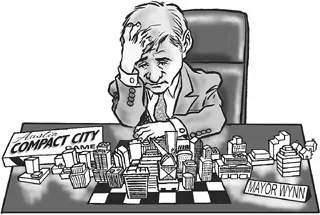
After weeks and months of promising hard choices, forced tradeoffs, and other gestures of fiscal leadership, Mayor Will Wynn this week laid on the table an actual controversial proposal: that the city permanently close existing libraries, parks and rec centers, neighborhood centers and health clinics, or even fire and police stations so Austin can devote its scarce General Fund resources to improving service at the remaining facilities. “I am convinced,” Wynn says, “that part of the structural imbalance we have to deal with is that we have lots of places where we deliver city services and not enough money for the services themselves. And we’re not going to have enough money for the foreseeable future.”
Austin has invested a lot of city money in bricks and mortar, most recently with the projects approved by voters in 1998’s billion-dollar bond package. But City Hall’s penury is already such that City Manager Toby Futrell has recommended in the proposed FY 04 budget that 10 of those bond projects — mostly libraries and rec centers — be delayed two years until we might have money to operate them. Wynn’s push to go further is not exactly rocket science, but for at least 10 years it’s been considered political suicide to recommend closing a library branch or health clinic, and closing existing facilities was a line Futrell was not willing to cross without political cover.
“As competent as the city manager is, and as good a job as she’s done with her proposed budget, she’s done everything she can do in terms of administrative efficiencies,” Wynn says. In the last two years, Futrell has scrubbed nearly $80 million out of the General Fund budget — but it hasn’t been enough. This year Futrell has proposed a 7.2% property-tax hike (to 49.3 cents, the “effective rate” that theoretically leaves Austin’s total tax revenue unchanged), on top of $38 million in reductions, to balance the budget. “And we’re going to have to do this all again next year, with another tax increase and more cuts,” the mayor notes, adding that the “efficiencies” Futrell would have to scrub out of the budget next year would be “debilitating.” Compared to next year’s budget battles, Wynn says, this year’s fracas “will look like the party that it is.”
So, the mayor argues — sounding eerily like Chauncey Gardiner — the City Council and citizens should be contemplating not cutting but “pruning” the General Fund — an extended metaphor of which Wynn is quite fond. “The trunk of the tree is the General Fund, and the roots are the revenues, and the branches are all the services we try to deliver to all the citizens,” he says. “Any arborist knows that, in drought years, you don’t defoliate the tree across the board. You trim some healthy branches to ensure the literal ‘structural balance’ of the tree” — that being Futrell’s preferred term for balancing Austin’s books — “and its ability to bear fruit.”
Wynn and Council Member Brewster McCracken earlier this month asked Futrell and her staff to provide a listing of all the city’s parks facilities, libraries, health and neighborhood centers, and fire stations with “data regarding location, budget and usage.” The staff response is posted, along with responses to all the other council and citizen budget questions, at the city Web site, www.ci.austin.tx.us/budget. What the mayor and McCracken really wanted, Wynn says, is an analysis that would identify which facilities are most redundant, cost the most per user, or would otherwise deliver the most bang for the GF buck if they were closed. That essential step has yet to be taken; right now, the argument for which facilities would get shut down has not yet begun.
“So far, we’ve only really had this debate on fire stations,” Wynn says, referring to the budget proposal to put smaller “squad” units in the Hyde Park and Blanco Street fire stations instead of closing them down entirely (see “Austin@Large,” p.14). “There’s been a reasonable analysis of that question, and it’s now in the political court. But we have the statistics and know the cost involved and what the fire chief thinks is ‘redundant.’ We haven’t done that everywhere else, and we owe it to the community to look [at the same issues] everywhere else in the General Fund.”
Wynn and McCracken (both longtime library advocates whose wives both serve, along with this reporter, on the board of the Austin Public Library Foundation) have cited “the beloved library system” as a case in point. Austin has more branch libraries than most any city of comparable size, but its materials budget per capita is well below the national average (and is being slated for a further 42% cut in the proposed budget), and its staffing ratios are the lowest of any big-city library in America; many APL branches only have two library staffers on duty at any time. “To me, it’s perfectly predictable,” Wynn says, adding that the library’s operating costs “are being eaten up by bricks and mortar instead of by books and computers.” Wynn feels the same about the parks department, which he says “somehow was turned into an indoor parks system that decided to build a lot of buildings and have the programs to go with them.”
Wynn acknowledges that he’s stepped back from his initial goal of finding the $18 million in additional savings in the FY 04 budget that would make a tax hike unnecessary. “I’m just looking for structural cuts that will make the effective rate truly effective,” he says — meaning reductions that will keep the city from the death-of-a-thousand-cuts Futrell has already promised for FY 05, along with another tax hike. So far, except for (to a degree) McCracken, other council members have been silent on Wynn’s modest proposal — figuring, perhaps, there’s no reason for them to take political heat when the mayor has volunteered to fall on his sword. “I recognize this is political dynamite, and I don’t enjoy the vision of being the guy holding the match,” Wynn says. “But it comes down to what’s more important — the services or the buildings?”
Nor does Wynn expect that such controversial measures will be accomplished between now and the scheduled final adoption of the budget Sept. 10. “I just think this is an appropriate time to tee up the debate,” he says. “We know we’re doing this again next year, so shame on us if we passed this budget and then sit on our butts for the next six months. If there develops some consensus that we need to do this, it’s going to be an ongoing process.”
This article appears in August 29 • 2003.