

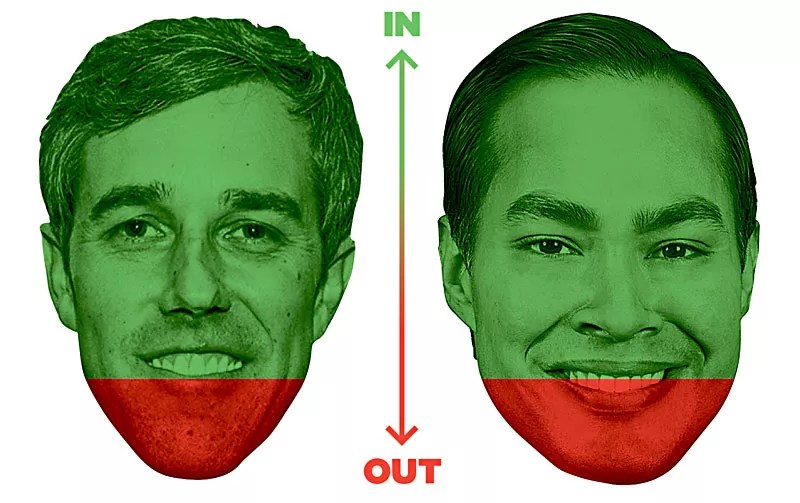
How are the 2020 Texans doing as the Democratic presidential train tumbles along, 23 weeks before the Iowa caucus? Though they’ve traveled different paths since we last fired up the Beto-Castro-Meter, both former U.S. Rep. Beto O’Rourke of El Paso and former U.S. housing secretary and San Antonio Mayor Julián Castro are right now in about the same place among the 20-ish Dems whose campaigns are visible in polling.
That place, to be sure, is quite some distance away from “next president of the United States.” In a race with three clear front-runners (Joe Biden, Bernie Sanders, Elizabeth Warren), some contenders keeping it close (Kamala Harris, Pete Buttigieg), and wild cards who will still be around when real votes are cast (Cory Booker, Amy Klobuchar, and hell, Andrew Yang), Beto and Julián are in a tier of their own. They’re at the bottom edge of viability, but they’ve both become household names, and they’re welcome guests at the party – unlike the no-hopers who’ve missed the cut for the Houston debate round, whose stature dwindles every minute they cling to the shreds of their unraveling campaign banners.
For the Texans, the tragedy of the El Paso massacre, and the chaos and pain and madness that surrounds the border and reverberates throughout our state, has proved a fortuitous, but also very necessary – for them and for us – occasion to demonstrate the intelligence and empathy and moral clarity Americans should expect from a president. The ample attention paid to both Texans this month has helped O’Rourke dispel the fog of fecklessness stifling his campaign, and may help Castro start to outgrow his niche as a connoisseur’s candidate. Both will roll into Houston with genuine home-field energy; as Trump’s hold on Texas looks more and more perilous, they may not be kings but can clearly be kingmakers. None of that will matter in six weeks’ time if either campaign starts running out of money, but other than that, there’s no obvious hurdle Beto or Julián must clear to stay in the race until the Texas primary on Super Tuesday, March 3.
This article appears in August 30 • 2019.