

 |  |  |
| From left: Gary Bledsoe and Jim Hightower in 1990 with Place 5 councilmember Robert Barnstone; Eric Mitchell, Place 6 councilmember since 1994; Jimmy Snell, former Place 6 councilmember photographs by Alan Pogue | ||
1975, two of the six seats on the council — Place 5 and Place 6 — have been occupied by,
respectively, a Hispanic and an African-American. Is it is merely coincidence?
After all, several whites have, over the years, run for those two seats. But
none of them have been elected. Or is it evidence that the “gentlemen’s
agreement” is alive and well?
Regardless of the answer — some Austinites dispute the idea that a
“gentlemen’s agreement” has ever existed — the May 3 election will once again
test the city’s ability to maintain racial balance on the council.
Councilmember Gus Garcia, an incumbent who has held the traditionally Hispanic
Place 5 for the past six years, has announced that he will break the agreement
in order to seek Place 2. A long-time proponent of single-member districts,
Garcia denounces the current system as “plantation politics.” In a recent
interview he told the Chronicle, “I don’t want to run with protection
any more. This is an effort on my part,” he explains, “to say Austin has
graduated from the gentlemen’s agreement.”
But while Garcia pronounces the agreement dead, he still refuses to
dump the corpse. “There are some folks who think that seat still belongs to the
Hispanics and that list includes me,” Garcia explains. “Because of the
condition of the two minority groups in this city, there still needs to be
somebody who is the standard bearer, and the community has said that’s place
5.”
So is the gentlemen’s agreement dead or not? Garcia doesn’t really have an
answer: “It probably appears that I am talking out of both sides of my mouth,
and I probably am.”
White or Wrong?
According to local lore, Places 5 and 6 were set aside in the early 1970s,shortly after the council was expanded from four to six seats. At that time, a
small group of city leaders decided to designate two of the seats for
minorities. That arrangement has since become known as the gentlemen’s
agreement. Whether an agreement exists or not, Austinites have not elected a
white candidate to Place 5 or 6 since 1975, when Jeff Friedman left Place 5 to
run for mayor. Nor have any minorities been elected to the other four council
seats, or to the mayor’s office.
Garcia’s decision to break with the past, along with the fact that two whites
— Bill Spelman and Karen Hadden — have announced their candidacy for his old
seat, has re-ignited debate about the gentlemen’s agreement, and about whether
or not Austin should finally begin electing its councilmembers from
single-member districts. Although it’s possible that Garcia will win Place 2
and one of the three Hispanic candidates running for Place 5 will win that
seat, some of the city’s Hispanic leaders are worried about their future
representation on the council.
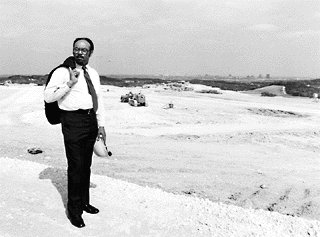 Former Place 6 councilmember Charles Urdy stands at the then undeveloped site of Barton Creek Mall |
bilingual Hispanic newspaper, says, “I’m very upset about it. I think we are
being set up to lose our designated seat.” Although Vasquez-Revilla dislikes
the gentlemen’s agreement, she isn’t ready to discard it. “Philosophically,
people shouldn’t have to be afforded the opportunity to win by lessening the
competition. But unfortunately, that’s the only thing that has ever worked,”
she says. “Until we have something better, why should we give it up?”
Hadden and Spelman both have ready answers when asked about their decisions to
run for Place 5. “I’m no gentleman,” has become Hadden’s ready reply when asked
about her decision to run for the historically Hispanic seat. She adds that the
gentlemen’s agreement has become more of a hindrance than a help to minorities.
“Designating one seat is a limitation, as opposed to a safety guarantee,”
explains Hadden, who teaches science for the Austin Independent School
District.
Spelman, an associate professor at the LBJ School of Public Affairs at UT who
is also running for the seat vacated by Garcia, says “The color of our skin is
part of who we are, but it’s only a part.” And he adds, “To the extent that the
gentlemen’s agreement provides only one place for Hispanics and one for
African-Americans, it is absolutely a remnant of Jim Crow.”
Gentlemen’s Disagreement
On a strict percentage basis, Austin’s city council, comprised of the mayorand six councilmembers, does not reflect the city’s racial makeup. Each
councilmember’s vote accounts for 16.7% of the total council vote (excluding
the mayor). Based on that, Hispanics are actually under-represented on the
council — since they account for 27% of Austin’s population — while
African-Americans, who comprise 12%, are slightly over-represented. (Asians and
other races account for 4% of the city’s population; whites make up the balance
of city’s 465,000 residents).
Several former councilmembers insist that there has never been any arrangement
to set aside seats on the council. Friedman, who served on the council from
1971 to 1975 and served one term as mayor after that, says the idea of a
gentlemen’s agreement is “a crock.” He says, “If Place 5 is anything, it’s a
Jewish seat. I held it from when it was formed until I moved on in 1975.”
John Trevi�o, who became the first Hispanic to hold Place 5 when he was
elected in 1975, says that he ran for that seat because it was left vacant when
his friend Friedman decided to run for mayor, not because of any gentlemen’s
agreement.
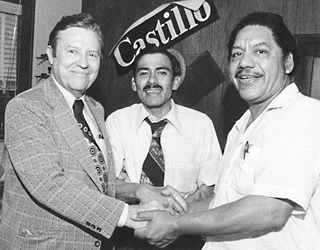 Austin’s first Hispanic councilmember John Trevino (center), with former Sen. Ralph Yarborough (left) and labor organizer Pancho Medrano. |
has been enforced for more than two decades. Shortly before resigning her
position as an aide to Garcia in order to run for Place 5, Bobbie Enriquez
wrote a position paper on single-member districts, discussing the history of
the council, and describing how, for several decades, Austin’s council was
comprised of the top five vote getters, who would then decide among themselves
which of the five would serve as mayor. That system lasted until 1969, when the
current at-large place system was enacted.
Enriquez writes that the changes occurred after “an African American named
Arthur DeWitty came within a hairsbreadth of winning a seat in the early
Fifties. A horrified gentry led by UT super-regent Frank Erwin revamped the
system into the at-large-plus-runoff structure.” Enriquez’s paper says the
gentlemen’s agreement was created in late 1970 “by a group of Anglo
businessmen, which included Roy Butler, Ed Wendler, Sr., and Lowell Leberman
[sic].”
Wendler disagrees. He says that in 1972, he organized a meeting of Austin’s
liberals at the Downtowner Hotel to put together a slate of candidates to run
against the group being supported by the conservatives. Wendler says the
liberal slate included Trevi�o, but there was never any agreement
between the liberals and conservatives to set aside seats on the council.
Instead, he says, Place 5 and 6 became the minority seats by default.
However, Garcia, who has been active in city politics for decades, agrees with
Enriquez’s paper, and adds some history of his own. He claims that a handful of
Hispanic business leaders, including Rudy Cisneros (owner of Cisco’s
restaurant), Carlos Velasquez (owner of Roy’s Taxi), and Charles
Villase�or (owner of Mission Funeral Home) agreed to the deal in 1971
and that the three businessmen, who have all since passed away, were then
included in the group that would decide which candidates for Place 5 would get
the approval and financial support of the Anglo monied class. (Cisneros’
alleged participation in the agreement continues to rankle some Hispanics, who
believe that Cisneros had been co-opted by the Anglo establishment. There are
some who still will not eat at Cisco’s. Instead, they go to Joe’s Bakery.)
Agreement or Political Myth?
No minorities were elected to the council in 1969, the first year of the newat-large system. In 1971, Berl Handcox, an African-American, won Place 6. In
1973 Handcox, who worked at IBM, won again, but there were still no Hispanics
on the council, as Place 5 was again won by Friedman. Finally, in 1975,
Trevi�o, who was supported by what Garcia calls the “Brown Machine” —
Sen. Gonzalo Barrientos, former Travis County Commissioner Richard Moya, former
railroad commissioner Lena Guerrero and others — was elected to Place 5.
 |  |
| Place 5 candidates Karen Hadden and Bill Spelman are going after the coveted seat traditionally held for Hispanics photographs by Alan Pogue | |
the gentlemen’s agreement, says the idea of an arrangement is “part of local
political mythology.” Lebermann, who was elected to Place 4 in 1971 and served
three terms, denies that the business establishment ever enacted a gentlemen’s
agreement. Now a member of the University of Texas Board of Regents, Lebermann
points out that Austin’s state senator, Gonzalo Barrientos, is Hispanic and
that numerous minorities have been elected to the city’s school board. “This
city has demonstrated again and again it’s color-blind in the people that it
elects at all levels,” he said.
“Oh, popcorn,” replies Bertha Means, the owner of Austin Cab Company, and a
one-time candidate for Place 6. Means is among those in the minority community
who believe that Lebermann and a handful of other city leaders engineered the
gentlemen’s agreement. If Austin is colorblind, asks Means, “Why were we out
picketing at the time? Why was I turned away from a golf driving range? Why did
we have to picket Barton Springs in order to swim? It’s obvious.”
Means, who supports Garcia’s decision to run outside of Place 5, believes that
the only way to ensure minority representation is to switch to a single member
district system (see sidebar). “I think it’s time for people to run in any
place they want to,” she says. “I also feel that it’s time to have single
member districts.”
Means believes that Handcox was selected by the white business establishment
to run for Place 6. But, like Lebermann, Handcox denies that scenario: “I don’t
know anything about a gentlemen’s agreement.” Handcox says he doesn’t believe
in setting aside seats for minorities. He says he made the decision to run for
council after having difficulty buying a house outside of east Austin because
local real estate interests were fighting the enforcement of civil rights laws.
No Pain, No Gain
Manuel Zuniga, who lost his bid for Place 1 last year, is now running forPlace 5. He says that his decision to run for the seat was not motivated by any
racial issues, but by the fact that it was left open when Garcia decided to run
for Place 2. “It’s a happy coincidence,” says Zuniga, who runs a building
supply business. “It’s the seat where I feel I can win.” But Zuniga adds that
Place 5 will also allow him to pay special attention to Hispanic voters, which
he says he is naturally inclined to do.
And while others see the entry of Spelman and Hadden into the Place 5 race as
a negative, Zuniga thinks it could help in the long run because it will force
Hispanic voters to find, nurture, and promote good Hispanic candidates for all
of the seats on the council. “There’s a lot of talk out there about losing this
seat,” said Zuniga. “But in the end, it may be the best thing that ever
happened to us.”
Zuniga firmly believes that he, Enriquez or Gus Pe�a, who is also
running for Place 5, will win the seat. But he concedes that “the idea that
Place 5 is a Hispanic seat is now lost.” Whether the gentlemen’s agreement ever
existed “is irrelevant,” he says. “Because it no longer exists now.”
This article appears in March 14 • 1997 and March 14 • 1997 (Cover).