

 State Senator Florence Shapiro |
don’t ask us before they smoke their first cigarette, drink their first alcohol, even have
their first kiss,” pleaded Rep. Debra Danburg (D-Houston) to the Senate Health
and Human Services Committee. Although a House member making the trek across
the hallway to speak before the Senate is extremely rare, Danburg was willing
to employ whatever strategy necessary to win the unusually contentious debate
surrounding Senate Bill 86, which would mandate parental notification for
minors seeking abortions, and penalize physicians who do not comply.
The general public tends to divide the abortion issue down party lines, but
this bill just won’t be pigeonholed. Although only one Republican in the Senate
— Jeff Wentworth (R-San Antonio) — is opposed, five Democratic senators are
joining the rest of the Republicans in support of parental notification.
Wentworth says that the reason some senators are breaking ranks with their
parties’ platforms on this issue is “due, in some measure to their personal
religious upbringing… It cuts both ways in both parties.”
As for the House, while it’s still too early to tell what the party breakdown
will be, it’s clear that allegiances are all over the map, according to Rep.
Danburg. She predicts that one-third of the House will automatically vote
pro-life, another third will automatically vote pro-choice, and that it’s the
third in the middle from both parties who could go either way. “The third in
the middle are conflicted and are in political jeapardy no matter which way
they vote,” Danburg says. “This is the kind of vote (representatives) can’t do
a 15-second sound byte on to save their butts in the next election.”
The bill’s author, Sen. Florence Shapiro (R-Plano), has tenaciously pushed the
bill for three legislative sessions, and came within one vote of seeing it pass
the Senate in 1995. A new Republican majority in the Senate this session gives
it a better chance of passing than ever before, and with SB 86 now awaiting a
vote on the Senate floor, both sides are pledging a fight to the finish.
Shapiro, who doesn’t identify herself as either pro-choice or anti-abortion,
says this bill is about parental rights, and should not be mired in a debate
about abortion rights. Pro-choice advocates are not buying that argument. “This
is just a little step closer to eliminating the freedom of choice,” says Julie
Thorpe, executive administrator of Reproductive Services, an abortion provider
in Austin.
Most statistics show a majority of Americans in support of the right to choose
to have an abortion, but the concept of parental notification enjoys the
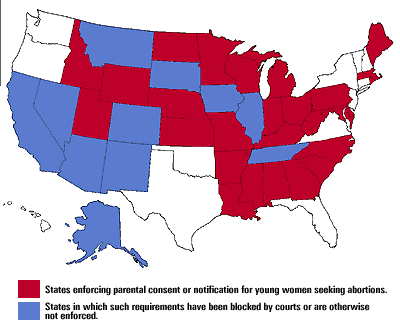
support of middle America, and is on the books in 38 states (see map). Many
parents tend to view it as a common sense measure to ensure the health and
safety of their children. Shapiro “will not [admit] the fact that this is an
anti-choice bill, and she’s able to pull that off because a lot of mainstream
people don’t see this as an anti-choice bill,” says Kae McLaughlin, executive
director of the Texas Abortion and Reproductive Rights Action League.
The debate shapes up as an argument over parental rights versus child welfare.
Senator Shapiro and her camp argue that Texas law supports parental
notification for all sorts of medical decisions from immunization to major
surgery, and that abortion is an invasive and sometimes risky procedure which
should not be exempted from normal parental responsibility. “Under the law
today my rights have been taken away — my parental rights,” says Shapiro.
Pro-choice forces are concerned that teenage girls who don’t wish to inform
their parents about their choice to have an abortion will go to any lengths to
keep their parents in the dark — including seeking an illegal abortion,
running away, or attempting suicide. “You don’t ever see a situation where a
child gets appendicitis and gets so scared to tell his parents that he goes out
and commits suicide. We’re talking apples and oranges here,” argues Danburg.
Shapiro points out that, in accordance with standards established by the
Supreme Court, the bill provides for a judicial bypass of parental notification
in special cases when a girl has legitimate fears about possible violent
repercussions of telling her parents, but pro-choice forces say the special
cases are not the only ones to be concerned about. “The biggest threat to
safety is for the upper middle class teens. These are the same kids who are
almost suicidal over SAT scores, and they’re going to try to solve their own
problems,” says Peggy Romberg of the Texas Family Planning Association.
Abortion providers and other physicians — concerned that SB 86 would levy a
Class A Misdemeanor charge and $4,000 fine on doctors who do not notify parents
— are worried about ambiguous language in the bill. The bill does not
elaborate on what might constitute the “reasonable effort” it requires of
physicians to contact a minor’s parents. The bill also fails to address the
possibilities that girls could present fake identification, deliberately give
incorrect contact information about their parents, or come accompanied by
adults posing as parents — all situations which could leave physicians open
for criminal charges or lawsuits.
Not at all ambiguous, however, is the bill’s definition of a fetus. Pro-choice
proponents fear that Sen. Shapiro’s bill, which defines a fetus as “an
individual human organism from fertilization until birth” will establish Texas
legal precedent, and lead to efforts in coming years to restrict birth control
and impinge on an adult’s right to choose an abortion. Shapiro defends the
language, saying that “well, you have to give it a definition,” and adds that
many other states have used the same language.
Pro-choice advocates also point out that because SB 86 requires physicians to
wait 48 hours after attempting to contact parents before treating a minor, the
bill effectively eliminates a minor’s ability to make use of RU-486, the
morning-after pill, which must be taken within 24 hours after conception to end
a pregnancy. If not ended within 24 hours, a pregnancy must develop for six
weeks before surgical abortion is possible. Although approved by the Food and
Drug Administration, RU-486 is still being tested for use in Texas.
 Kae McLaughlin, executive director of the Texas Abortion and Reproductive Rights Action League |
care or counseling following a “secret” abortion. “Where is the support for
that girl when she wakes up in the middle of the night and realizes what she’s
done?” worries Kathey Pendleton, executive director of the Austin Crisis
Pregnancy Center, which counsels against abortion. However, even the bill’s
supporters admit that most young teens who come seeking abortions are already
accompanied by an adult or parent. “Generally speaking, at the age of 12 or 13,
her parents are the first ones to know about it. The ones we’re really
targeting here are the more mobile teenagers,” says Pendleton.
The bill’s sponsor in the House, Rep. Ken Marchant (R-Carrollton), agrees that
older teens will tend to make choices independent of their parents. “There is a
certain point at which the law still considers a woman to be a juvenile when
she clearly is not. A 17-year-old is certainly not the person that I’m trying
to have influence over,” he says, adding that he would consider lowering the
age requiring parental notification if it would encourage passage in the
House.
Pro-choice advocates say this bill is about much more than parental rights or
concern for minors. They feel the topic of parental notification has been
strategically chosen by the anti-abortion faction. “I think this bill is
definitely a brainchild of the religious right because it brings parents in in
a way that makes them think they can be more secure. So for us to oppose
something that looks generally acceptable on first blush makes us look
radical,” says McLaughlin. Romberg goes a step further, suggesting that Sen.
Shapiro’s motivation is personal. “She’s been carrying the bill for three
sessions, probably because she feels it protects her in the Republican party as
a pro-choice candidate,” she states.
There are 14 other bills concerning abortion before the legislature right now
— including a similar one which would require parental consent as opposed to
just notification — but none are drawing the combination of possible passage
and heated debate which surrounds SB 86. Having passed out of committee in the
Senate, the bill will now go to the Senate floor, where Wentworth says he will
attempt to kill it using the same strategy which successfully brought it down
in 1995 — that is, gathering votes against allowing it to be voted on at all,
rather than trying to fight a floor debate on the issues of the bill itself.
And though it’s likely to pass in the Senate, SB 86 would still have to make
it out of the House State Affairs Committee to ever reach a vote in the House.
That Committee’s chair, Rep. Steve Wohlens (D-Dallas), would only confirm that
“it is fair to say that chairmen in general have a lot of discretion with
bills,” but would not comment on speculation that he intends to kill the bill
in committee.
Though pro-choice advocates agree that parental involvement in a teen’s
decision to choose an abortion is preferable, they question whether this bill
will do more harm than good for teens in crisis. In the face of these
objections, the bill’s legislative supporters alternate between arguments
against abortion in general and touting the issue of parental rights. Standing
alone among Senate Republicans, Wentworth bemoans attempts to mandate
parent-child conversations from the Capitol. “If I knew the law that we could
pass to make communication between parents and their daughters perfect, I’d
pass it,” he says. “But there isn’t any such law. It’s beyond our power.”
This article appears in March 7 • 1997 and March 7 • 1997 (Cover).