

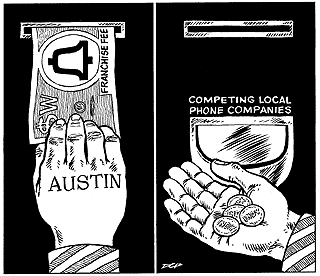
 illustration by Doug Potter |
with your routine city government? You, too, can take part in an ongoing debate that’s
spawned personal recriminations, thwarted careers, and stoked political
firestorms all over town for months! And it’s as easy as picking up your
phone.
In fact, it’s all about picking up your phone, and how much you pay to
the City of Austin for the privilege of doing so. In its ongoing attempt to
figure out its role in the passion play of deregulated telecommunications, the
city recently passed its Telecommunications Services Ordinance (formerly known
as the Standard Telecommunications Ordinance; that is, the STO is now the
TSO). This action simply — well, fairly simply — takes the current franchise
fee paid by Southwestern Bell for using the city’s rights-of-way to run its
telephone lines, and levies it against all future Bell competitors in the open
telecom market.
The net effect to you, as a phone customer, is basically zip — you’re already
paying the franchise fee, passed along as a line item in your phone bill, and
if you decide, when you actually have the choice, to switch your local service
to AT&T or whomever, you’ll be paying about the same amount through them.
So what’s the big deal?
Well, as we’ve all learned by now, nothing is simple, either in word or deed,
in the world of telecom. As a point of policy, the city wants the widest range
possible of telecom providers in Austin; to this end, they once planned to
build a separate physical network through the Electric Utility conduit, open to
all comers and free of the stranglehold of Southwestern Bell. This got
short-circuited by HB 2128, Texas’ state-level deregulation effort, which
prevented cities from owning or operating telecom networks. The city then
decided to franchise the electric conduit as they have franchised the
rights-of-way occupied by Bell and Time Warner n�e Cablevision,
and entered into a preliminary agreement with CSW, an arm of an investor-held
electric utility serving other Texas communities including the Rio Grande
Valley.
This plan is still floating in the realm of the possible, but in the meantime,
federal telecom deregulation eliminated much of the immediate need for a
separate network by ordering incumbent local carriers — i.e., Bell — to
resell space on their networks at fire-sale prices to potential competitors.
This displeased Bell for many reasons, among which was the fact that it is
still paying rent on Austin rights-of-way for lines that will be used by
competitors whose customers weren’t being billed the franchise fee. Hence was
born the TSO, which spent almost a year in a state of constant flux, as city
staff worked out the practicalities of this assessment — percentage or flat
fee, a levy on receipts versus a per-line charge, etc. — before, and even
during, its approval by council.
Again, this basically ratifies the status quo, but the drafting of the TSO
gave numerous constituencies in Austin an opportunity to rail against and/or
try to transform that status quo. Their objections are manifold, sometimes
conflicting. There are some protestors who dispute the need for a franchise or
service fee at all, claiming that the city’s rights-of-way have long been paid
for, and that their ongoing maintenance costs far less than the $8 million or
so a year which the TSO would raise. Others feel the fee should be, if not
eliminated, at least reduced, so as to help small companies — especially
high-tech and multimedia developers who do most of their work online — grow
without adding a city fee to their cost of doing business. (A similar argument
was used by the Federal Communications Commission, back at the time of the
AT&T breakup, to absolve Internet service providers and other “new
technology” businesses from paying access charges to Bell et al. for use
of the local networks — charges which ever since then have been paid by
long-distance carriers.)
Still others are comfortable with the notion of the city’s collecting a fair
rent for use of its property, but they would like to see this $8 million
devoted, through an enterprise fund, specifically to supporting the high-tech
industry or to providing public-access telecom services, such as those
sponsored by Austin Free-Net through the libraries. Right now, the revenue from
the Bell and Time Warner franchises goes straight into the city’s General Fund
and subsidizes the broad range of city activity, as does the transfer from the
Electric Utility. While many players within Austin’s high-tech and telecom
communities made lots of noise during the long gestation of the TSO, they
didn’t manage to coordinate their discomfort into a powerful advocacy effort,
or to sufficiently question the basic premise of a franchise fee, and the City
Council managed to pass the TSO without incurring a huge amount of heat from
the city at large.
Plenty of heat, however, was generated within the narrow corridors of
city government, and between those players in the community, and the flames and
fallout are still ricocheting. One of the most vocal opponents of the TSO has
been Ted Kircher, Ronnie Reynolds’ appointee to the city’s Telecommunications
Commission. Kircher has been quite frank about his distaste for the
franchise/service fee, calling it “a teat from which the city needs to be
weaned.” At last Thursday’s council meeting, Kircher’s dismissal from the
Telecom Commission was on the agenda, for either being a squeaky wheel
(according to Kircher), insulting members of the council (according to Gus
Garcia, whom Kircher described on the Ausplan listserv as “a man who’s probably
never hit a keystroke”), and/or making racially offensive comments to city
staff (according to longtime Telecom Commission member Stuart Heady, who called
for Kircher’s resignation or dismissal on those grounds.)
The first two of these possible reasons are beyond dispute — Kircher is
definitely a critic of the city’s telecom policies, and he definitely has
disparaged the qualifications of the council to deal with the issue. And
Garcia, who chairs the council’s telecom subcommittee and has often shown
himself to be thin-skinned, did demand an apology from Kircher which was not
forthcoming. The racial part is somewhat more nebulous — Kircher claims that
his conversation, back in October, with African-American city staffer Cheryl
Williams dealt with legitimate, even academic, questions of technology’s impact
on disadvantaged communities, and that Williams was not offended by his
comments either then or since. As Heady reported the incident — which he
apparently learned about from Williams’ boss, Office of Cable and Regulatory
Affairs manager Paul Smolen, who likewise expressed no reservations about it
back in October — Kircher’s turn of phrase became “Your people would still be
in the cotton patch without technology,” which does indeed have a different
demeanor and, Heady argued, was too inflammatory for a public servant to use,
even if its meaning is defensible.
The outcome of this particular fracas is of less significance than its meaning
for the telecom constituency as a whole. Whatever Kircher’s alleged sins, it’s
clear that he and his former ally Heady are now sworn enemies, on matters of
policy as well as political correctness. Which means that telecommunications,
like the environment, or East Austin development, or a host of other city
issues, has engendered its own bitter divisions not only between but within its
camps. It may be a brave new world, but Austin’s Information Age appears to be
characterized by politics as usual.
This article appears in March 7 • 1997 and March 7 • 1997 (Cover).