

As had been signaled even before the third(!) special session of the 87th Texas Legislature got underway, the House and Senate redistricting committees have moved quickly to finalize their own maps and finally get out of town, while keeping next year’s March primary calendar intact. In the previous special, lawmakers passed a bill giving themselves until Nov. 15 to draw district lines for both chambers, plus the state’s congressional delegation and the State Board of Education, before having to delay the primaries until April or May, depending on how long it took for the Lege to get it together. However, we still await any hearings or movement on the draft congressional map proposed earlier this month, and Gov. Greg Abbott has already made peace with the need for a fourth(!!) special session to finalize that. (This special expires on Oct. 20, so the March primary is not yet a lost cause.)
This week, the Senate adopted its own map for the next decade, “reflecting” the changes made necessary by the 2020 census. We use scare quotes there because the Senate districts, like those proposed for the House and Congress, respond to the state’s torrid growth – 95% of which occurred among Texans of color – by including fewer opportunity districts for Black and Hispanic Texans to elect candidates of their choice than exist currently. Senate Redistricting Chair Joan Huffman, R-Houston, whose ability to stay on message even when the message is nonsense is quite remarkable, asserted a few dozen times during the committee and floor debates on her handiwork that she did not at all consider race in drawing new districts, and didn’t even know that widely reported 95% statistic we just mentioned. Sure, Joan. Of course, in Texas racial and partisan gerrymanders are basically the same, and the latter is legal, so here we are, although Senate Dems put in the effort to create a legislative record for the courts to consider when the map is inevitably challenged. The big losers are voters of color in Tarrant County, who are divided in many ways so as to shift Senate District 10, currently represented by Beverly Powell, D-Burleson, about 20 points to the right and ripe for a Republican to hold for the next decade. (That R will probably be longtime Rep. Phil King, R-Weatherford. Powell herself is talking about jumping into the now-contested Dem primary for lieutenant governor.) Three Democratic senators, all from the border, voted to approve the map on final passage, despite its retrogression on Latinx opportunity districts; one Republican, Kel Seliger of Amarillo, did not.
The new maps respond to the state’s torrid growth among Texans of color by including fewer opportunity districts for Black and Hispanic Texans.
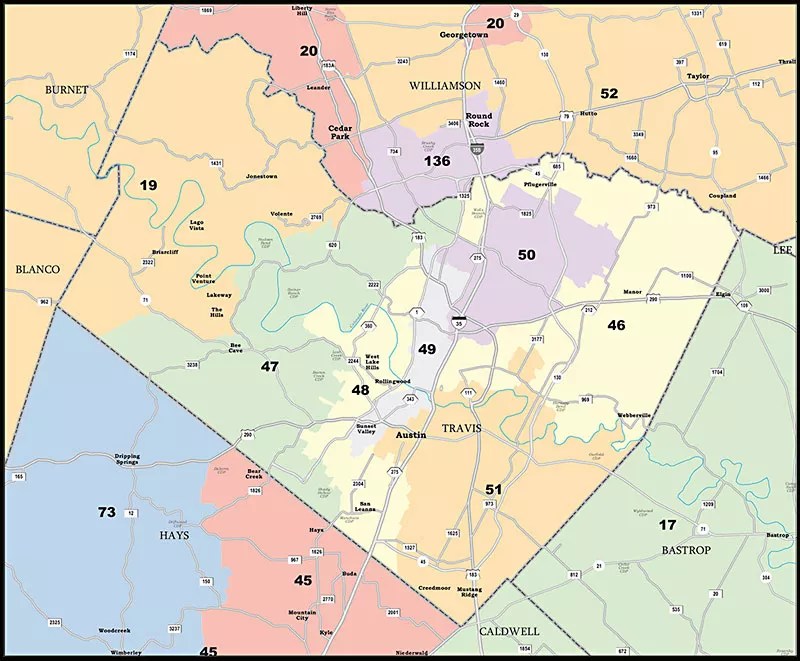
The Texas House map got dropped last Thursday and by early Tuesday morning had already been amended and voted out of the House Redistricting Committee, chaired by Todd Hunter, R-Corpus Christi. That committee substitute (the Austin area is shown above) corrected the original map’s weird swapping of Reps. Vikki Goodwin and Donna Howard in House Districts 47 and 48, but has not yet incorporated a precinct swap that would allow Erin Zwiener, D-Driftwood, to continue to represent a new, solidly blue version of her HD 45, anchored in San Marcos. Right now, she’s in HD 73, whose current occupant, Jan. 6 Capitol riot attendee and secessionist Kyle Biedermann, R-Fredericksburg, has been drawn into the newly configured HD 19, which also absorbs the reddest precincts in Western Travis County; former City Council Member Ellen Troxclair, who just last week was proudly reeling off supporters in her campaign for a Senate seat, has now abruptly but without shame switched to the HD 19 race. (That Senate seat, SD 24, whose current tenant Dawn Buckingham, R-Lakeway, is running for land commissioner, no longer includes any of Travis; former Sen. Pete Flores, R-Pleasanton, has tipped his hat into the race for the seat.) While Zwiener still has hope that her colleagues will see fit to tweak the map on her behalf, the cards have probably been dealt for Rep. James Talarico, D-Round Rock; the new HD 52 loses its precincts closest to Austin (to the now much bluer HD 136, held by Rep. John Bucy III, D-Austin) and picks up more Trump-friendly exurban WilCo territory. However, Talarico won in 2018 when this district was likewise theoretically red, so we’ll see.
In total, because the House map has to respect county lines and the major population growth has been in the urban counties, Hunter’s ability to make big gains for the GOP solely through redistricting is limited. The map voted out of committee contains 85 likely GOP seats, compared to 83 now. In 2013 there were 95 Republicans in the House, 12 of whose seats (including four in Central Texas) have since flipped, so even a defensive map like the one Hunter has proposed may become a busted “dummymander” by the end of this decade.
This article appears in October 8 • 2021.