

The country flattens as you cross from Hays to Caldwell County, just east of San Marcos. The river feels near but you never glimpse it. A mile north of Martindale, Jordan Buckley, the communications director for the social justice group Mano Amiga, turns his car into the small neighborhood of Hopson Ranch Estates. He loops around and comes to a stop. These are brick houses on 1-acre lots, large, exposed, anonymous. It’s an in-between place, where nothing should ever happen.
“So this is Terry Turner’s house,” Buckley says. “You see how long the driveway is. There’s the sidewalk, that’s where the easement starts …”
Everything we know about what happened here on Oct. 11 comes from an arrest report released by the Caldwell County Sheriff’s Office 10 days later. Most of that is the account of 65-year-old Terry Duane Turner. Turner told police that at 3am that morning he woke to use the bathroom and saw a car parked in his driveway with the headlights off. He went to his bedroom, grabbed a pistol, and ran outside.
When he did – again, according to Turner – the car’s headlights came on and its driver accelerated rapidly in reverse. Turner chased it. The car left the driveway and turned backward into the street. Turner came abreast of the driver’s side window, rapped on it twice with his gun, and shot. The bullet passed through the window, through the upraised hand of the man inside – as though he was instinctively trying to shield himself – and into his brain.
Turner ran back inside and called 911. “I just killed a guy,” he told the dispatcher. “He pointed a gun at me and I shot.”
The man Turner killed was 31-year-old Adil Dghoughi (pronounced Ah-deel Drou-ry), a Moroccan immigrant from a highly educated family who came to America in 2012 to get a master’s degree in business administration. Dghoughi had lived in Austin since early 2020, hoping to find a job as a financial analyst while working as a ride-hailing driver.
It was still the middle of the night when Caldwell County sheriff’s deputies arrived. They found Dghoughi’s car sitting perpendicularly to Turner’s driveway, with the transmission in drive. An ambulance took Dghoughi to a hospital in Kyle. One crucial detail from Turner’s story proved untrue – Dghoughi had no gun, not on his person, not in the car.

Police did not arrest Turner that morning, however, and the facts of the killing didn’t immediately seep out into the community. “It was initially reported just as, ‘Man Shot, Suspicious Vehicle,'” said Sonja Villalobos, Martindale’s mayor pro tem. “The way the initial report came out, it would lead someone to conclude that somebody was trying to do something at this house.
“But then I started getting a flood of messages from different people: ‘What’s going on over there? What happened?’ And then I started Googling and then I started reading. And I was like, ‘Oh my goodness!'”
One of those who called Villalobos was Adil Dghoughi’s brother, Othmane, who lived in College Station. “He didn’t really have anybody in the area to help advocate for him and kind of navigate through the law and everything,” Villalobos said. “So I talked to him and he was just sobbing on the phone. And it just blew my mind even more.”
Villalobos said she realized that Adil wasn’t the perpetrator of a crime but the victim of one. She called Buckley. “I was just like, ‘It’s time to do action.'”
The Origins of Mano Amiga
Jordan Buckley is 39 years old, looks younger, was raised in Austin, and earned degrees in sociology and Spanish from the University of Texas. After graduating in 2006 he went to Guatemala to work with Mayan victims of the government’s genocide and then to Florida to organize alongside farmworkers. In 2014 he returned to Texas and settled in San Marcos. He co-founded Mano Amiga three years later in response to the anti-immigrant demagoguery of the 2016 presidential campaign, taking inspiration from groups like Grassroots Leadership and Immigrant Legal Resource Center.
“We started by doing deportation defense campaigns,” Buckley said, speaking in a quiet baritone, fast and precise, “working with local families whose loved ones had been ensnared in the ICE pipeline, principally through our jail, who would have their lives upended and be thrown into possible expulsion from the country over traffic offenses and for other bullshit reasons.”
One of these early campaigns was the effort to free Victor Avendano, who was pulled over for rolling through a stop sign in January of 2018 and taken to jail on a four-year-old arrest warrant. Learning that he was undocumented, Hays County turned him over to U.S. Immigration and Customs Enforcement. Avendano’s daughter Nataly was a senior at Wimberley High School at the time. “I talked to the Hays County Jail and they were like, ‘Even if you paid the bond, he has the [ICE] detainer.’ So then I started calling places. I called Univision, the news outlet, and they gave me Mano Amiga’s number.”
Mano Amiga staged a loud rally at the Hays County Jail the next day. “I don’t think San Marcos had ever before seen quite such a protest outside of a jail,” Buckley said. “You know – scores of people. A lot of people in the community tell us that there hasn’t been such a vibrant protest since the Chicano Movement of the early Seventies.”

For months afterward, Mano Amiga worked Avendano’s case. When Beto O’Rourke came to town during his 2018 Senate bid, the group persuaded Nataly to cut class, make a stop sign out of cardboard – symbolizing the trigger for her father’s arrest – and stand at the front of the crowd. “[Hays County Judge] Ruben Becerra was the emcee of the event and he had agreed to call on Nataly first as a favor to our organization,” Buckley said. “Nataly told Beto exactly what had happened and asked if he would pledge his support, his clout, and his connections to try to get her father freed.”
O’Rourke agreed, made calls, and ICE released Avendano. O’Rourke subsequently worked the episode into his stump speech. And after graduating from Wimberley High, Nataly went to work as the immigration coordinator for Mano Amiga.
“I had talked to plenty of lawyers and they were just not giving me any hope at all,” she said of her first attempts to free her father. “They were just like, ‘Yeah, there’s really nothing we can do whenever they hit the detention center.’ But thanks to Mano Amiga and all the efforts at organizing and pushing forward and speaking out, we were able to accomplish something that I was told was impossible.”
Adil and Sarah
Sarah Todd talked about meeting Adil Dghoughi for the first time, mixing the past and present tenses as though he’s still alive to her. “We met on Facebook Dating,” she laughed. “It was the first date I’d been on in I don’t know how long, so I was expecting nothing from it. I was sitting outside at Little Woodrow’s, which is my go-to place, and he walked up and, you know, he has a very distinct walk. He looks unique. And so I knew right away that it was him and like he saw me and I saw him and I” – Todd’s voice breaks – “I literally have never had somebody smile at me like that in my entire life. Like, just how happy he was. And after that we just were inseparable.”
It was the spring of 2020 and Dghoughi had been in Austin for two months, looking for work as a financial analyst but driving for Uber and DoorDash. “I would go with him sometimes,” Todd said. “If there was a homeless person, he would get extra food and go take it to that homeless person. One time we were driving – I live in the country, about a mile away from where he was shot – and there was a snake in the middle of the road. And he pulled the car over to get the snake out of the road, so it wouldn’t get run over. Like, who does that?”
Todd saw thoughtful acts like these throughout her relationship with Dghoughi. She learned he had deep friendships in Morocco, in France, and on the East Coast, and that he FaceTimed with his mother every day, often late at night, when it was morning in Morocco.
Todd believes that Dghoughi took a wrong turn that evening while driving to her house and stopped to check his phone. County deputies reportedly found the phone, which they still haven’t returned to the family, open to a GPS app with Todd’s address entered in the search field.
On the day of Dghoughi’s death, Todd woke at 5am, realizing he wasn’t there. She sent him a message over WhatsApp. No reply came back. Four hours later she was at the Caldwell County Sheriff’s Office in Lockhart. From the beginning she felt that something wasn’t right.
“I got there at 9 in the morning, and the detective tells me that Adil was shot. And I asked, ‘Where was he shot?’ He tells me in the head. I said, ‘Okay, is he going to make it?’ And he’s like, ‘I don’t know but it’s looking like it was self-defense.’ Within six hours – you’re already telling me that it was self-defense? And I just looked at him and I was like, ‘That’s absolutely impossible. That is impossible. Adil would have never, ever, ever confronted anyone.'”
Todd understood that Dghoughi’s presence at Turner’s house late at night had created suspicion. “They were saying, ‘Oh, why was he out at that time?’ Well, that was the time that he would be up because he worked overnight for Uber. And then also that was the time that he would talk to his mom.” Todd believes that Dghoughi took a wrong turn that evening while driving to her house and stopped to check his phone. County deputies reportedly found the phone, which they still haven’t returned to the family, open to a GPS app with Todd’s address entered in the search field.
After the interview with the Caldwell County detective, Todd went to the hospital in Kyle where Dghoughi lay dying. As she left the hospital she received a call from the sheriff’s office. They wanted her to retrieve her car, which Dghoughi had been driving when he was shot.
“I really, truly felt like they thought that Adil was an immigrant and they could just brush it under the rug and call it self-defense. That is how I feel … that they were hoping that was going to happen.”- Sarah Todd
“All they cared about was how much it was going to cost and how much I needed to pay them,” Todd said. “Can you believe that? I literally just left the hospital and found out my boyfriend is not going to make it – like, he is not going to make it. And you’re calling me because it’s going to cost $800 for me to come get my car? And if I don’t come get it, you’re going to start charging me $20 a day? I mean, it’s just these little things that they kept doing. I really, truly felt like they thought that Adil was an immigrant and they could just brush it under the rug and call it self-defense. That is how I feel … that they were hoping that was going to happen.”
The Confederate Monument
“This is the same year they put in the monument, a few months before it went in,” Buckley says, reading a copy of an advertisement that appeared in the Lockhart Post-Register in 1923. “‘Attention Klansmen – KKK parade, August 17!'” He reads another ad. “They took this one out on September 2, same year – ‘Speaking on the courthouse lawn!’ So this is the time that they’re planning it, obviously, and it was installed just a month later, in early October. And the same place that they gathered is where the monument got put.”

The 7-foot monument Buckley is talking about has sat on a corner of the Caldwell County Courthouse square in Lockhart for 98 years, ostensibly to memorialize dead Confederate soldiers. It’s one of hundreds installed in the early 1900s by the United Daughters of the Confederacy, a group whose public pronouncements and philosophies at the time were not much different from those of the Ku Klux Klan.
Margaret Carter is a lifelong resident of Lockhart. Born in 1960, Carter said that even when she was a child she knew what the monument meant: that Black people were not welcome in downtown Lockhart. “A lot of people have made the remark that, ‘Oh, I never knew it was there.’ We knew it was there,” Carter said. “We were just taught to ignore it. You know, like most of us do about racism.”
As a leader of Lockhart’s African American community, Carter tried in the early 2000s to get the monument moved off the square. But people were afraid. “‘Stay quiet!’ they said. ‘Don’t make no moves that might disturb the community.'” Then, after she organized a memorial for George Floyd last year that drew 300 people, Carter saw an opportunity to revisit the issue. She banded together with Mano Amiga and Austin transplant Cody Kimball of Bluebonnet Records, getting the Caldwell County Commissioners Court to hold a hearing on relocating the monument.
Of course, the idea polarized Lockhart. The Rev. Ryan Lozano of St. Andrew Orthodox Church compared those who wanted to move the monument to terrorists, fascists, and communists. “Other than Black Lives Matter, the only group actively engaged in destroying monuments is ISIS,” Lozano told the commissioners, “but there have been others in history. … The Nazis, who destroyed Jewish cemeteries and monuments. The Red Guard, who destroyed 30 centuries of priceless art.”
Sterling Riles, a Lockhart veteran with 13 years of combat service in Iraq and Afghanistan, responded that failing to remove the monument would be “like asking [a] Jew … to come into their courthouses and walk on the lawn and see swastikas, Adolf Hitler memorials, and somebody tells you, ‘It’s okay, it’s a part of history. Just accept it.’ … That’s an excuse to spit in my face in 2020 … that’s all it is.” Two months after the hearing, the commissioners voted 4-1 to move the monument to the Caldwell County Jail Museum. Citizens raised $29,600 to finance the move. As of this writing, the monument is up on skids, ready to go.
Carter credited the members of the court, who are not radical progressives, for accepting the truth about the monument’s meaning. “It was put there and portrayed as a memorial for soldiers, which, that’s really not the case,” Carter said, likening the monument to a wolf in sheep’s clothing. “But that’s what the Klan was too – by day, they were the sheriff, they were the drugstore owner. And by night, they wore the sheets. And a lot of people say that was long ago but that history is still happening today and we’ve got to educate ourselves.”
The Media and the Vigil

“My brother was killed on a Monday,” Othmane Dghoughi said. “The whole week, nobody called me. Nobody contacted me. The hospital called to tell me my brother was in the hospital but besides that I never heard from one of them. They had my contact information and I have the proof. They had it. Nobody contacted me.”
Like Sarah Todd, Othmane Dghoughi has never felt comfortable with the response from the Caldwell County Sheriff’s Office to his brother’s killing. After a week of silence from the sheriff, Othmane called the office and set up a meeting. On his way to Lockhart from College Station, he called KXAN-TV in Austin; reporters from the station arrived after Dghoughi sat down with the detective.
“The interview was like an interrogation about my brother. … They were asking me, ‘Does he hate women?’ Or asking, ‘How is he when he drinks?’ Then, while we’re talking, the detective gets up and says, ‘I’ll be back.’ And he went to the next room and I heard him, he said, ‘Oh fuck. The media is here. This is going to get big.’” – Othmane Dghoughi
“The interview was like an interrogation about my brother,” Dghoughi said. “They were trying to justify [Turner’s] shooting more than trying to give my brother his rights. They were asking me, ‘Does he hate women?’ Or asking, ‘How is he when he drinks?’ Then, while we’re talking, the detective gets up and says, ‘I’ll be back.’ And he went to the next room and I heard him, he said, ‘Oh fuck. The media is here. This is going to get big.'”
Indeed, Todd and Dghoughi had been calling every media outlet they could. They had also contacted the Council on American-Islamic Relations, whose representatives connected them with Villalobos, who brought in Buckley and Mano Amiga. Villalobos began helping Othmane get possession of Adil’s body so it could be transported back to Morocco.
In doing so, Villalobos also was struck by the Caldwell County authorities’ coldness to the family. But one thing loomed above everything else: Turner still had not been arrested. Villalobos told Buckley she wanted to hold a vigil for Adil Dghoughi to bring attention to the case but also to demonstrate compassion for his loved ones. “We needed to show them that we are a caring community,” Villalobos said, “that we’re not a bunch of racists here, that we are compassionate, and that we could come together for this family.”
On Wednesday, Oct. 20, as plans for the vigil proceeded, CNN contacted the sheriff’s office to ask about Dghoughi’s case. On Thursday, an arrest warrant was issued for Turner. On Friday, he surrendered to Caldwell County authorities, was booked for first-degree murder, posted a $150,000 bond, and was released.
“We needed to show them that we are a caring community, that we’re not a bunch of racists here, that we are compassionate, and that we could come together for this family.”- Martindale Mayor Pro Tem Sonja Villalobos
Twin vigils were held the following day to honor Adil Dghoughi’s life, one in the afternoon at the Texas State Capitol, organized by CAIR, and another that evening, in a grassy field at the entrance to Hopson Ranch Estates. Todd, Othmane, Villalobos, and members of Mano Amiga joined a Muslim imam for what proved to be a healing ceremony. “It was very nice, it was respectful,” Villalobos said. “It was livestreamed in Morocco and the family expressed their gratitude. They did their prayer, their sundown prayer, and we all stood around them while they were praying with our candles, to just have light because it was already dark. And you could just feel a strong sense of love and peace.”
Still, it was obvious that some in the community disapproved. The day care across the street from the vigil site had posted “No Trespassing” signs along their property boundary. A bouquet of flowers taped to a telephone pole was torn down the next day. And when Villalobos returned to work on Monday, she learned that a neighbor had anonymously called to ask if the city of Martindale had used public funds to cut the grass in the field before the vigil.
The Press Conference
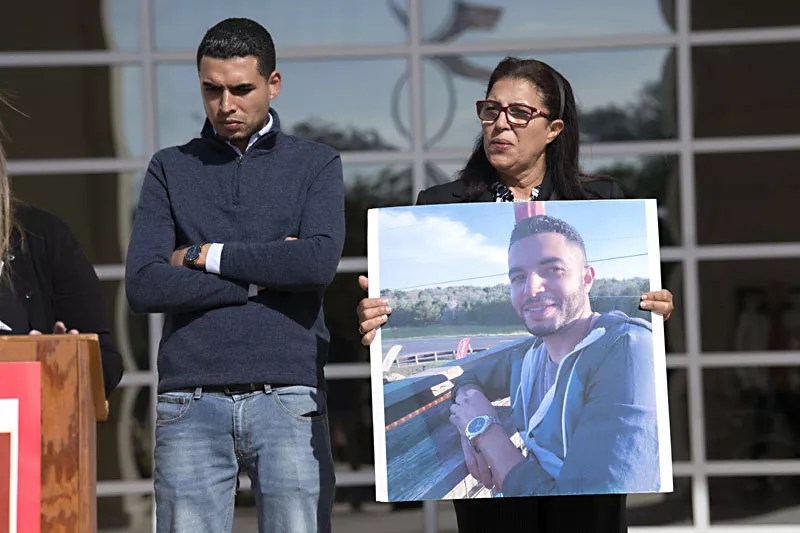
A month later, on Nov. 22, Jordan Buckley carried a podium – he said he got it at a thrift store – to the top of the steps of the Hays County Government Center. He set an inexpensive PA system in front of it. To the sides, he placed large, blownup pictures of Adil Dghoughi. “This is how we like to do it,” he said. “Don’t ask permission.”

In its 4½ years, Mano Amiga has had a string of successes as it’s evolved from a handful of volunteers to a nonprofit with a paid staff. Together with the Bail Project, the group helped establish a revolving fund that provides bail for indigent arrestees, so they don’t languish in the Hays County Jail for months before their day in court. They orchestrated the passage of San Marcos’ cite-and-release ordinance, a rule forcing police officers to issue citations, instead of making arrests, for offenses like graffiti, petty theft, and possession of small amounts of marijuana. They are in the final stages of a campaign to bring a public defender’s office, with a $5 million budget, to Hays County. And they have an ambitious agenda for the coming year, including an effort to get cannabis decriminalization on the ballot in San Marcos’ November 2022 local elections.
Their Nov. 22 press conference drew a crowd of perhaps 20 people, equal parts family and friends of Adil Dghoughi, members of Mano Amiga, and news media. Dghoughi’s mother, Fatiha Haouass, had arrived from Morocco two days earlier and spoke to the group. So did Buckley, Othmane Dghoughi, and Villalobos.
When the speeches were done, the group filed through the government center’s metal detectors and up the stairs, where Hays County Pct. 1 Constable David Peterson met them and answered questions. Buckley asked Peterson what his deputy, Sgt. Eric Villalpando – who has lived next door to Terry Turner for 17 years – knew about Dghoughi’s killing and if the deputy had insight into why it took 10 days for authorities to issue an arrest warrant. Peterson told the group that Villalpando had slept through the shooting, the sirens, and the hours of investigation. “That’s all I can give you,” he said. “We do not have facts or anything like that concerning what happened.”
Haouass, Othmane Dghoughi, and Todd then returned outside and stood for interviews with television reporters, vowing to never stop speaking out until they had secured justice for Adil. Away from the cameras, they expressed their doubts. Dghoughi said he’s been told a grand jury will meet some time in the next three months to consider his brother’s killing but that he has little faith in Caldwell County Criminal District Attorney Fred Weber. “The way this is going, it doesn’t look like there’s going to be an indictment,” Dghoughi said. “I spoke to the D.A. and he said, ‘I’m going to present the case to the grand jury, and of course I’m going to give them other options – lesser charges – if they think that it’s not first-degree murder.’ I know why he said this: He’s telling me, ‘Expect this, it’s going to happen.'” If there is a trial, Dghoughi, Haouass, and Todd would like to get a change of venue for it, preferably to Travis County. They’d also like to bring the FBI into the case.
“His birthday is December 27, and we were going to Mexico … And then in April we were going to Morocco, so he could finally go see his family. It’s just so many plans and so many things that we had, and now it’s like I have nothing.”- Sarah Todd
Todd spoke about the emptiness she confronts now that her boyfriend is gone. “His birthday is December 27, and we were going to Mexico for his birthday and we were going to do New Year’s in Mexico. And then in April we were going to Morocco, so he could finally go see his family. It’s just so many plans and so many things that we had and now it’s like I have nothing.”
Todd is a born-and-raised Texan who has lived in Caldwell County for more than 20 years. As a gun owner and a supporter of the Second Amendment, she understands on a personal level the challenge that Dghoughi’s case represents. She’s afraid the members of the grand jury won’t see a man pursuing an unarmed person into the street to murder him, but someone legally standing his ground against an intruder. But she believes Turner did intentionally murder Dghoughi and she thinks she knows why.
“I think it’s because he saw the color of Adil’s skin,” Todd said. “He saw that he was dark-skinned … I think that this man, his entire life, was hoping that he could be in this type of situation and use his weapon to murder someone of another color, period. That is how I feel.”
Why Did Adil Die?
A version of this article appeared in print on Dec 10, 2021 with the headline: Why Did Adil Die?
This article appears in December 10 • 2021.
