

|
|

It’s birthday time again. “Corner to Corner” is now three years old — which means it’s time for me get on my soapbox and talk about my own neighborhood. Which is handy, since it once again figures heavily in the News of Today. As you read this, I’ll have finished a year as president of the Swede Hill Neighborhood Association (SHNA), and thus been proximate to not one, not two, but three big-deal attempts to reinvent Central Austin. There’s downtown, to our west past I-35; there’s Robert Mueller Airport, to our northeast along MLK; and there’s the ongoing tragicomedy of the Austin Revitalization Authority, which includes the southern edge of our neighborhood along East 12th Street. (Those three roadways, plus Comal Street, form SHNA’s boundaries.)
This makes Swede Hill prime real estate. That is, unless you’re the ARA or the City of Austin, which would like to declare part of my neighborhood a slum.
Originally, you’d have been reading this after the city council’s public hearing on the ARA’s East 11th and 12th Street Project Area Survey — better known as the “slum and blight” study. That hearing has now been kicked forward, in hopes the extra time will allow ARA to fix its sinking ship, or at least fix its leaking slum and blight study. Were I on the ARA board, I would be looking for a lifeboat.
Hand-Picked Representation
Of course, I’m not on the ARA board, and neither is anyone else who actually represents my neighborhood. Ever since its creation, by the strong arm of former Councilmember Eric Mitchell, in 1995, many believe the ARA has done little to share, or even to pretend to share, its power and control with the people who will actually suffer its consequences. Instead, some say, a self-defined oligarchy has commandeered the corridor as its personal property, and aims to use $9 million in Federal money to lavishly scratch its members’ backs under the guise of helping the people.
And everyone who stands in its way, regardless of their color, is called a racist. The neighborhoods along 11th and 12th Street have been integrated for years, are today largely Anglo and Hispanic, and have been mostly abandoned by the same upwardly mobile African-Americans who now control the ARA. Yet the notion that the locals’ voice within the ARA should be, if not greater than, then at least equal to that of the “black community” (whoever that is) has been dismissed within the authority’s inner circle, which excludes not only my own neighborhood but many on the actual 17-member board. The real decisions about 11th and 12th Streets have been made by about 10 people, most with easily discernible political or financial ties to one another.
This was bad enough back when it started in 1995, but since then, you may have noticed, the political climate in Austin has changed a bit. Today, with the constant background murmur about empowering neighborhoods and building, or rebuilding, the city from the bottom up, it’s hard to see how the city council can continue the ARA farce without writing off its oft-touted pro-community stance. Why bother to create a neighborhood plan, and meet the city’s admirable standards for genuine community involvement, when you can just cook up an ARA from amongst the names in your Rolodex and white-guilt the city into submission?
To rehearse some tired old info: When Mitchell presented the fruits of his Rolodex — his hand-picked ARA slate — to city council for approval, it had no neighborhood reps at all. On-the-dais arm-wrestling led to four neighborhoods — out of at least six established neighborhood associations in the corridor — being added to the board.
Swede Hill was one of the blackballed neighborhoods, the price we paid for mixing it up with Mitchell over his scheme to gift-wrap some city-owned property at the heart of the Hill — used as a park, with the city’s participation, for nearly 20 years — as a present to former GOP congressional candidate and developer Jo Baylor. The neighborhood, you may remember, won that battle, and a few months ago actually saw this parcel become an official park. For her part, Baylor saw her former husband, developer Cal Varner, join the ARA’s brain trust, and when one of the out-of-town planners hired by ARA to do its dirty work made his first(!) visit to Austin earlier this month, Baylor was tapped to be his chaperone.
All this put me, along with a lengthy list of other neighborhood and community leaders on the Inner East Side — including those who did get ARA board slots, only to be marginalized by city staff and the board’s amorphous yet all-powerful Executive Committee — in the posse of “aggrieved stakeholders” who entered into city council-initiated “facilitated discussions about East Austin redevelopment” a few weeks past.
We translated this last phrase as “mediation” — in the words of Chestnut Hill NA’s Portia Watson, brusquely dropped from the ARA board, “There’s a dispute here, and we’re here to settle that dispute.” To us, a settlement meant changing the bylaws governing the board, and putting real-life stakeholders in a majority of the seats. Leaving the ARA generally intact, though transformed, seemed a realistic middle ground between the sides. (None of these ideas targeted specific board members, but rather board seats held, in theory, by one or another constituency, though the current ARA board is full of people who “represent” groups which would rather be represented by someone else.)
We instead began the process — not referred to as “mediation,” of course — with lots of talk about everything being on the table, everyone working from their current positions toward solutions, consensus, and what not. This sounded a hell of a lot to me like starting from ground zero; indeed, we were told that the ARA status-quo was “one mechanism for revitalization; there could be others.”
It’s the Board, Stupid
This was a surprising and delightful assertion, ostensibly coming from the powers-that-be, and music to the ears of those of us stakeholders (including me) who feel the ARA has, from its inception, been neither legitimate nor necessary. But, of course, it was not true. As has been speculated regarding other Kirk Watson-spawned facilitation efforts here in the Land of 1,000 Task Forces, the ARA discussions seemed designed not to find a solution, but to arrive at the solution most desired by those in charge.
To wit, it became quite clear that the city — specifically the city staff in the Neighborhood Housing and Community Development Office (NHCDO), overseers of Austin’s share of HUD funds — would rather lose major limbs than delay and/or jeopardize the imminent flow of federal funding under the ARA’s auspices. That is, while the ARA board may have been on the table, the ARA process was not. It then became yet clearer that the ARA board was not, in fact, on the table; its representatives were unwilling to consider any proposal that removed current board members.
After four meetings and four proposals for a “restructured” ARA board, the ad hoc community coalition finally proposed the “big board,” not removing anyone but adding all stakeholders who wanted to be there. This ended up with 25 members; even though this very concept had earlier been endorsed by members of the ARA board, it was rejected by the ARA without explanation, and we all went home.
Later press comments by ARA board president Dr. Charles Urdy — Mitchell’s predecessor on the council dais — pointed to the “big board” as being too big, although it seems to me that the current 17-member board, let alone the 21-member board advanced by Urdy earlier in the talks, is already too big if efficiency is a paramount goal. In any event, as long as the ARA is unwilling to remove current board members whose relevance to the East 11th/12th renewal process is debatable, it has no business telling any stakeholder that there’s no room for them.
The real story, according to some who sat in on the ARA’s discussion of the final proposals, was what you’d expect — the ARA blackballing community reps who could threaten its cozy games and blow the whistle. With its last-minute thumbs down, the ARA gave its game away. It also, for anyone with any sense who has been involved in this process, sounded the call to the lifeboats.
So now we are back where we were, branded as obstructionists for trying to steer the ship away from the icebergs. Last week, with less than 48 hours notice, the ARA invited all the aggrieved stakeholders to form a “Community Planning Council” to “advise” the board, and to enjoy the privilege of meeting — for the first time — with the planners hired months ago, at great expense, to decide the future of the community in question. We declined, in my case not to make a grand boycott statement, but to avoid wasting more time admiring the beautiful arrangement of the ARA’s deck chairs.
“Slum and Blight” Far From Right
One need look no farther than between the covers of the Project Area Survey, n�e the “slum and blight” study, to see how screwed up this process is. The Survey is required for the city to receive about one-third of the total HUD loan package, dedicated to slum clearance and the attendant city acquisition of vacant property. Of course, to spend federal money on slum clearance, one must have a slum, which the Survey is designed to prove.
The guidelines are fairly simple: For the city to designate, under federal criteria, a “blighted area” — which is what council will do if it adopts the Project Area Survey — more than 50% of the property in said area must be deteriorated, dilapidated, abandoned, vacant or obsolete. It does not take a Ph.D. in urban planning to figure out that 11th Street between I-35 and Navasota, and 12th Street between I-35 and Poquito, can safely meet these criteria. The city and ARA have repeatedly asserted that any HUD money linked to the slum and blight — and the attendant power of eminent domain — would only be used within these blocks, forming the ARA’s target area.
|
The ARA and the City of Austin would like to declare some neighborhoods along 11th & 12th streets “slums.” |
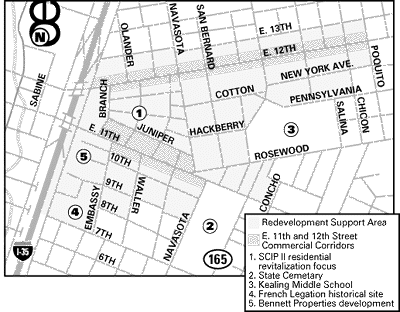
So imagine the surprise when the Survey as released actually covers a vast and irregular area going far beyond those boundaries. When the Survey was passed around at the don’t-call-it-mediation meetings, we were told that the rationale for this expansion was well outlined in the document itself. It is not. The boundaries don’t correspond to any other boundaries — neighborhood associations, community-development target areas, the holdings of individual property owners — that currently organize the Inner Eastside. The Survey document does, however, admit that its lines were drawn to cherry-pick sites with future market value, and to make the blight seem worse than it actually is.
Unfortunately for the latter goal, much of what’s singled out in the Survey isn’t blighted at all. There are dozens upon dozens of errors in the document; for example, Ebenezer Baptist Church’s new 12-unit senior-housing development on 10th Street is listed as deteriorated and abandoned property. (Guadalupe neighborhood leader Mark Rogers was able to fill nine single-spaced pages with errors gleaned from just the first 37 pages of the several-hundred-page Survey. This mightily embarrassed city staff, especially new NHCDO director Paul Hilgers, who toured the area and, to his surprise, saw $100,000 homes on sites designated as blighted.)
The consulting team (most of which is actually Austin-based) that produced the survey earned more than $30,000 of public money, for which fee it neither walked the blocks in question nor examined (or understood, or chose to understand) the current zoning in the area. This is exactly the sort of travesty that could be avoided by having community control, since most of us have walked our blocks scores of times, know the status quo of all the properties in our neighborhoods, and helped create the current zoning.
Instead, to undo the stupid and/or corrupt work of the Survey team, the city has delayed council hearing on the Survey yet again. Remember, city staff originally tried to ramrod this through council as a “routine” housekeeping item in June, before the Survey was even completed, and uncoincidentally just in time for Mitchell’s last meeting as a councilmember.
So the Survey tells us on the Eastside, in effect, that some folks in Swede Hill or Guadalupe, but not their neighbors across the street who live in identical conditions, live in slums. It also tells us that nobody north of 13th Street in Swede Hill need be concerned about 11th/12th Street renewal, but some folks in Guadalupe all the way south to Seventh Street will be directly affected. (The most likely reason for the latter: Much of Swede Hill north of 13th Street, including Oakwood Cemetery, is listed on the National Register of Historic Places, and slum clearance and eminent domain in such districts is next to impossible.)
These discrepancies makes no sense, but their implications are sinister. Do the city and the ARA intend to break their word and start clearing “slums,” using eminent domain if necessary, all throughout the Inner Eastside, which the newly expanded Project Area Survey would make possible? Or will developers — such as Bennett Properties, whose Eastside Mall site would now become a “slum” — use the designation to their advantage, to buy up or drive out adjacent and recalcitrant property owners?
The neighborhoods are not convinced, not only that we live in slums, but that we need to live in slums to make “revitalization” work. The city already owns 20-odd parcels in the corridor, most of which are vacant. The non-slum-and-blight portion of the Section 108 package — about $6 million — is earmarked to build 40,000 square feet of new office and retail space, which could easily fit within the city’s current holdings. (How does the ARA know we need office and retail space without a completed master plan? You tell me.)
Alternately, proceeds from their sale, even if under the ARA’s auspices, should be enough to acquire and clean up other properties in the corridor deemed more suitable for development. Land values in East Austin are rising faster than in the city as a whole, and Swede Hill alone has seen more than $10 million in private investment, within the last two years, within 1,000 feet of the ARA target area.
So, instead of churning HUD’s money to clean up “blighted slums,” the city and ARA could actually broker the prime real estate they currently control and create a lot of “revitalization” without a dime of tax subsidy. So far, though, the ARA’s voyage has led not to the marketplace but to the public trough and feather bed. Illustrating the latter: The old Shorty’s Bar building on 11th, once readied for sale by the city at a price under $80,000, is now the object of a ARA-driven rehab effort costing nearly $400,000 of public money.
Last Say on the ARA
After the Survey, sometime around the new year (again, behind the original timeline) comes the ARA’s master plan for East 11th and 12th Streets, courtesy of a planning team from the University of South Florida (USF) in Tampa. Now, USF has a fairly well-respected urban design program, but there’s no shortage of qualified planners in East Austin, let alone in Austin as a whole. However, the USF team leader, David Crane, has worked in the past, in different cities and combinations, with ARA executive director and former Assistant City Manager Byron Marshall, his successor Marcia Conner, former NHCDO director and SCIP II housing impresario Gene Watkins, and Mitchell. So there.
If the ARA is still around in its current form, expect the plan to receive the same reaction — shock, outrage, violent anger — that the Project Area Survey has received, and expect the same gyrations from ARA and city staff to ram it down our throats. That’s a pretty big “if,” though — it might finally be clear that the city’s vision of a neighborhood-driven metropolis should not apply everywhere except 11th and 12th Street. Or that the frenzy of development activity throughout Central Austin has not bypassed 11th and 12th because of some sort of occult curse, but because of the ARA’s own ineptitude and intransigence. Or simply that an initiative like the ARA will not work without the all-important “buy-in” of people like my neighbors, who are, after all, supposed to be its beneficiaries.
The ARA’s contract with the city, currently in its third temporary extension, will eventually have to either be renewed or terminated, and the message to the authority — from the community and, maybe, from the council — is clear: Change or die. To be honest, my bet would be on the latter. Either way, I look forward, on “Corner to Corner’s” fourth birthday, to be able to report on a different kind of odyssey.
This article appears in October 24 • 1997 and October 24 • 1997 (Cover).