

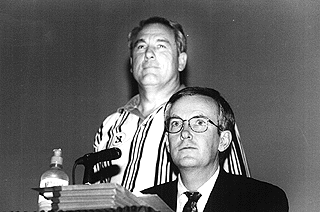
 Ronney Reynolds beams as a quaking Daryl Slusher faces the rowdy crowd at Covington Middle School. photograph by Jana Birchum |
Middle School, Monday night. The auditorium is a standing-room only madhouse, a seething sea of silver-haired
retirees from the uttermost reaches of Southwest Austin and beyond. As if on
trial, a full council is seated at a pop-up table on a very empty stage. It’s
going to be a long night for four of them — Daryl Slusher, Gus Garcia, Beverly
Griffith, and Jackie Goodman. To them, the crowd is a geriatric lynch mob of
about 500 opponents, each one foaming at the mouth.
The mistake of the latter three councilmembers is that they have been
open-minded about Slusher’s infamous proposal to barricade off one side of the
six-lane Southwest Parkway. As a writer for the Chronicle, Slusher
assailed the seven-mile road as a taxpayer-subsidized boondoggle for the rich
and famous. Cutting through Austin’s luscious Hill Country on its way to the
hinterlands, the almost deserted road serves one key landowner: FM Properties
Operating Company, spin-off of global polluter Freeport McMoRan. Because the
pockmarked road was built over springs, it is slowly becoming one big sinkhole.
To standardize the city’s 4.4-mile portion, the repair bill stands at $2.2
million. More importantly, Slusher knows, and is not afraid to say, that
overpopulating it means the end of Barton Creek. This crowd doesn’t give a
damn. The road is their catapult to downtown Austin. Slusher might as well have
asked for their first grandchild.
It is safe to say that the four councilmembers, and their small and very
out-of-place following of enviro-fundamentalists and council junkies, have
stumbled into an ambush. Mayor Bruce Todd chose this Oak Hill locale for a
public hearing, instead of council chambers, because he wanted to make sure
Slusher and his vocal supporters look like buffoons. It’s working. Few use the
wide-open stretch of asphalt — a city survey counted five cars a minute during
rush hour! –but every one of them must have stopped by on their way home from
work.
To kick the tar-and-feathering off, the wily Todd plays a video of the
December 19 council meeting, when the public hearing was set and Slusher’s
proposal first considered. Through selective editing and shrewd argumentation,
the video makes it appear that Slusher opposes a public hearing at Covington.
That was never the case, says Slusher. Few in the crowd know this because they
rarely attend Austin council meetings. Indeed, a good portion of the audience
doesn’t even live inside the city; dozens of Lakeway residents have been
transported in two busses chartered by their town — a town that doesn’t pay
Austin’s taxes nor votes in its elections, but obviously uses the Southwest
Parkway.
To begin the public hearing, or more appropriately, public assault, Todd
grants open mike privileges to County Commissioner Bill Aleshire. In a
15-minute verbal projectile, Aleshire calls the proposal “idiocy” and “stupid.”
He sets his sights on Slusher and asks, “What would this city’s environmental
agenda be if we didn’t let extremists set it?” The well-dressed and the
perfumed pump signs and wear stickers with a number three stamped with a bar
sign over it, to signify the number of lanes they don’t want closed. This is
more of a campaign rally than a council meeting, when you consider that mayoral
wannabe and developer caddy Ronney Reynolds paid for the signs out of his
campaign account.
Things aren’t going well for gadfly Robert Singleton, et al. They have
lost the home-field advantage, and are outnumbered about 20-1. They are jeered
at every turn. Place 5 city council candidate Karen Hadden is showered with
boos for suggesting, very politely, a cure for auto overpopulation. Another
activist suggests that less lanes slow traffic and therefore increase safety.
Shrill laughter ripples through the crowd. One enviro leaves the meeting
cursing that it’s a set-up.
“Take a bath!” someone shouts.
The enviros retaliate weakly. Save Our Springs Chair Kirk Mitchell goads the
crowd by continually pointing out that they’re a lot richer than most of
Austin. He mentions that many here, particularly Lakeway folk, don’t have to
pay for the road’s upkeep. Every reminder of their wealth only serves to boil
the blood of the well-heeled, who look like they would stone Mitchell if they
had the chance.
It goes like this for more than two hours, until Steve Beers, of the Sierra
Club, shocks many by saying he opposes the closing, partly because of the spite
it has created: “I hardly recognize my city with the kind of venom I’ve heard
tonight.” That sets the tone for the council debate, and in his long-awaited
concession speech, Slusher taps the same vein. “We should not move ahead,
polarized.” He slides into a soliloquy about the fragility of the creek. The
crowd moans. Slusher pushes on, “I really appeal to you to listen. You people
live in one of most environmentally fragile areas in the state of Texas, if not
on the North American continent. Is closing half the road a crazy idea?”
“Yes!”
“Well maybe it is, but I tell you what, if we become the first generation to
not pass on Barton Springs to our children, they’ll think we’re crazy
and they’ll be a lot madder than anyone here tonight.” He suggests a task force
of various government and community representatives to look at solutions to the
road’s economic and environmental threats, but despite Reynolds’ insistence,
won’t revoke his idea to close half the road. Gus Garcia, the swing vote, takes
center stage. He likes the idea of removing only two lanes. The audience
murmurs with displeasure. Garcia suggests shelving the lane removal and task
force ideas for now, and having the city manager study the problem. Todd,
Reynolds, and Eric Mitchell, who are having the time of their lives, vote no —
they want to force a vote now, up or down — but the motion passes, and the
crowd erupts with a booing and hissing avalanche.
No one can really blame the less-than-progressive minority councilmembers for
relishing the moment. Todd, Reynolds, and Mitchell have spent countless
Thursdays enduring the taunts of the masses, and for once, the tables were
turned, and revenge was in the air. The very folks in Southwest Austin whom
Slusher spent years pissing off with his endless talk about the proliferation
of MUDs, the need for S.O.S., and the vulnerability of Barton Creek, showed no
mercy in their attempt to burn Slusher at the stake. Reynolds looked like he
might weep with joy.
Meanwhile, how does S.O.S. defender Bill Bunch feel about Slusher’s retreat on
one of his promised environmental initiatives? “I would have preferred that he
stayed the course,” Bunch says. “But I understand that without the votes, it’s
useless to push forward.”
FAIR’s Still There
To understand what the council did Thursday, taking the first step inshowering six Austin corporations with a $32 million electric rate giveaway, it
helps to picture a certain scene from an I Love Lucy episode. For five
cents, Lucy is selling mayonnaise that cost her six cents. Asked how she’ll
make a profit, she answers: “Volume!”
Councilmembers Goodman, Todd, Reynolds, and Mitchell, all played Lucy last
week. If they hang together for two more votes, and if the four (Un)FAIR
(Federation of Austin’s Industrial Ratepayers) members — AMD, Motorola, Texas
Instruments, and IBM — accept their terms, the Electric Utility Department
will have to sell a hell of a lot of electricity to turn a buck. That’s
because, as reported last week, the corporations, under the deal, may be paying
only two-thirds of what it costs the city to produce electricity. So the logic
of the council approving the reduction, which returns today for second
approval, is hard to figure. But, then, some things just can’t be explained at
council meetings.
The approved reduction takes the corporations’ rates from 4.5cents a kilowatt
hour to 4.2cents (residents pay 7.4cents), saving the Selfish Six (in addition
to the four FAIR members, Seton Hospital and Applied Materials also get the
break as members of the same industrial ratepayer class) about $4.2 million
each a year. In exchange, the corporations, as represented by FAIR, had
promised six years of fidelity to the EUD, in the event that the Lege
deregulates the electric utility industry and competitors offer lower deals.
Goodman was in charge here, because she was the swing vote — Todd, Reynolds,
and Mitchell were the definite “yes” votes. She says the EUD needs the $40
million-plus a year in revenue the Selfish Six provides, in order to pay off
the utility’s weighty debt. But she was torn — she usually favors the little
man, and the EUD deal promises otherwise: Residential ratepayers will probably
have to make up the difference somewhere.
So Goodman wanted to get all she could out of the corporations. Since the
industry isn’t expected to deregulate until at least 1999, and the deal would
kick in ASAP, she didn’t think it would be a big deal if she asked the
companies to stay on an extra two years. They are, after all, good corporate
citizens. And they would, after all, still get the reduction — $8.2 million —
for those two years they couldn’t leave the EUD anyway. But FAIR rep Alan
Holman said nope, no way, one extra year only: “We’d just as soon call it off
and go home.” Goodman played their bluff and went ahead with her proposal.
Slusher, Garcia, and Griffith still feared that the decision was premature, in
light of the fact that most scenarios put deregulation at least two years away.
But their four colleagues approved Goodman’s plan anyway, and FAIR hasn’t
walked out yet. Citizen representative, attorney W. Scott McCollough, opposed
Goodman’s proposal, but says, “We’re moving in the direction of reasonableness.
It’s still a loser, but it’s better than what we had before.”
This article appears in February 7 • 1997 and February 7 • 1997 (Cover).