




|
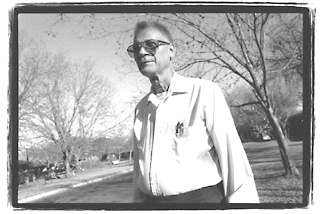
Alfred Dotson, president of the Pecan Springs/Springdale Neighborhood Association |
At the beginning of the month, right before the Austin City Council about-faced and deep-sixed the controversial Tannehill Apartments, Councilmember Jackie Goodman — laying the groundwork for her abstention from voting — decried how Tannehill had degenerated from a brand-new-day idea into the same-old-same-old. Because the developer and the neighborhoods couldn’t get along, she said, the council was forced to make a decision that was “politics rather than urban planning.” Mind you, this is coming from a woman whose career in office — along with those of her comrades — has been defined, and largely made possible, by the conversion of urban planning into politics. But if Goodman may have been a little off point, as far as the job of the council is concerned, it is true that the (sexy, theatrical) politics of Tannehill overwhelmed the (boring, difficult) planning questions, which live on even though the project is dead.
To be exact — sexy, theatrical, cultural politics. Nasty neighbor-developer spats over unwanted land use happen, as you know, all the damn time. And as land-use battles go, Tannehill was pretty run-of-the-mill. A developer wants to build a big apartment complex near existing single-family homes. The neighbors don’t like it, at least not the way it was proposed. They fail to reach a compromise and it dies, and the status quo is preserved. ‘Nuff said. Compared to, say, the folks in Far South Austin, fighting to keep their neighborhoods from washing away on a tide of dirty floodwater and mobile homes and tiltwall industrial shantytowns, the folks in the Springdale Hills and Stonegate subdivisions, on either side of Martin Luther King, Jr. Blvd. between Springdale and Ed Bluestein, had it easy.
An Affordability Thing
What made Tannehill stand out amid the ruck of unloved and doomed projects was the obvious difference between the two sides. The Springdale Hills and Stonegate residents are mostly older, if not downright old. The Tannehill supporters were mostly young parishioners of Praise Tabernacle, a new-model “megachurch” around the corner, which — unlike the project’s actual neighbors — had been offered, and claimed, a somewhat mysterious stake in the project and the chance to cooperate in its development.
All of these people are black, which made the city all nervous and sensitive, and led the council to handle Tannehill with more gravity than it probably deserved. Even the angry neighbors — whose problem, by their account, was with the details, not the idea — did not ascribe any particular racial motivations to the project. Still, words like “tragedy” filled the air at the final hearing, as the project was blamed for “dividing the community.”
The truth is that the black community, like all communities, is already divided along demographic lines other than race, and that the council’s eventual divided vote (4-2-1 against) mirrored these demographics. The two pro-Tannehill votes were from the two councilmembers — Spelman and Watson — most fairly described as “yuppies,” a term that also describes many Praise Tabernacle parishioners, at least in the eyes of the church’s neighbors, who are not, safe to say, the church members’ neighbors. The rest of the councilmembers are either less-than-wealthy, or over 50, or both.
The age and socioeconomic makeup of the council is not, of course, the whole issue: The pro-votes from Spelman and Watson were less against the elders of Springdale Hills and Stonegate than for “affordable housing,” that beloved shibboleth of today’s developer, which in the case of Tannehill would have been made possible by a healthy dollop of state-supported tax credits. (Had it been built, Tannehill’s tax credits would have, over time, offset 80% of the project cost.)
Now, the “affordable” part is based on formulae that take the entire city into account, so it’s pretty easy for a land baron to move into an area with below-median property values — like East or Southeast Austin — build to their pleasure, without regard to compatibility of any kind, call the result “affordable,” and demand special treatment. Using this as a strategy to override neighborhood concerns is specious, and so far hasn’t proved to be successful. When a developer wants to build a tax-credited complex at MoPac and Braker Lane, then we’ll see a real solution to Austin’s affordable housing needs.
Such a project might send the neighborhoods up northwest into fits that make the Tannehill fight seem tidy. But is there any neighborhood in Austin that would welcome a multi-family complex with nearly 200 units, affordable or unaffordable, in its formerly single-family backyard? On paper, in the abstract, many would say yes. In practice, they say otherwise.
“We’re not ecstatic that we won. We’re not opposed to apartments, and we’re especially not opposed to affordable apartments, because we realize that there’s people out here who need this kind of residence,” says Alfred Dotson, president of the Pecan Springs/Springdale Neighborhood Association. “But the Tannehill Apartments were opposed, primarily, because they sat right between two communities that had been there for 30 or 40 years, and we saw all kinds of detriment to that. Had they been placed strategically, four or five blocks away, in the right spot, they wouldn’t have been objectionable at all.”
Wide Open Spaces
Four or five blocks away, in more than one direction, there is nothing, just as there is nothing where Tannehill was actually proposed, and plenty of nothing all over Middle East Austin. It is this abundance of nothing — hundreds of acres of raw land — that brought the Tannehill project’s developers out here, that brought Praise Tabernacle out here, and that promises in the next few years to bring one project after another out here, each promising to transform Pecan Springs and environs in ways the neighbors may like — or may have to learn to like.
Pecan Springs proper is only one of several neighborhoods bordering and scattered among the old J.C. Tannehill League. But its name — largely because of its neighborhood association, whose boundaries go far beyond Pecan Springs itself, and which is one of Austin’s oldest and most active NAs — has become applied to almost the entire area from the airport to U.S. 183, and from Walnut Creek and Manor Road on the north to the railroad tracks separating it from old Govalle to the south. (The Pecan Springs NA only extends south to MLK; the lands south of that, including the actual Tannehill site, fall within several other NAs, including Stonegate — which only covers about four blocks — and Truman Heights.)
|
A recent proposal to build “affordable” apartments did not sit well with some in these old Austin neighborhoods. |
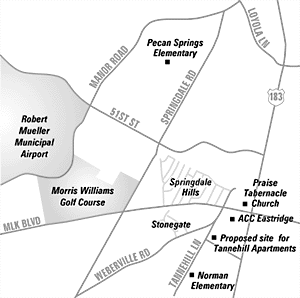
The emptiness out here belies the fact that Pecan Springs is one of the oldest settled parts of today’s city of Austin. The original land grant to Jesse C. Tannehill predates not only Texan but Mexican independence. By 1875, enough families had put down roots there to justify the creation of a school, making today’s Pecan Springs Elementary — originally located at Manor Road and 51st Street — the second-oldest school in Austin ISD.
By that point, Pecan Springs, like most of the small communities in eastern Travis County, was becoming a multi-racial settlement, as rural African-American populations from the east and southeast slowly migrated toward the city of Austin. This population shift — culminating in the glory days of urban black culture in the central city, in Austin and other towns, between the two world wars — abruptly reversed with integration and the postwar decline of the black inner cities.
Which brought African-Americans seeking to escape this decline, and attain the American Dream of suburban-style homeownership, back to Pecan Springs. The neighborhoods that do exist amidst the wide-open spaces date from the mid-1950s to about 1972, mostly produced by the big ranch-home factories like Nash Phillips-Copus (developer of both Springdale Hills and Stonegate), and comparable to the proto-suburbs built out in the same era, at the same distance from downtown, in other directions (like Crestview to the north or Dawson to the south).
In the beginning, the homes got sold to middle-class white people, and some — like University Hills — remain substantially Anglo to this day. But by the late 1960s, when Springdale Hills was built amidst what at the time was completely empty countryside, most of the folks looking to buy homes in the East were black, since “equal housing opportunity” was still, in Austin, a largely theoretical concept.
This sufficiently explains why, today, Crestview and Dawson are basically inner-city neighborhoods, outflanked by ever-widening belts of sprawl, while Pecan Springs is still the edge of town; once it became a “black neighborhood,” development came to a grinding halt. “This… was due entirely to social and related market factors,” wrote the consulting firm of Holford and Carson in its “Pecan Springs/University Hills Development Plan,” crafted in 1978.
“Streets, water, sewer, gas, and electrical service were all in place and had adequate capacities for the anticipated growth” on the 583 then-undeveloped (and still mostly undeveloped) acres in the study area, the plan reports. “The large immigration of blacks [created] fears that the neighborhood would become entirely Black. These fears… were undoubtedly responsible for the decline in the relative market value of existing homes and completely destroyed the market demand for new homes.”
The Holford and Carson plan itself was an attempt to rectify this state of affairs. When the area was annexed — which, in some parts, didn’t happen until 1972 — it was brought into the city with interim zoning, as is standard practice. It took five years for the city to consider permanent zoning; when city staff recommended that the whole area be zoned at the equivalent of today’s SF-2 (the typical housing tract), the existing neighborhoods were delighted, but the owners of the undeveloped land were appalled. As a compromise, the city agreed to zone the existing neighborhoods as proposed, and sign off on a development plan — the Holford and Carson plan — for the raw land.
Like most Austin plans, the Holford and Carson study came to naught, but given that nothing else has really happened in Pecan Springs in the interim, it makes for interesting reading in light of today’s battles. One sentence, in particular, jumps out: “The stability of the neighborhood will be threatened if rental units dominate further construction.” Developer Dreams, Neighborhood Wishes Which brings us back to Tannehill, and to an inescapable truth about East Austin: Most of the new construction in the last 20 years has been multi-family — due in part to the availability of government subsidy — and more than one of these complexes have turned into hellholes. That’s not true of all of them, of course, but one bad apple, et cetera. “As soon as one apartment complex deteriorates to the point where it is a problem, that’s the only thing you hear about,” says Councilmember Willie Lewis, Dotson’s predecessor as president of the Pecan Springs NA.
The folks in Springdale Hills and Stonegate, many of whom bought these houses when they were new, have kept their neighborhoods in a lot better shape than one sees in other developments, of whatever ethnicity, of similar vintage throughout Austin. For decades, they have watched a boom unparalleled in all but a handful of American cities totally pass them by, for the most transparently racist reasons. Now, when a developer finally takes an interest in building onto their area, it’s with a big multi-family project, with all the risk that implies, designed for people who, by their own admission, are looking for a way station, not a permanent home. No wonder the neighbors are hacked.
Actually, the Tannehill developers aren’t the only builders coming to the area; as we speak, new single-family homes are going up in the northwest corner of Springdale Hills, listed at prices equivalent (in mortgage vs. rent terms) to those proposed for Tannehill. “I just met with a young Hispanic lady who’s building a home over there,” says Dotson. “Springdale Hills has been solidly black, but it’s beginning to open up. Not that anyone was barred over there, but it was just perceived as a black enclave.”
It doesn’t take a certified planner to know that this “opening up” is bound to accelerate. To the west of Pecan Springs lies the soon-to-be-ex-airport, with mixed-use, master-planned, new-school development conceived in its stead; to the east is the U.S. 183 corridor, the express route to Edge City, and east of that the proposed SH 130 routing, apparently destined to be closer to today’s East Austin than many of today’s East Austinites would like. All of this makes Pecan Springs, with parcels of more than 100 acres lying around untouched, a developer’s dream date.
It would be nice, in the view of the Pecan Springs neighbors, if developers dreamed of building things that might actually be of use to the neighborhood. “We do need some sort of community-oriented businesses out there, and we have — at least on our side — had input on the zoning of the properties,” says Dotson, referring to overlays placed on land within the Pecan Springs NA (“our side” of US 183 and MLK) to prevent more noxious uses. “We realize that, all along MLK from Springdale Road east, it’s very likely there will be commercial ventures, but we hope they will be balanced by an array of nice, single-family homes. With the development of the airport site, more people will want to come and not only work but live here.”
The need for a mix of uses, being standard planning gospel of the moment, is easy to ascribe to an area as low-density and fertile as Pecan Springs. “I’m not totally convinced that single-family is always the best thing,” says Lewis, “but I don’t think apartments will always be the best thing, either. We should have some type of mixed use, without it being too dense or something the neighborhood perceives they can’t deal with.”
Back in 1978, Holford and Carson focused on non-residential regional uses (as opposed to community-oriented uses, i.e., the difference between a shopping mall and a grocery store) as the best way to quickly improve the neighborhood’s image, and thus restore interest among residential developers. Today, the opposite is the case; non-residential, or at least non-SF, use takes a heap of selling to the locals, no matter how vital it may be as a planning doctrine, and it will not happen without neighborhood support.
With the Tannehill decision, the neighborhoods have their best chance in years to create the long-sought mix that will work to everyone’s benefit. “They need to sit down,” says Lewis, “decide what type of things they’d like to see instead — on this land and other vacant land around them — and try to get those things to come in.”
This article appears in December 26 • 1997 and December 26 • 1997 (Cover).