The first couple of months of each new Lege session, until the mid-March bill filing deadline, are always about money: how much there is, who has it, and who’s gonna get it. While the state’s next budget is still in play, the real action is in the budgetary committees (Senate Finance, House Appropriations) and more precisely among the handful of ranking members on those committees. They are doing the actual “markup” of the draft line-item budget to determine what sort of an omnibus bill will finally make it to the floor. This year, with the budget officially $10 billion in the hole, the maneuverings are more intricate than usual. (Sen. Bill Ratliff, R-Mt. Pleasant, let slip the other day that, allowing for population growth and inflation, the deficit is really closer to $15 billion. Keep it under your hat.) Whether those maneuvers will be visible to citizens is another matter altogether.
The numbers promenaded again last week, as Gov. Perry’s State of the State address danced around the editorial pages and press releases. Republicans and conservative think tanks applauded the governor’s fiscal responsibility; Democrats and progressive interest groups were considerably less enthusiastic.
Consider a few of the more intriguing Perry numbers. “Since 1990,” declared the governor, “our population has grown 27%, and inflation has increased by 37%. And what has government grown by in the same period? 125%.” It seemed an imposing increase — until skeptics pointed out that the “government” spending Perry cites includes all federal spending in Texas over the last 12 years. This also happened to be a period of explosive growth in health care costs and federal Medicaid funding. It further coincides with a massive state prison construction program as well as increased education funding — consequent to lawsuits (the Ruiz and Edgewood cases) the state finally lost after many years of expensive dithering.
In the real world, over the last several years, state spending as a percentage of gross personal income and gross state product (reflecting the overall growth of the Texas economy) has steadily decreased, now approaching a nickel on every dollar of personal income. That doesn’t mean we’re not paying taxes — especially in the case of school taxes. The state has effectively pushed downward onto local taxing districts, more and more of the costs of education, whether in public schools, community colleges, or universities. In addition to the abruptly imposed across-the-board budget cuts, currently gaining traction is the notion of “deregulating” university tuition — once again shifting costs from the state to individual Texans, and directly undermining the state’s neon promise to “Close the Gaps” in educational access.
In a similar vein, the governor singled out Galena Park ISD (northeast of Houston) for achieving an “exemplary” state rating while serving 66% poor children and spending “less than the state average per student.” Houston Sen. Mario Gallegos, whose district includes Galena Park, quickly pointed out that the governor’s numbers did not include a recent tax increase that raised the district’s spending per student. Nor did they reflect that 10% of Galena Park’s budget — $6 million annually — is “recapture” money that will disappear should the GOP succeed in ending “Robin Hood.” “The governor should have shown the big picture,” concluded Gallegos.
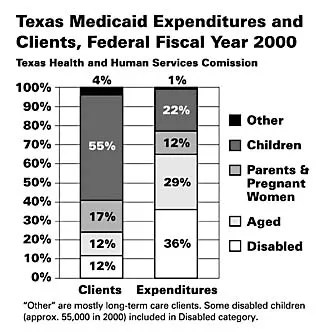
The budget committees are also looking hungrily at Medicaid costs — although Medicaid spending both draws down federal dollars and generates economic development. Perry was vague on specific Medicaid cuts, only insisting that it’s time the state got its fair share of federal funds — which won’t happen unless the state spends its fair (and significantly lesser) share of matching funds.
The governor did offer the following mathematical conundrum: “To achieve a savings of $3.8 billion, we could reduce our current appropriations levels by an average of 9% in the next budget, with the exception of public education which we can increase by half a billion dollars. And this average reduction of 9%, compared to the reductions being achieved by agencies right now, would represent an actual increase for many of these agencies.” That degree of willful incomprehensibility has not been achieved at the Capitol since … the Bush administration.
A good deal more comprehensible — but difficult to hear over the mantras of “no new taxes” and “scrub the budget” — are those areas of Medicaid service not considered “acute care” (i.e., federally mandated doctor and hospital programs that the governor has exempted from direct cuts because he has no choice). In the next few weeks, watch for these likely targets, who now receive “optional” Medicaid services:
• 55,000 aged and disabled Texans in community care programs (instead of more expensive nursing homes);
• 13,000 births (children to be born and paid for in any case, but by local taxpayers);
• 11,000 mentally retarded Texans receiving residential care;
• 15,000 frail elderly in adult-day-care programs;
• 3,000 terminally ill patients per month in hospice programs;
• 40,000 mental health patients per month in outpatient programs;
• 308,000 people per month getting prescription drugs; and
• 42,000 elderly and disabled Texans in nursing homes.
And those numbers do not tell the whole story, because several of these programs have long, and long-enduring, waiting lists.
On the other hand, there’s the health care policy offered recently as an alternative to Medicaid by the chair of the House Select Committee on State Health Care Expenditures, Temple Republican Rep. Dianne White Delisi: seat belts, healthy food, teetotaling, and monogamy.
This article appears in February 21 • 2003.