

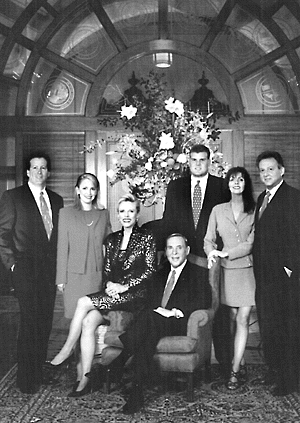
 Bullock, in his 1996 Christmas card, flanked by his wife Jan (seated on his left) and his family. |
wood frame house located a dozen blocks east of the ornate Hill County
Courthouse in Hillsboro, Texas. It is in a middle-class neighborhood of orderly
yards, tall trees, and modest homes. Bullock’s father, an engineer employed by
the City of Hillsboro, had troublesome health problems, and as a boy, Bob spent
much of his time across the street, at the home of his sister, Louisa, and
brother-in-law Will Bond, the man who later convinced him to run for the
legislature. Bullock was 16 when his father died, and he and his mother moved
into the Bond’s house.
Bullock married his first wife shortly after graduating from high school, and
in 1951, he joined the Air Force. For the next four years, he was stationed in
San Antonio, working as a supply sergeant. He visited Korea briefly, delivering
supplies to the troops. When he was discharged, he went to Texas Tech and then
to Baylor Law School. In 1957, still in law school, he ran for the legislature
and won. Two years later he was re-elected, but quit the legislature before his
term was complete to practice law. He returned to Austin a couple of years
later to work as a lobbyist for the Texas Auto Dealers Association.
In 1967, Bullock took a job working for Attorney General Crawford Martin, and
shortly afterward, helped run Preston Smith’s successful campaign for governor.
He became the governor’s legislative advisor and chief fundraiser, and in 1971,
Smith appointed Bullock Secretary of State, a job he held for 15 months. During
his tenure, Bullock ruled that college students should be permitted to vote in
the towns where they are attending school. He also tightened campaign finance
reporting requirements, a rather ironic move given that one of Bullock’s
political tasks was to collect large cash contributions from wealthy donors on
the governor’s behalf.
A year later, Bullock was eyeing the comptroller’s job, which had been held
for 25 years by Robert Calvert. In January of 1975, after a campaign in which
he spent $149,000, Bullock took over as comptroller, a job that he
revolutionized and turned into one of the most powerful elected offices in
Texas. Under the cover of “fiscal responsibility,” the comptroller can throw
rocks at any and all of the agencies in state government without being accused
of playing politics.
As the comptroller in a new era of post-integration politics, Bullock embraced
affirmative action hiring practices, after having opposed minority rights for
years. “When I was in the legislature, I voted for every segregation bill I had
a chance to vote for; I voted for 20 of them,” Bullock told the Washington
Post in 1975.
Yet in his first year on the job as comptroller, Bullock doubled the number of
blacks on his payroll and increased the number of Hispanics by a third. He also
promoted minorities and within nine months of taking office, a black, a woman
and a Hispanic were heading divisions at the agency. “Long before diversity was
fashionable in state government, Bullock was doing it and doing it at levels
that would be acceptable today,” says one former employee.
Bullock also modernized the agency. Billy Hamilton, now the deputy comptroller
under John Sharp, went to work for Bullock shortly after he took office. “There
were still a lot of backwaters with ceiling-high cabinets and green musty
ledger books,” he recalls. And revenue estimates were still being done with
pencils and graph paper. Revenue forecasting was highly imprecise and was based
on very little information. Bullock overhauled the entire process and bought
some of the first personal computers ever used in Texas government.
While Bullock was adding the latest technology to the office, he was also
employing old-fashioned force to collect taxes. Backed by pistol-toting guards,
he began leading raids on businesses that weren’t paying their taxes. On one
day in September 1975, with newspaper and television reporters in tow, Bullock
led raids on six businesses. The raids reaped huge political dividends as well
as providing Bullock with lots of positive press.
The comptroller’s job also confirmed Bullock’s reputation as a merciless boss.
He told one reporter, “I work 24 hours a day. I never stop. Even when I’m
asleep.” Long-time observers call him a “control freak” whose desire for inside
information and the upper hand borders on obsession. “Just when you think you
know what he wants, he changes on you,” says a former employee.
During his 16-year stint at the comptroller’s office, Bullock became renowned
for his “blue zingers.” Unlike other memos that Bullock sent out, a memo on
light blue paper meant one thing: read it now and get the answer back to
Bullock immediately, if not sooner. Hamilton recalls having some two dozen blue
zingers piled on his desk when he came to work one Monday morning. “He drives
everybody who works for him crazy,” says Hamilton.
Despite his reputation, or perhaps because of it, Bullock has employed dozens
of people who now work throughout state government. Garry Mauro, the general
land commissioner, was Bullock’s chief aide during Bullock’s first two years as
comptroller. John Keel, the director of the Legislative Budget Board, and Glen
Castlebury, the director of public information for the Texas Department of
Criminal Justice, both worked for Bullock.
The lobby swarms with Bullock’s former employees. His former chief deputy for
13 years, Jack Roberts, is a highly paid lobbyist representing powerful
interests like the Tobacco Institute and Anheuser-Busch. Phone lobbyist Rell
Rice served under Bullock for seven years. Robert Spellings, a lobbyist for oil
and insurance interests, was chief deputy comptroller under Bullock, as was the
Civil Justice League’s Ralph Wayne. — R.B.
This article appears in January 31 • 1997 and January 31 • 1997 (Cover).