




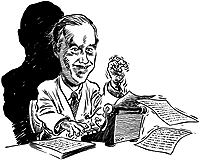
illustration by Doug Potter |
of the city hall chambers in El Campo, Texas on October 17, the months-long
hate campaign between Congressional opponents Ron Paul and Charles “Lefty”
Morris is about to get even dirtier. A mediator has signaled the end of
the candidates’ first — and only — debate, and Morris’ campaign manager
Billy Rogers has just introduced himself to Paul’s campaign coordinator
Eric Rittberg.
“Oh. So you’re Billy Rogers,” says Rittberg, who then jumps
from his chair and shouts down to the still-seated Rogers: “You owe
me an apology for calling my boss a Nazi!”
“We never called your boss a Nazi,” protests Rogers.
“You’ve been calling my boss a Nazi for months! I’m tired of this!
How dare you call Ron Paul a Nazi! As a Jew, I’ve had to live with this
type of shit for 33 years and I’m tired of it! My parents and grandparents
have gone through this! How can you sleep at night, when you disrespect
everything Jews have gone through?”
Rogers summons forth a cool sarcasm, and remains in his chair. “You
know in your heart that we never called Ron Paul a Nazi. All we did was
notify the press that his name is on the Neo-Nazi Web page. If he has a
problem with it, he should get his name off the list.”
Rogers leaves his seat, and the argument is rehashed outside, with Rogers
refusing to apologize, and Rittberg maintaining the same explosiveness before
jumping in his car and speeding away. And so it goes, this latrine-style
rumble that has even piqued interest overseas; the London Independent ran a profile on Paul and his quirky views that has some foreign readers,
no doubt, convinced that Central Texas is way out of the mainstream. And
as for the Nazi name-calling issue — it’s only the latest flare-up in a
string of accusations, inflammatory commercials, and unsubstantiated allegations
in a race that both sides admit has been unusually brutal.
“I’m for freedom of speech, even for ugly things, but calling me
a Nazi is the most aggravating, insulting thing that an opponent has ever
done,” says Paul, 60, who has seen plenty of opponents during the three
terms he served in the House of Representatives in the late Seventies and
early Eighties. “In 20 years of politicking, that’s the most despicable.”
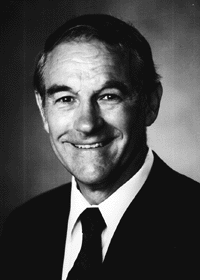 Ron Paul (Republican) |
Needless to say, this ain’t your typical race. The driving force behind
the mud-slinging is a political pamphlet Paul has been putting out for more
than a decade. In it are the unorthodox views that Paul, who switched from
the Libertarian to the Republican party to run for U.S. Representative in
District 14, has had to spend no small part of his campaign defending. When
Paul first published the monthly newsletter in 1986, he called it the Ron
Paul Political Report, but later renamed it The Ron Paul Survival
Report in these more apocalyptic days (see accompanying sidebar for
some of his greatest quotes). The newsletter includes Paul’s attempts to
further such ultra-right domains as ethnocentrism, dissolution of the federal
government, state secession, and armed resistance. And, also true to his
Libertarian roots — no matter how much it might alienate the right wing
— Paul’s newsletter includes an adamant call for drug legalization.
Advocating the abolition of federal drug laws may not sit well with the
constituents of the District 14, which stretches from the suburbs of Austin
south to Corpus Christi, and east to Houston. Austin’s local daily called
Paul the “fringe-of-the-fringe,” and it’s hard to imagine that
the farmers, ranchers, and suburbanites who populate the rural district
would embrace much of Paul’s Libertarian manifesto. Yet much of the Surfside
doctor’s platform — his insistence that the U.S. government, including
its public schools and environmental regulations, is the root of all evil
— has struck a chord. As the Republican candidate in a district where conservatives
have the edge, the polls placed Paul far ahead of his Democratic opponent
Morris, a 56-year-old personal injury lawyer from Bee Cave, by 15 points
as recently as six weeks ago, though the race has tightened considerably
since then.
Morris knows his best chance is painting Paul in all his spectacular
oddity, and he has kept the press and the public well-apprised. In May,
Morris’ staffers discovered Paul’s newsletter on an Internet directory under
the heading, “Racialists and Freedom Fighters.” Also included
were the likes of David Duke, the American Nazi Party, the Knights of the
Ku Klux Klan, and the Women for Aryan Unity. Morris let the Dallas Morning
News in on it, and the newspaper discovered that the site had been posted
by The Heritage Front, a neo-Nazi group based in Canada.
Big-city dailies and small-town weeklies across the state had a field
day, and headlines like “Morris accuses Paul of neo-Nazi association”
blared from newsstands. But publicly, at least, neither Morris nor anyone
from his campaign ever called Paul a Nazi, though Michael Sullivan, Paul’s
press secretary, claims that Morris, in his “faux East Texas
accent, tells individuals on the campaign trail that Ron Paul is a Nazi.”
Morris denies it, of course, but the real matter at hand is that Paul considers
Morris at least a tad guilty by association. After the stories flew off
the presses, Paul’s campaign faxed out a press release with quotes from
his campaign coordinator Rittberg: “As a Jew, I’m insulted by the senseless,
anti-Semitic statements.” To Rittberg, Morris was promoting “hatred
and ignorance,” and to emphasize his distaste, Rittberg showed up at
Morris’ next press conference sporting his yarmulke.
Rogers is not the only one playing up Paul’s appeal to the neo-nazis
— about a dozen volunteers with the partisan political group the 21st Century
Democrats protested Paul’s August 8 press conference at the Victoria Holiday
Inn, where Paul announced a 14-point plan for the district. Though billed
as a pledge for no new taxes, the plan took a back seat to the protestors,
who carried signs denouncing Paul and requesting that he release his newsletters
to the media. Morris had repeatedly made the same request; while he had
already provided the media a smattering of articles received anonymously,
there were years of back issues he wanted to see. For months, Paul had responded
that it is impossible to dredge up all his old writings, but he told voters
that they could request individual copies from his campaign headquarters.
However, at the press conference-turned-protest, Paul conceded to pressure
from reporters, promising to release all back copies.
But that promise has yet to come to pass. His concealment is easy to
figure: The articles that have been leaked have been an embarrassment for
Paul. In one 1992 article, Paul labeled the illustrious congresswoman Barbara
Jordan, now deceased, a “moron” and “fraud” whose accomplishments
depended on her race and sex. Paul now explains that he’s been wronged —
his “academic, tongue-in-cheek” opinions have been stripped of
their context. But when the Victoria Advocate requested the entire
copy of the newsletter, promising to publish its entirety, he refused that
too.
Other tidbits from Paul’s newsletter — also released to the press by
the Morris campaign — include inflammatory quasi factoids such as the contention
that 95% of African-American men in Washington, D.C., are criminal or semi-criminal.
He writes that he doesn’t think that “a child of 13 should be held
responsible as a man of 23. That’s true for most people.” But, he continues,
“black males, age 13, that have been raised on the streets and who
have joined criminal gangs are as big, strong, tough, scary, and culpable
as any adult and should be treated as such.” He also implied that a
mortar attack of a federal building was not such a bad thing, since no one
was hurt (see sidebar).
Then there’s his paranoia about the expansion of the federal government.
In a letter to subscribers of his Survival Report entitled “Forfeiture
Alert” and addressed “Dear Frightened Reader,” Paul warns
that the government has unleashed “forfeiture squads” to acquire
the assets of unsuspecting Americans. He advises the readers to purchase
two books that offer legal advice on how to safely move money across the
U.S. border, how to “buy and sell gold privately without leaving a
paper trail for the IRS to follow,” and how to avoid transactions that
“label you a money launderer.” If you follow the advice, it will
“make it difficult or impossible for bureaucrats… to know what you
have and where you have it,” and will allow you to “bulletproof
from seizure those assets you can’t hide.”
Paul maintains that he keeps no correspondence with ultra-right wing
organizations, and he doesn’t know how the Heritage Front discovered his
newsletter, speculating flippantly, “maybe Lefty sent the name up to
them.” As to why the neo-Nazi group was drawn to his newsletter in
the first place, he credits his strong and consistent support of individual
liberties. Paul ran as a Republican candidate against Senator Phil Gramm
in the 1984 primary and as a Libertarian against President George Bush in
1988. He believes that more individual liberty is possible by stripping
the federal government of duties not expressly stated in the Constitution.
Out the door would go the Environmental Protection Agency, Social Security,
Medicare, the Department of Energy, the Federal Reserve, the IRS, aid to
foreign nations, and the Department of Education.
Ax the Feds
To smother bureaucratic growth, Paul never voted for a tax increase in
the seven years that he served as a representative, and he was named “The
Taxpayer’s Best Friend” in the late 1970s by the National Taxpayer’s
Association. When asked for specifics on how much government he’d like to
eliminate up-front, he responds, “Twenty-five percent. If I’m in a
good mood, I’ll say 50%. I just really want to cut.” He says he mainly
wants to shift “unconstitutional” federal powers to the state
and local levels, but he clearly wants less regulation, as well. The ideal
economic period in American history, he says, was the Industrial Revolution
in the late 19th century, when the economy grew at a 10% clip, and when
there were few regulations on business and “there was no EPA.”
He has said that there ought to be no environmental regulations at all,
that property owners should be able to do anything they want on their property
as long as it doesn’t hurt neighboring properties. The views may sound extreme,
but in District 14, where property rights is king and the IRS is the devil,
a campaign to erase government bureaucracy has wide appeal. As proof of
his popularity, Paul beat four-time incumbent Greg Laughlin in the primaries,
after Laughlin switched his allegiance from the Democrats to the Republicans.
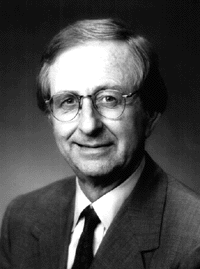 Charles “Lefty” Morris (Democrat) |
office but has provided financial support to liberal Democratic candidates
such as congressman Lloyd Doggett, has clothed himself in traditionally
Republican regalia in preparation for this race. “Lefty’s” campaign
commercials are quick to explain that his nickname comes not from his political
views, but from his days as a baseball player. And if that’s not enough,
his campaign slogan lets you know that “Lefty is Right!” Morris
sounds a little like Paul when he talks of cutting the federal government,
though he’d use a surgeon’s knife instead of a guillotine. The neophyte
politician believes the Social Security and Medicare programs must be fixed,
though he doesn’t have a specific how-to plan. He’d like to reform campaign
finance laws to remove special interest money from Congress, and to eliminate
the tax loopholes created for those special interest groups. That, he says,
will provide an additional $800 million a year that can be used to shrink
the deficit and balance the budget.
But Morris saves his most conservative side for his stance on the drug
war. To stem the flow of narcotics up Highway 59’s path through his district,
Morris proposes an FBI center in Victoria, more public funding to schools
for drug education programs, and more drug agents along the border. And
if that doesn’t hook right-wing voters, Morris has played up Paul’s libertarian
belief that all drugs should be legalized. Paul has made that call repeatedly
in his newsletter and other writings, clearly expressed in statements like
this one from Reason magazine in 1988: “All drugs must be decriminalized.”
When considered in context, the idea of drug legalization certainly has
merit, but it would seem to be politically taboo for any candidate trying
to run a serious campaign as a Republican. Morris, of course, notified the
press as soon as he uncovered Paul’s views in April, and Paul’s response
was a memory lapse of Reaganesque proportions. He said he had written hundreds
of articles and could not remember specific ones. What he must have meant,
he explained, was that the federal government should be out of the drug
enforcement business, and that state and local communities should pick up
the slack. “We’ve spent $200 billion on the drug war and haven’t gotten
anywhere,” he said. “Something has to be done.” But Morris
wouldn’t let him off that easily, and to patch up Paul’s memory strainer,
he blanketed the district (and Austin) with simple but damning TV ads showing
Paul at a National Organization for the Reform of Marijuana Laws (NORML)
conference in 1988, pounding on a podium and zealously shouting: “Let’s
get rid of the drug dealers by getting rid of all the drug laws.”
Despite Morris’ hard evidence, Paul continued to shade the truth weeks
after the drug hullabaloo — the Colorado County Citizen reported
on a political rally in Columbus where Paul stated that he had not supported
drug legalization. Though Paul’s memory lapses have been frequent, they
should not be blamed on excess marijuana use. In fact, he stresses that
he’s never seen an illegal drug and wrote in his newsletter that while he
wants to legalize drugs, he does not condone their use: “Who knows…
they might turn you into a raving liberal.” Two weeks after Morris’
ad underlining Paul’s views on drug laws, Paul wore his white physician’s
smock in his own TV commercial, promising “to get the drugs out of
town.”
Frivolous Commercials
Realizing that the best answer to attack ads are counter-attack ads —
since it can make it difficult to figure out just who is telling the truth
— the next ad salvo was launched from Paul’s camp, a television commercial
criticizing Morris’ profession and a lawsuit he once filed. In Paul’s ad,
a steaming coffee cup is in the upper left corner to stoke memories about
the million-dollar lawsuit filed by a woman who burned herself with McDonald’s
coffee. A speaker behind a news desk says, “Frivolous lawsuits filed
by greedy lawyers are one of the most pernicious evils in our society.”
He continues, “Lefty has made a career of chasing ambulances, suing
widows, and vocally opposing tort reform. If he gets in, hang on to your
wallets.” He then accuses Morris of frivolously suing a widow on a
minor malpractice claim against her physician husband, who had been dead
for 13 years.
But Morris responds that the claim against the widow, filed in Brazoria
County in the early Nineties, is far from “minor.” The suit involved
a boy who suffered permanent brain damage because the physician who delivered
him failed to order a key blood test, and didn’t warn the boy’s mother of
special care that the infant needed to guard against a rare condition. Morris
also explains that the only reason the widow was listed in the lawsuit was
because he had to sue the doctor’s estate to receive the money, and that
the deceased doctor’s insurance company, not the widow, eventually paid
the damages.
Paul has also accused Morris’ campaign of being “financed by huge
donations from trial lawyers.” Indeed, according to the Wall Street
Journal, only four other ongoing campaigns for federal office have received
more campaign contributions from trial lawyers. Morris replies that he was
the president of the Texas Trial Lawyer’s Association (TTLA) in 1983 and
1984, and has always supported their causes. But Paul also discovered, and
publicized, that Morris once volunteered as a lobbyist for the TTLA in the
mid-Eighties, and had been fined $100 by the Secretary of State for not
applying as a lobbyist. This, despite the fact that Morris has repeatedly
promised to put an “end to the undue influence of lobbyists” on
lawmakers, and has refused to accept PAC money because, he says, he will
not work for anyone’s special interests.
Paul also charges that Morris is working hand-in-hand with another interest
group, the AFL-CIO, the umbrella group for labor unions which has run commercials
denouncing Paul and supporting Morris. Paul’s press secretary, Sullivan,
complains that the AFL-CIO incorrectly states that as a house member, Paul
voted to weaken pension plans, when, in truth, the bill that he and the
rest of the house unanimously supported strengthened pension plans. Sullivan
charges that the group got its information from Morris, and didn’t bother
to check the facts. “Where do you think the AFL-CIO got their stuff?”
he asks. “It’s certainly odd that they just happen to be talking about
the same things `Lefty’ does, and using the same lies.”
While both candidates have been quick to fling accusations at each other
on the air waves, getting the two to debate face-to-face has proven more
difficult. Paul’s campaign staff refused to schedule a meeting with the
Chronicle‘s editorial board if it meant sitting down with
Morris. Paul charges that before the El Campo debate, Morris had consistently
refused to debate him “because (Morris is) afraid to discuss
issues.” Particularly, Paul complains that Morris avoided the district’s
largest debate, held in Victoria. The Morris campaign claims it was the
other way around — that in fact, Paul was the one who backed out.
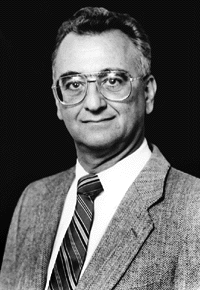 Ed Fasanella (Natural Law Party) |
may have been led to believe that Morris and Paul are the only ones in the
race — Ed Fasanella of the up-and-coming Natural Law Party wasn’t even
invited to the debate. Fasanella, 49, is a lifelong teacher and education
administrator who was turned on by the party’s focus on education. Well-versed
in governmental affairs, Fasanella would like to bring more attention to
alternative fuel sources like wind power, to reduce the country’s addiction
to fossil fuels, to see an increase in sustainable agricultural programs,
and eliminate genetically engineered foods. The party also seeks to get
the nation hooked on transcendental meditation, and more practically, reform
campaign finance laws. Fasanella acknowledges that he has little chance
of winning, but says he hopes to at least help shape the issues.
When Morris and Paul finally did debate in El Campo, the charges that
had prevailed throughout the campaign surfaced again, with Morris throwing
jabs at every opening and Paul reacting in kind. Before the show ended,
he charged Morris with remaining in college to avoid the draft — he had
seven deferrals until exceeding the maximum draft age. “Maybe he was
making trips with Bill,” Paul joked. Morris responded that as a poor
farmer’s son, he couldn’t get through school quickly because he had to work
to pay his own tuition.
After the Mud Settles
And so it goes, a classic mud-slinging bout that makes Bob Dole’s attempts
to attack Bill Clinton at their debates look like a tea party. Fortunately,
like the rest of the country, District 14 voters appear more interested
in vision than confrontation. Paul’s current vision, rather than his attempts
to conceal his past writings, may ultimately be his downfall. It’s the age-old
Libertarian Catch-22 where you have a candidate striving to be part of an
institution he abhors. If Paul is elected, he may have a tough time building
any sort of consensus in a process that demands it. As a congressman, he
was frequently in a super-minority on votes; in seven years in the House,
he never approved a single budget plan simply because they were too big.
In fact, Paul’s views are considered so far out that many in the Republican
Party are supporting his Democratic opponent. Robert Hewitt, Jr., a lifelong
Republican from Victoria, who has contributed to and volunteered on Republican
campaigns — never Democratic — for 20 years has switched gears to throw
his energy behind Morris’ campaign. He’s afraid that as a legislator, not
only will Paul be unable to get anything done, but he could actually hurt
the district’s economy with his attempts to stamp out the federal government.
Hewitt, whose work for Morris is strictly volunteer, doubts, for example,
that Paul would vote for federal funds to support the Victoria County Airport,
or the Victoria Barge Canal, which runs from the coast to Victoria and transports
products to the petrochemical industry there. “Republicans who have
worked in the party for many years have concerns about where Paul is leading
the party, and whether he’s a Libertarian or a Republican,” says Hewitt.
Paul, though, says that his Libertarian-leaning beliefs mesh well with
voters in his district who want to reduce the federal government: “If
you keep giving a finger, pretty soon you’ve lost a hand.” But he admits
that with regards to most of the government bureaucracy, “nothing’s
really going to change,” and says he’s running for Congress to awaken
the public to the nation’s demise.
Paul’s off-center views have at least done that; voters are expected
to hit the polls en masse for his fight against Lefty. And the money
continues to flow. Paul has spent about $1.5 million on his attack ads and
other campaign paraphernalia, while Morris has spent close to $1 million.
Although Paul was ahead six weeks ago, now the race has tightened. Both
campaigns claim the lead, and political oddsmakers predict a neck-and-neck
home stretch.
This article appears in November 1 • 1996 and November 1 • 1996 (Cover).