

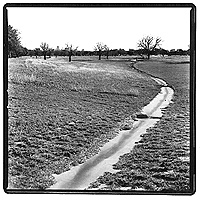
 This open field at the “Triangle” bordered by Guadalupe, Lamar and 45th Street will soon be filled with a Randall’s supermarket, a cinema, restaurants, coffee shops, various retail, and a big parking lot. photograph by Kenny Braun |
the history of Austin’s great war between developers and citizens, the “Triangle Development”
probably will not be remembered as one of the epic battles. In fact, the battle
cry of the respective generals seems to be, “Can’t we all just get along?”
The “Triangle” refers to that grassy patch of land in north central Austin
bordered by Guadalupe, Lamar, and 45th Street, which has the Austin Child
Guidance Center and the Texas Mental Health & Mental Retardation (MHMR)
Department’s Children’s Psychiatric Unit residing in its southwest corner.
The open, almost treeless patch of grass isn’t long for this world. Coming
soon to a field near you: A Randall’s supermarket, along with a theatre,
restaurants, coffee shops, various retail stores, and of course, a big parking
lot.
The incoming shopping center, to be developed by Cencor Realty Services, has
the environmentally aware, pro-compact-city neighborhood in a bit of a quandary
— after years of fighting sprawl, especially discouraging building over the
Edwards Aquifer in southwest Austin, and advocating more central city
development, they are getting their wishes fulfilled. But as they say, be
careful what you ask for, because you just might get it. More than one Hyde
Park resident, when told of plans for the Triangle, has said something to the
effect of “Yuck — a Randall’s?” often followed by “Is it really necessary to
cover up every last patch of open space in town?”
But it may not be as bad as people expect. Those same grumblings were heard
when HEB announced its plans to build Central Market a few blocks to the south
of the Triangle, at 38th & Lamar. Central Market has since gone on to
become quite a hit, popular not only as a “natural foods” grocery store, but
also a hangout of sorts, featuring an outdoor cafe and live music.
Although the wisdom of building another supermarket a mere five blocks from
Central Market is questionable — Randall’s execs must be awfully confident to
go toe-to-toe with the HEB-owned juggernaut — both the developers and the
neighborhood associations (NAs) with which they have negotiated are hoping the
area will take on a similar character — not a mere strip mall, but, as Hyde
Park Neighborhood Association representative Cecil Pennington puts it, a
“destination.”
Pennington is a planning consultant who formerly worked for the Texas General
Land Office as head of the Land Planning and Analysis program. In that
position, he became familiar with the “destination” scenario through his
involvement with the planning of the 38th Street Public Utility District upon
which Central Market now sits — a deal that also involved developers,
neighborhoods, and the MHMR. Now, he sits on the neighborhood side of the
three-way table.
He and reps from the 11 other NAs surrounding the Triangle have been in
negotiations with Cencor, a statewide developer with offices in Austin, since
late 1995, shortly after discovering that MHMR would use the property as a
source of revenue to fund halfway houses rather than for facility expansion. As
a condition for development, the state issued Cencor a vague mandate to accept
neighborhood input.
“We [the NAs] huddled… and decided what we’re going to do is, up front, tell
the developers what our expectations were,” Pennington says. “The biggest
problem that we’ve seen as neighborhoods is coming into the process too late,
and always being labeled as deal-breakers. So we created a document of what we
considered were `neighborhood compatibility standards.’ The neighborhood
leaders brainstormed… and provided this document that’s divided into land
use, traffic and access, site design, and building design, formatted with a
vision statement for each of those projects, with goals, objectives, and
actions the developer can take to secure this. We tried to make it friendly for
the developer, and it was put together by professionals — developers and
planners from the neighborhood. It’s set up to put the kitchen sink into this
thing; we went down to how they handle trash delivery.
“If we can just get 60% of this, we would have a very good project that we
would be happy with. The bottom line of this whole document is that the
neighborhood did not want a standard commercial strip center; we did not want
to see the `Golden Triangle’ [the busy retail area between MoPac and US183]
recreated at Guadalupe and Lamar. What we wanted was a New Urbanism-style town
center. Something other than drive-by retail. The project we’ve seen addresses
some of this. Whether it addresses it adequately is the question at this point
in time.”
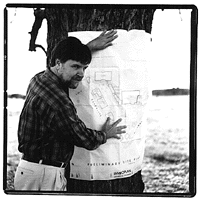 Residents acted as collabortors, not deal-breakers, in efforts to come up with the 45th Street Triangle plan that Hyde Park Neighborhood Association rep Cecil Pennington (above) displays at the development site photograph by Kenny Braun |
realty firms with which Austin has dealt, realizing that working with citizens,
rather than bullying them, is the way to go.
“Tom Terkel [Cencor’s executive vice president] has been a very good person.
He’s been open and, I feel, honest and willing to talk with the neighborhoods.
He has also been honest enough to say he doesn’t believe some of the New
Urbanism doctrine, he doesn’t feel some things will work, and he won’t try to
do it. But that’s fine — I’d rather have someone do that than try to promise
you the sun. We’ve made some improvements on what was originally put
forward.”
Terkel says that it took a while before his company and the neighborhood
representatives saw eye-to-eye. “We started from different points of view,” he
says. “We came to the process with an orientation that reflected the
experiences we’ve had in developing projects in suburban communities. The
[Triangle] neighbors that we’ve dealt with brought to the process a perspective
based on a familiarity with their neighborhood, and an appreciation for how
inner-city development should occur. There’s been an educational process. It’s
really been a two-way street, where I’ve learned a lot about some of their
ideas, many of which we now agree with, now that we understand them. And they
have also learned from us what some of the needs and requirements of the
retailers that we deal with are. We’ve blended those requirements with the
inner-city development goals that they have, to come up with a site plan that
everybody feels pretty good about. It reflects a consensus of compromise….
“The overriding thrust of the goals that we heard from the neighborhoods was
that they wanted to make our project blend in to the community, and they wanted
the buildings and the pedestrian access to those buildings to be very
user-friendly,” says Terkel, “as opposed to being a distinct, separate place
that was not user-friendly to pedestrians and considered only vehicular
traffic. I think those goals are excellent goals and are going to work very,
very well at this location. We’ve incorporated a number of changes to the site
plans to reflect those goals.”
The area is currently something of a speedway, and especially difficult for
bicycle traffic. Strong traffic-calming methods will be needed if the Triangle
is suddenly going to become a magnet to cars. Among the suggestions being
examined are grooved pavement, the noise of which theoretically would alarm
drivers and get them to slow down. A much bolder possibility that Cencor is
considering is installing raised pedestrian crossings — two-foot elevations
that could be seen as an oversized variation on the speed humps currently being
used to calm traffic in many neighborhoods, but doubling to serve both cars and
foot traffic alike. Such pedestrian crossings are already planned on the Drag
in an effort to calm UT-area traffic.
And if completely replacing the grassy field with acres of parking lot is
distasteful, some underground parking is being considered, and Cencor is
leaning towards a detention pond underneath the Randall’s as a means to handle
the increased runoff from the lot’s impervious cover. Drainage runoff is a
major concern to the North University Neighborhood Association (NUNA), which
frequently sees flooding of the segment of Waller Creek that runs through
Hemphill Park. NUNA President Bob Morse says he isn’t completely satisfied with
the runoff plans he has seen so far.
Pennington also confirms that there are still some problems. One problem
doesn’t have a ready resolution — a proposed apartment complex is now out of
the plan (as documented in a recent Austin American-Statesman article,
the local apartment market is finally starting to weaken), thus stymieing a
major mixed-usage goal. At the most recent meeting between the developer and
the neighborhoods, Cencor contemplated putting some apartments above the retail
stores, but that is still only a consideration.
Also, Pennington says, “One of the things that kept coming back was the
dominance of Randall’s, this big old store and how it fit on the site and this
big parking lot.”
Pennington says that Lamar Street neighborhoods wanted a buffer of retail
shops between them and the Randall’s to avoid having a monolithic, box-shaped
store with its back turned to them, and both he and other neighborhood reps
presented several different possibilities for this.
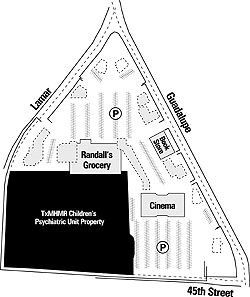 Proposed site plan for the Triangle at 45th Street, Lamar, and Guadalupe |
transit stop through [the development]. It may be that [Cencor is] just not
committing themselves to a spot at this time; verbally they’ve said they’ll do
something with transit.” (A spokesman with Capital Metro confirms that the
development won’t interfere with plans to send light rail down the Guadalupe
corridor.)
Although the major players involved in the Triangle Development have committed
to working together, one certainly shouldn’t get the impression that Cencor is
being welcomed into the area with open arms. Even some of the neighborhood reps
who’ve been making suggestions to improve Cencor’s plan admit that, given their
druthers, would just as soon see the Triangle remain open green space. Other
neighbors are flat-out opposed to the development. Elliot Young, from the Hyde
Park North neighborhood, authored an article harshly condemning the project in
(sub)TEX, a UT-based newspaper. In it, Young assailed the development as
one more step in “the mall-ification of our lives.”
“It’s something which I don’t think anyone in the community needs at this
point,” Young explains. “There’s so many other supermarkets and strip malls
that are surrounding this neighborhood. It’s something which I think will
negatively affect the community, aesthetically taking a green space away and
putting up an ugly mall.”
Another major objection from Young — and many other residents in a recent
meeting of the Hyde Park North Neighborhood Association, an auxiliary of the
larger Hyde Park Neighborhood Association — is the impact that the new
development will have on neighborhood businesses like the Flightpath Coffee
House and the Fresh Plus Grocery’s 43rd St. & Duval location.
“If there was some sort of development that had included local businesses,
that is something that I’m in favor of and people in the community are in favor
of. What we don’t want is a proliferation of more Wal-Marts or HEBs or huge
corporations that come in and don’t really give anything to the community. The
volume with which they do business allows them to undersell small
businesses.”
Young also expressed concern about the larger issue of the development — the
privatization of public resources necessitated by state underfunding of its
agencies. Cencor is leasing the land from MHMR, which has decided that it won’t
use the Triangle for expansion, and needs the cash flow that the development
would generate.
So far, though, neither Young nor any other area resident has mounted an
organized campaign to stop the development altogether.
“This is not a bad development,” Pennington concludes. “It has a pedestrian
crossing down the center, it has daytime and nighttime uses, it has a mix of
offices with retail, it does have some traffic calming and pedestrian
amenities. The question is, is that enough? And what can be done to make it
better?”
This article appears in February 14 • 1997 and February 14 • 1997 (Cover).