

|
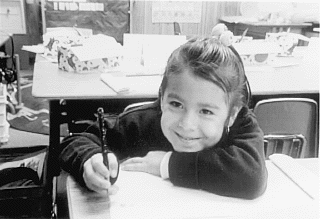
The Fenton Avenue Charter School in Los Angeles as documented in “Education’s Big Gamble: Charter Schools” on PBS this month. |
A charter school operates under its own self-developed academic and management plan, away from the prying eyes of education bureaucrats. It receives all or part of public funds on a per-pupil basis, and as such, it must take all comers. The school also has to deliver the goods scholastically, according to each state’s education guidelines, and it must, in most states, demonstrate fiscal responsibility. Other than that, charter schools in the U.S. can assume many forms — they can be non-profit, or for-profit, they can be started from the ground up or created from an existing school, they can target specific populations or academic interests, or they can use a more comprehensive curriculum. Whatever they do, the object is to innovate, and by doing so, set an example for other schools and raise the standard of public education for everyone.
Conservatives love the charter school concept because it has the potential to bust up the education status quo, especially teacher unions; liberals have long fought against charters for precisely that reason. But as charter schools have gained currency state by state, liberals have had to look on the bright side, and have decided to beat their conservative adversaries at the same game. Accordingly, teacher unions are now running charter schools in five U.S. cities. The main thing about charter schools, conservatives and liberals both agree, is that they offer “choice” within public schools, and break the mold of “one-size-fits-all” schooling. And that’s got to be nothing but good, right?
As “Education’s Big Gamble: Charter Schools” — the first of four weekly installments this month of The Merrow Report on PBS (3pm Sunday, September 7, KLRU) — demonstrates, charter schools do hold a lot of allure, and many are fulfilling their promise to do more with the same (or sometimes even less) money. But the fact that they are an alternative to regular public schools does not alone ensure success. At some point, even though they’re not running their day-to-day decisions past some central office administrator, these schools have to be accountable to taxpayers — because children get hurt when they’re not.
John Merrow, an award-winning correspondent and commentator for PBS and NPR, has tackled the subject of education in America for 23 years. This latest series (which airs in Austin on Sundays at an hour distinctly unfriendly to working parents, so set your VCRs) looks at some of the more popular issues in school improvement. In the first program, Merrow visits four schools in three states, finding both astonishing success and revolting failure.
Fenton Avenue Elementary School in San Bernardino, Calif., was once one of the worst schools academically in the Los Angeles school system, and one of the most neglected. It was granted a charter, and $5.2 million in funding, which the staff used to lower class sizes, buy computers, and repair the facilities. Fenton even runs its own food services operation, and every child is fed breakfast and lunch, regardless of income. As in more and more low-income schools, Fenton officials require uniforms and plenty of homework. Illiterate parents have the chance to learn right along with their children. Guess what? Fenton is doing very well now.
But at the “Citizen 2000” charter school, a for-profit institution in Phoenix with vague leanings toward some sort of multi-cultural curriculum, the dream was not deferred by nasty education bureaucrats, but by the woman running the place herself. Reflecting its Republican leadership, Arizona has about the most laissez-faire charter school law in the country, allowing unlimited numbers of charters, and providing few rules on how to account for the schools’ fiscal performance.
It was apparently a perfect place for Lawndia White Venerable, the principal of Citizen 2000, to swing into action, as she fudged enrollment figures in order to get more money from the state, left teachers basically clueless about the school’s discipline policy, and co-mingled the school’s finances with her own. She paid herself $85,000 ($20,000 more than other principals in Phoenix) and hired family members for her staff; when Merrow asks her why, she huffs, “They don’t ask you for overtime.” One day, in the middle of year two of Citizen 2000, the school ran out of money and simply didn’t open again. The Arizona State Board of Education did not ask one thing about what Venerable was doing, even though she made off with $4.8 million in state education dollars and had nothing to show for it. The State of Arizona has indicted Venerable on 31 counts of fraud and mismanagement of public funds. The losers? The kids, of course. “They were counted like gold, and in the very end they were treated like dirt,” laments one former teacher.
As Merrow shows us, the promise of charter schools is the freedom they hold out, but when that includes freedom from responsibility, then charter schools are a bad bet indeed. His report should help Texans remember that some gambles involving kids aren’t worth the payoff.
Programs two and three of The Merrow Report, airing September 14 and 21, deal with the monumental task of trying to reform urban education; program four, airing September 28, examines the rush to establish education standards in America.
For more information, go to the U.S. Dept. of Education charter schools Web site: http://www.uscharterschools.org/
This article appears in September 5 • 1997 and September 5 • 1997 (Cover).