

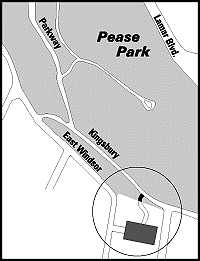
 Bobbitt asked to extend his driveway across green to access Kingsbury Road |
recuperative tone at last week’s meeting. Generally pedestrian items prevailed,
ensuring the city’s continued functioning without worsening holiday hangovers.
In the near-total absence of weightiness, a seemingly false drama was accorded
one individual’s bid to construct a driveway through a patch of unused park
land. City Hall is considered a crucible for madness, and the two hours of
ad hominem that accompanied the proposal did nothing to dispel that
perception.
But beneath the fa�ade of simplicity lay a stumping mess of legal
questions that may have meant the removal of Pease Park from public hands, and
the setting of precedent with regards to displacing park land. Greenspace is
sacred in Austin, and increasingly hard to acquire; thus, University of Texas
law professor Philip Bobbitt assembled a sterling cast of luminaries from the
Old West Austin social structure to shore up his argument that he should be
allowed to extend his driveway through a patch of unused land in Pease Park,
and persuaded Ronney Reynolds and Mayor Bruce Todd to sponsor his proposal.
All this attention for a piece of land about the size of two parking spaces
may seem strange, but the land is officially part of Pease Park, the city’s
quintessential inner-city greenway that meanders along Shoal Creek in West
Austin and is a favorite among frisbee golfers, volleyball enthusiasts, and
dog-walkers looking for a friendly no-leash area. The 425-square-foot strip
that Bobbitt wants stretches from his property line to Kingsbury Road, a length
of about 10 feet that includes land designated as Pease Park. But the greenway
that people actually use doesn’t begin until the other side of Kingsbury Road,
where Shoal Creek runs.
The fact that the strip Bobbitt wants is separated from Pease Park proper by
Kingsbury Road prompted one speaker’s assessment that the land in question is
“useless” and “trash-strewn and poison ivy-riddled.” Still, park purists like
Councilmember Beverly Griffith and other protestors would brook no concession.
Griffith and others argued that the land provides a “vegetative buffer” that
protects area residents from park noise. But the only vegetation on the
proposed site is grass, and whom that protects is anybody’s guess.
Bobbitt lives atop the hill that rises from Kingsbury Road, on Windsor Street,
amid the Alfa Romeos and the Porsches and the grand homes that characterize the
Pemberton Heights neighborhood. He, and prominent friends like radio
personality Betty Sue Flowers, complain that his current driveway requires him
to negotiate the dicey corner of Enfield and Windsor, where hurtling cars
spring from blind curves. “My late father was hit here three times,” he said at
the meeting. The Old Enfield Neighborhood Association supported the proposal in
a testimony of sympathy to Bobbitt’s predicament.
The Public Works Department reported that in less than two years, there have
been five reported accidents at the corner. Nonetheless, it isn’t considered
unsafe by state transportation standards. And although Todd repeatedly
attempted to fish a personal judgment from Public Works Director Peter Rieck on
the safety of the intersection, Rieck refused to bite, conceding only that more
“site distance” would be preferable. Nor does the Public Works Department
recommend additional safety features like a traffic light, although
councilmembers opposed to the driveway offered it as a solution.
Bobbitt will accept the traffic light; but it’s the driveway — down the hill
behind his house to Kingsbury road — that he really wants. He brought in
engineers from the high-dollar firm of Espey Huston & Associates to argue
the environmental positives of the road design, and to promise an engineering
marvel of modernity, complete with switchbacks and a 15-foot-high wall to
retain polluted run-off. Bobbitt covets the land so much that he and his
supporters argued that the proposed driveway would bring more of a residential
presence to the unpopulated Kingsbury Road, thus helping to eradicate the
prostitution and sexual activity that goes on at night in the park’s more
secluded enclaves. “This is an effort to solve the criminal problem,” he said,
referring to the possibility that lights and traffic in the deserted area would
discourage those intent on “cruising,” as Bobbitt called it.
Such expansive arguments held no quarter with Griffith, whose homework
produced key arguments that turned the scope of the debate from a simple zoning
case to a threat to all park land. For one, the park’s deed explains that if
any part of the park is not used for pleasure, it will revert to the deeder,
former Gov. Elisha Pease. Griffith also pointed out that Chapter 26 of the
Texas Parks & Wildlife Code says that public park land can only be
relinquished if there are no prudent alternatives to doing so. Griffith pointed
out five alternate routes Bobbitt could take; one included a stoplight and was
less than two minutes away. Because of the alternatives available, the Parks
& Recreation Department recommended denial.
Though Bobbitt had suggested the city lease the land to him to avoid the
latter conundrum, Griffith, Gus Garcia, Daryl Slusher, and Jackie Goodman would
take no chances and voted against the proposal. And as the councilmember who
took the vocal lead in the movement to de-pollute Springdale Park in Northeast
Austin last year, Eric Mitchell was a sure bet to side with the Springdale Park
activists who showed up to lodge their concerns about the precedent Bobbitt was
asking the council to set, leaving Todd and Reynolds on the short end of a 5-2
vote.
Though the driveway issue wasn’t life-or-death, it did prove, once again, that
Griffith is a stalwart park land purist and further put to rest widespread
concern — voiced by environmentalists during her election campaign —
that her real estate involvement and her inclusion in West Austin social
circles would limit her resoluteness. As a parks department board member for 10
years and as president of the Austin Parks Foundation, Griffith has been a lead
voice on efforts to protect the city’s greenways — witness her unpopular stand
against the Bloch Cancer Survivors’ Park last fall. In the Bloch case, the
proposed memorial to cancer sufferers at Town Lake would still have been in
public hands, but Griffith refused to give away an inch of green. In Bobbitt’s
case, where Griffith painted it as a question of one man’s convenience against
the availability of parkland for the entire city, the answer was easy. When Griffith says “park,” she ain’t talking about your car.
Also Last Week…
…Mitchell abstained. In itself, this is not news. The councilmember’soft-careless attitude makes him an devotee of the abstention — or “The big A,”
as he calls it — often after walking onto the dais at the tail-end of a
vote.
But when his insurance company, Wormley-Mitchell & Associates, has been
poised to possibly benefit from a city contract, it’s been a whole new ball
game. At least twice, Mitchell may have skirted city and state law by voting to
award a contract to one of his insurance recipients. One of those contracts
recently went to Prism Development, owned by Capital Metro Chair Michael Van
Ohlen. Perhaps because this paper criticized Mitchell for his vote, or perhaps
because election season is upon us, Mitchell, without comment, abstained last
week on awarding a $67,405 contract to the very same company — Prism
Development — for construction at the Metz and Hancock Recreation Centers.
Bravo for that New Year’s resolution.
Also, Jackie Goodman’s proposal to formulate the Conference of Texas Cities
— a coalition of Texas towns that would, as a group, hire lobbyists to protect
their interests at the lege — was delayed last week because of a lack of input
on the proposal from other cities. The coalition’s efforts would be in addition
to the $415,000 contract already awarded to Don Adams and Angelo Zottarelli for
their lobbying efforts on Austin’s behalf. (Think we don’t need more help? Just
take a walk down memory lane to 1995’s Austin-bashing session.) However, in a
short discussion, the mayor persuaded his colleagues of the need to find common
ground among the cities before funding is approved. Goodman isn’t giving up
hope, and plans to float another proposal whereby specialty lobbyists will be
hired on an as-needed basis.
This Week in Council:
Still adrift in political purgatory are two hotly contested items that willsoon reach the council dais. One is the proposal for an electric rate reduction
for six of the city’s largest electricity users (IBM, Motorola, AMD, Seton
Hospital, Texas Instruments, and Applied Materials). Consumer advocates worry
that such a move may shift the burden of paying for our debt-ridden utility to
residents and small businesses. The decision was put off in December pending a
cost of service study, which is expected to be completed this week.
Also looming is Reynolds’ proposal to revamp council meeting rules to, as he
terms it, improve protocol and increase public participation. Not all council
participants see it that way, though. Daryl Slusher requested a delay in
December to receive more input on the proposal.
This article appears in January 17 • 1997 and January 17 • 1997 (Cover).