

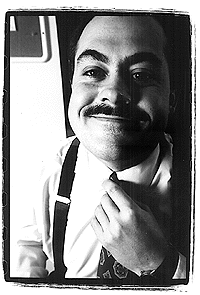
 Wyatt Roberts’ prayers for a Triangle flame-out went unanswered |
Paramount Theater late last year. She referred to the media/digital/information
continuum-thing in particular, and to the warp and woof of life at the end of
the millennium in general, where change spawns more change in a promiscuous
rite nobody can hope to comprehend all at once. Later that evening, she sang an
eerie song that described drifting in boats on a dark sea.
All of which is a useful reminder that years are merely watermarks and top ten
lists nothing more than quickly drawn charts. If this one seems more or less
adequate, don’t worry. Enjoy the illusion while it lasts; everything will
change during the time it takes you to read it. (Trends and events are listed
in no particular order. Local and national items are not separated because no
one experiences them that way.)
1. Blaming the Internet. As the ultimate version of a teeming, uncontrolled
orgy of communication — not unlike the underground press in France before the
Revolution of 1789 — the Internet provoked concern and occasionally wild alarm
among the paid gatekeepers of information. A catalog of horrors was invoked.
College students, teenagers, office workers wasting time online! Perverts
getting in touch! Bad information flowing like water! As John Schwartz wrote in
the Washington Post, “People lately are willing to make the most amazing
stretches of fact and reason to blame the Net. When Pierre Salinger held a
Paris press conference to announce what turned out to be a bogus TWA Flight 800
conspiracy that had been floating around online discussions for months, stories
in The New York Times and Chicago Tribune painted the Internet as
a conduit of unreliable information. As if Salinger couldn’t do what thousands
of others who read that message had done: dismissed it as a paranoid fantasy,
one more Net urban legend like the Neiman Marcus $250 cookie recipe.”
2. Rich Oppel, Editor in Chief of the Austin American-Statesman. The newspaper
everyone loves to malign still suffers from hidden agendas, missed
opportunities, and occasional cluelessness. None of that should obscure Oppel’s
achievement in turning it around and launching it down a better road. When
people talk about him behind his back, they describe an intelligent and
determined character, disrespectful of sacred cows and quick to fix mistakes.
(This was not the case with previous Statesman editors, to put it
mildly.) Changing the tone and direction of a large enterprise like the
Statesman is an infinitely complex task, and it takes time. In 1996, his
second year on the job, Oppel moved the behemoth markedly closer to the goal of
a sophisticated urban daily. Given the pressure he must be under from the
parent corporation in Atlanta to stay profitable no matter what, this was no
mean feat.
3. The Marriage of Time-Warner and Turner Communications. This should be taken
as a positive sign. As with the latifundias of ancient Rome, excessive
size in the world of media giants is a necessary prelude to eventual
fragmentation and collapse. Until then, the faux hipness of magazines such as
Time and the mock worldliness of news servers such as CNN will grow more
desperate and less convincing.
4. Samsung is Coming! This unfortunately titled series by the KEYE-42 news team
offered a glimpse of local television at its most shameless. Ostensibly a look
at Austin’s newest corporate citizen, it was boosterism in the raw, “news” as
pure corporate promotion, and probably a glimpse of the future.
5. KVUE-24 Listens to You on Crime. Only in the world of TV news does applying
common sense to crime coverage in a peaceful city qualify as a radical
innovation. KVUE’s new crime policy, which boiled down to “if this is just
another episode of senseless violence, let’s blow it off,” garnered national
coverage and established it as the class act in the Austin market. Amusingly,
the tactic drove its sensation-prone competitor, KEYE-42, nuts. As of this
writing, however, KEYE had taken the top ratings spot away from KVUE.
6. Liberal Media, R.I.P. When Bob Dole failed to whip up excitement over the
idea that the Liberal Media were fawning over Closet Liberal Bill Clinton, his
campaign gave way to unfettered desperation. The media fawned over Clinton
because they respect adroit powerholders, and no one outside the lunatic right
really believes in the Liberal Media any more. If there were such a thing, last
year would have seen headlines like “Contempt for poor people reaches new
heights with welfare law,” or “Overdevelopment yields bitter fruit as floods
ravage Northwest.”
7. The Triangle Survives. The current media economy does not favor the survival
of small regional newspapers devoted to a cause or an idea. Drastic,
simultaneous price increases engineered by the American paper cartel have dealt
especially devastating blows, creating huge and sudden increases in production
costs. So it was no surprise last summer when The Texas Triangle,
a weekly newspaper that brought a new professionalism to the reporting of gay
and lesbian issues in Texas, announced that it was closing up shop. Distributed
in Austin and Houston, it had survived years of shoestring budgets and a
campaign by talk radio demagogue Wyatt Roberts that backfired hilariously,
actually attracting advertisers for a time. Thus it was heartening when a show
of community support gave the paper the wherewithal to pay off some debts and
get back in the fray, resuming publication after only a few weeks’ hiatus. It
remains to be seen whether small, specific-interest newspapers can survive the
high costs of production without migrating online.
8. Saturation. Media consultants spent three times as much money in 1996 as
they did in 1992 to achieve the same wretched turnout at the polls, and surveys
showed television viewership declining among people born after the Sixties.
This should tell us something. And when a series in the San Jose Mercury
News, a small newspaper given extra clout via inspired online presentation,
inflamed black Americans with its story of CIA connivance in the drug trade
while barely causing a shrug among the majority, that should tell us something,
too.
9. Disaster. Carnage was the overwhelming motif of news coverage in 1996, and
for good reason. As planes dropped from the sky like confetti and hurricanes
reduced communities to toothpicks, they offered a welcome distraction from a
huge, complex, and frightening story that will not go away: the human
destruction wrought by the shift to a global economy.
10. Dead Media. Local novelist and polemicist Bruce Sterling and California
colleague Richard Kadrey began this inspired research project in 1995, the
results of which can be found by typing “dead media” into any search engine (a
useful though unofficial site is at www.islandnet.com/~ianc/dm/dm.html). A
perfect antidote to the hubris of media enthusiasts who think that a capacity
for relentless communication somehow amounts to a transcendent breakthrough,
this catalog of ephemera — hieroglyphics, the Incan quipu, Navajo
code-talking, the Scopitone, the Apple IIe, and dozens more — lent invaluable
perspective. Dead media litter human history, and the morgue never closes.
This article appears in January 10 • 1997 and January 10 • 1997 (Cover).