

 |
neighborhood that stands in the way of development is a nest of radicals, troublemakers,
nay-sayers. So we are told. Yeah, right.
You couldn’t ask for better irony than this: The builder/developer who gave
us Westover Hills — the subdivision covering most of the ground around
Anderson High School, up along Mesa Drive — was named Mayfield (Wallace O.
Mayfield, to be exact). If he had just gone ahead and named it “Mayfield,” with
all its Cleaveresque connotations, no one today would be marveling at the
dissonance. It’s about as all-American as Austin gets up here, from the
crabgrass to the Christmas lights to the… anti-development yard signs?
Why are these folks, living in their LBJ-era Parade of Homes creations from
Nash Phillips/Copus and Bill Milburn, born with names like “Villa Privado” and
“The Tuscany Trendsetter,” locking horns with Growth and Progress? If a new,
big-ass supermarket — an Albertson’s, the pride of Idaho, no less —
came to Mayfield, you can bet that June Cleaver would not be protesting. Nay, she would be welcoming the wider selection of mayonnaises, and
meal-fixins in a bag, and good honest work for the less fortunate. Take up arms
against capitalism in action? How rude.
But they’re fightin’ mad up here in Westover Hills, Balcones West, The
Trails, Green Trail Estates, Mesa Trails, Forest Mesa, Mesa Village, Northwest
Mesa, Northwest Oaks, Hills Oaks and back to Westover Hills — all the
mini-hoods that make up the Balcones and Northwest Austin Civic Associations,
i.e., Mayfield North and South. Or perhaps they were fighting mad, since
they no longer need to fight Albertson’s. After an 18-month battle, the last
third of which was fought en plein air and on the local airwaves, the
two adjacent neighborhood associations (NAs) managed to “Save Mesa Drive,” as
the yard signs say, when the Boise-based Albertson’s, the nation’s number-two
supermarket chain, abandoned its effort to build a 47,000-square-foot, 24-hour
superstore at the southeast corner of Mesa and Spicewood Springs Road. But
resting on their laurels they are not. “We’re very concerned about what happens
throughout the city,” says Balcones Civic Association president Laurin Currie.
“We’re always looking at how development impacts any neighborhood, and we’re
willing to go to bat for them if necessary.”
Ward and June, the avengers. Yeah, I know, I know — there’s lotsa folks
who’ll take this Cleaver business as some radical-chic insult. It is not so
intended. No one should be chastised for wanting to live in Mayfield, as
illustrated by the vigor with which folks elsewhere — say, in parts of East or
South Austin — work to make their neighborhoods more Mayfield-like than they
intrinsically are. The trouble only comes when the Cleavers use up and blow off
the rest of the world while hiding out in Mayfield, and in truth, Austin’s most
selfish, insular, apathetic, and exploitative environs are generally more
vulgar, nouveau riche, unwelcoming, and distant than the homey streets
of Westover Hills and points northwest.
But to deny that these late-Sixties subdivisions around Mesa, Spicewood
Springs, and Steck, up where the grand-bourgeois 78731 ZIP code meets the
petit-bourgeois 78759, represent, both in design and in practice, the same
mid-class, mid-century, mid-American notion of “community” that’s depicted in
Leave It To Beaver is to deny reality. These are streets where kids ride
their bikes, walk to nearby schools and join Little League, or maybe AYSO since
this is the Nineties. (Such was not always the case; as recently as the
mid-Seventies, when Anderson High was built, much of this land was The Country,
accessible only by dirt roads and home to some “undesirable” trailer types, and
thus cheaper than more genteel subdivisions closer in, much as parts of far
Northeast Austin are today.) And there’s also no denying that Mayfield has
taken quite a beating lately from prophets and sages of the New City, who blame
its class separations, its enforced isolation, its denigration of both the
built and natural environment, its dependence on single-passenger car traffic
— even the shape of its windows — for the decline of American civilization.
And yea verily, as this translates into Austin politics, the folks of the
Balcones and Northwest Austin Civic Associations have done their part to
confirm the New Urbanists’ fears, delivering their votes without reservation to
folks like Mayor Todd and Councilmembers Reynolds and Mitchell, probably the
most pro-sprawl, anti-neighborhood elected officials to disgrace the civic dais
in many a moon. (Even Bob Larson and Louise Epstein, bilious as they were in so
many other ways, usually turned their best side to the neighborhoods; in fact,
Epstein lived not far from Mesa Drive.) So when the Albertson’s thing broke
this summer, many in the Central City thought but one word: Karma. Bet you
wouldn’t be squawking if Albertson’s wanted to bulldoze the Barton Creek
Watershed, or a lower-income neighborhood on the Eastside, now would you?
Well, actually, they would, as Currie implies. “What happened to us is the
same thing that happened with BFI,” he says, referring to the Browning-Ferris
recycling plant-cum-environmental menace on the Eastside. “Someone tries to go
around, or over, the neighborhood and the citizens, and land-development
decisions get made administratively, and there’s no accountability. The people
who live there don’t even know they have a particular type of zoning, or what
rules do or don’t apply to them.”
To the Balcones and Northwest Austin Civic Associations, the negative impact
of the planned Albertson’s on Mesa Drive was obvious and indisputable, for
three main reasons. First, the lagoon of impervious cover required would lead
to drainage troubles on a stretch of Spicewood Springs Road that already has
flooding problems. Second, while most of the parcel is currently undeveloped
and addressed to Spicewood Springs, Albertson’s intended to bust through an
entrance on Mesa Drive, bulldozing some Mom-and-Pop commercial tenants in the
process.
Third and most important, the new shopping center would have generated
spectacular traffic increases on Mesa, which was designed as a residential
collector street and which, except for the few blocks around Spicewood Springs
and Steck, is Two-Car-Garage City without a parking lot in sight. (Both of
those cross streets, of course, are arterials, but even they aren’t really set
up for highway-strip traffic.) There’s already a supermarket at Mesa and
Spicewood Springs, a Randalls-nee-Safeway that, in today’s mega-market climate,
looks barely bigger than the corner store (it’s half the size of the planned
Albertson’s), plus a Walgreen’s across the street (developed by golf champ Tom
Kite and kin) that went in only after detailed negotiations with the Balcones
and Northwest Austin NAs. These and adjoining commercial islands, Anderson
High, some big churches, and the general effect of Boom II have already made
Mesa Drive traffic frustrating and frightening to BCA and NWACA members, and a
megastore is the last thing they want to see go in. (The two groups, combined,
represent residents between FM 2222, US 183, Loop 360 and MoPac, with Steck
their dividing line. By the way, before MoPac was MoPac, it was the northern
end of Balcones Drive, which now ends at 2222, but whose name persists in the
neighborhood.)
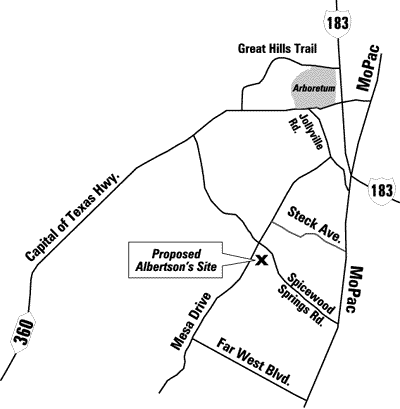 Northwest neighborhood residents worried about traffic banded together to halt the construction of an Albertson’s grocery store at the corner of Mesa Dr. and Spicewood Springs. |
story, and which ultimately makes it relevant to all Austin neighborhoods,
whatever your innate solidarity with the Mayfield milieu. Even without having
specific numbers, it would seem a no-brainer that Big Supermarket + Already
Clogged Residential Street = Traffic Nightmare, and that Albertson’s site plan
would be relegated by city planners to File 13. But whatever makes the wheels
of Austin’s developmentocracy turn, it ain’t this kind of common sense. And in
case you hadn’t guessed, Albertson’s had throughout its Mesa Drive odyssey
taken the we-don’t-care, we-don’t-have-to, screw-the-neighbors tack we have all
seen and loathed all over town.
To evade the traffic deal-killer, says Currie, Albertson’s reps, secretly and
against their word to the neighborhoods, met with city staff and prevailed upon
them to cook the Mesa Drive land-use figures. The scheme worked like this:
According to the Land Development Code (LDC), if a proposed development is
located on a street where 50% of more of the parcels within 1,500 feet on
either side are zoned single-family residential (SF-5 or lower), then the
project cannot cause traffic conditions on that street to deteriorate; if it
does, then it is disallowed pro forma, and the Albertson’s clearly did.
(The chain refused to do a traffic count in its site plan; the neighborhoods
ended up engaging their own traffic engineer.)
Within 1,500 feet of the Albertson’s site, Mesa Drive is 95% residential.
However, half of that total comprises the frontage of The Trails and Mesa
Trails, two garden-home line communities developed in the 1970s as planned-unit
developments (PUDs). Even though they’re not conventional detached housing, the
density is equivalent to SF-2 zoning (that is, about the same buildout as
Clarksville) and the residents own their lots, have separate driveways, and
otherwise conform to the conventional specs for single-family housing. But
since they’re PUDs, they aren’t technically zoned at SF-5 or lower, and this
was used as an excuse by friendly city engineers to lower the Mesa Drive
residential percentage to 48%, thus allowing Albertson’s to proceed — after,
the BCA and NWACA found out, the city engineers were paid a visit by
Albertson’s functionaries. When this made the news, and led to reactions of
chagrin and disgust from a Planning Commission who knew nothing of the deal,
Albertson’s gave up. The City Council has also amended the LDC to eliminate
this particular flavor of crap from the developer’s menu — with, to be fair,
the support of both Eric Mitchell and Ronney Reynolds, who as election time
nears are getting religion where the neighborhoods are concerned.
The fact that decisions like the Albertson’s traffic ruling can be made by
staff without their having to tell the Planning Commission and Council — let
alone the public — has galvanized the BCA and NWACA into direct engagement
with the ongoing Citizen’s Planning Committee-spawned review of the LDC. Currie
and his allies have presented three proposals for consideration:
*that administrative decisions be accompanied by the same, if not greater,
public-notification requirements that now accompany Planning Commission or City
Council consideration of planning and zoning cases;
*that commissioners and councilmembers be able to pull staff-handled items for
discussion at meetings;
*and that staff decisions be subject to a structured appeal process from
citizens.
“It’s not the staff’s intent that’s reflected in the Land Development Code,”
Currie notes. “It’s the council’s intent, and through them that of the
citizenry. We definitely need a process that allows for these matters to be
expedited, but we also need one that allows for disputes over these so-called
`minor adjustments’ to be resolved. And it would be better for the staff as
well to be able to function without being lobbied and pressured by developers
who’d rather not see issues become public.”
So, add the Mesa Drive Albertson’s to the list of projects — the Barton Creek
PUD, Bennett Properties’ Eastside Mall, and Jo Baylor’s Swede Hill homes, to
name three — where developers tried to sleaze their way around the public and
instead came up with zilch (or less than zilch, considering the damage done to
Albertson’s goodwill). Do we see a pattern here? How many times are we going to
see this repeated, with every project becoming ugly and rancorous, before the
Eric Mitchells and Jim Bob Moffetts of Austin get the message? By this point,
they’ve even got Ward and June riled up against them, which they should find
truly frightening. “The sad thing is that people are used to being defeated,”
Currie muses. “They almost expect it. And that’s got to change. We’re inspired
by our victory here that it can change. And we want to help other neighborhoods
make it change for them.”
This article appears in January 3 • 1997 and January 3 • 1997 (Cover).