

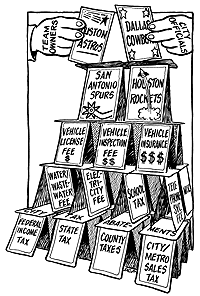
 illustration by Doug Potter |
Stars want the puck out of Reunion Arena. The Spurs think the Alamodome is too big. The Cowboys want to
fix the hole in the roof. The Rockets don’t like The Summit, which lacks
skyboxes. The bottom-dwelling Mavericks hope a new venue will help Jason Kidd’s
lousy shooting. The Astros say the 30-year-old Astrodome is an antique and they
want a retractable roof.
The whine you’ve been hearing lately from the pro sports world is the
multi-million dollar squeal of team owners clamoring for public financing of
new sports venues. And as soon as the Texas Legislature returns next month, the
owners will begin a full-court press to convince legislators that they should
allow local governments to hike taxes on retail sales, rental cars, hotels,
parking and admissions in order to finance $890 million worth of new sports
complexes.
Never mind that the Alamodome is only three years old. Never mind that when
the Astrodome was built it was considered the eighth wonder of the world. Never
mind that Dallas Cowboys’ owner Jerry Jones gets virtually all of the revenue
from Texas Stadium. Never mind that all of the pro sports venues in the state
except the Astrodome were built with public money. The owners want newer digs
with more money-making potential. And if they don’t get it, well, they just
might leave.
In September, USA Today reported that $9 billion will be spent on new
sports stadiums throughout the country before the year 2000. Of that total,
more than half — nearly $5 billion, according to a 1994 study by KPMG Peat
Marwick — will come from taxpayers.
Texas team owners will be pushing hard for their billion-dollar building plan.
Last session, the owners failed to pass a stadium financing proposal written by
Sen. Royce West (D-Dallas) that relied on creating new taxing jurisdictions in
the areas surrounding proposed stadiums. West’s bill passed the Senate but died
in the House on a point of order called by Rep. Kim Brimer
(R-Arlington),
chairman of the House Committee on Business & Industry. Brimer’s committee
has since conducted a series of hearings on stadium financing. Now, he and four
other members of his committee have written a bill that has a good chance of
becoming law. Brimer’s bill, known as HB 92, will allow voters from cities,
counties, or groups of counties, to vote on local levies.
Leading the blitz for the owners will be some of the best lobbyists in Austin.
Rusty Kelley and Jack Roberts, both of whom made last year’s Chronicle list of the 10 most powerful lobbyists in the state, are both registered
lobbyists for Hillwood Development, which is owned by the Perot family of
Dallas. The Perots also own the Mavericks.
The city of Houston, which employs another top-drawer lobbyist, Mike Toomey,
will be pushing hard for the Brimer bill. Last month, Houstonians narrowly
approved a $500 million financing package that will pay for a new $265 million
baseball stadium; Astros’ owner Drayton McLane plans to put up about
$37
million of his own money to build the retractable-roof stadium. Houston voters
also approved a quarter-billion-dollar retrofit for the Astrodome, in the hopes
of attracting a new pro football team. If the Lege doesn’t approve a financing
package, though, McLane may follow Bud Adams — who will soon move the Oilers
to Nashville — and relocate.
Jones, too, wants a retractable roof at Texas Stadium, presumably so God will
still be able to watch the Cowboys play. He also plans to lower the playing
field, put in grass, add yet more luxury boxes (the Cowboys already have the
most skyboxes in pro sports with 380) and increase seating to 104,000. The
ultimate goal, said one official close to the club, is to bring the Super Bowl
to Dallas, a move which the official said could bring $450 million in new
revenues to the city. “Sure the owners will benefit, but so will the entire
populace,” he said.
Jones would make millions off of a Super Bowl, but he doesn’t want to pay to
help make it happen. Of the five proposals evaluated last month by the state
comptroller, Jones’ plan is the only one that would be completely funded by
taxpayers.
Comptroller John Sharp’s evaluation of the stadium financing proposal shows
that public money — about $569 million — will fund nearly two-thirds of the
total construction costs of the new stadiums. Private sources will provide the
remaining $321 million.
Randy Erben, a lobbyist for the Spurs, said Texas needs a new law on funding
new stadiums because current statutes don’t allow cities to develop
public-private partnerships. He said the Brimer bill “gives cities… some
options if and when there’s collective will to proceed on a project.”
The Spurs believe a new arena will cost $100 million. But that doesn’t include
land or infrastructure costs. Leo Gomez, a spokesman for the club, says the
Spurs, who have one of the smallest markets in the NBA, want a facility with
about 20,000 seats and 60 to 75 skyboxes, which would make their home venue
comparable to the Delta Center in Salt Lake City or America West Arena in
Phoenix.
If Brimer’s bill falters, West is planning to file one that will provide state
funding for stadium construction. But most Capitol observers think the Brimer
bill has the better chance of passing since it would place the tax burden on
citizens who want the stadiums, rather than on the whole state.
But the Brimer bill already has drawn fire from critics in the hotel and
rental car industries, which don’t want to be saddled with another tax. And
Dick Lavine, a fiscal analyst at the Center for Public Policy Priorities, which
advocates spending for social services, says, “This is public money for private
gain.” Rather than compete with other states for pro sports teams, Lavine said,
“we ought to keep up on SAT scores and delivering health care to children. If
there’s money to be made, the teams will stay. We don’t have to subsidize
them.”
Comptroller John Sharp hasn’t been supportive of the Brimer bill, either. In
a cover letter to a report on stadium financing delivered to Lt. Gov. Bob
Bullock at the end of last month, Sharp said that the local tax concept
contained in HB 92 is “the best option.” But he concluded “I must tell you
that, if I were still in the Legislature, I would not vote for it.”
Sharp might not vote for it, but many legislators probably will. HB 92 is
certainly not a slam dunk — few bills are — but when pro sports teams want
new venues, they usually get them, regardless of how much the public has to
pay.
This article appears in December 20 • 1996 and December 20 • 1996 (Cover).