

by Mike Clark-Madison
photos
by Kenny Braun
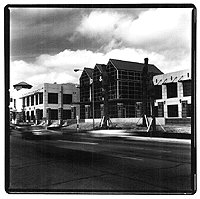 The new digs of |
Austin yesterday. Austin Tomorrow, you may know, is the city’s official
comprehensive growth and land-use plan, adopted in the mid-1970s, still in effect
despite several efforts to replace it, and nearing the end of its intended
lifespan. Now, looking around at your city, “planned” is likely not the first
adjective that springs to mind. Most of the many, many nostrums and prescriptions
of Austin Tomorrow were routinely and shamelessly ignored during two decades of
Boom and Bust and ReBoom. As a result, many Austinites — especially the ones who
build things for a living — tend to dismiss Austin Tomorrow as a joke, and the
entire concept of comprehensive planning as a fool’s game at best, a violation of
sacred rights at worst.
Even supporters of a well-designed and livable city
have learned to avoid what Statesman columnist Susan Richardson last April
termed “the M word” — master-plan. “Austin seems to like plans that go nowhere,”
Richardson recounted. “What we have instead is just what the Austin Tomorrow plan
wanted to avoid — a city that mushrooms along U.S. 183 and… over the Edwards
Aquifer…. [Government] policies unevenly promote sprawl, rather than redirect
growth to the inner city.”
This implies, accurately, that the goals of Austin
Tomorrow, while never practiced, have never ceased to be preached. When the
plan’s citizen-authors divided the city into priority growth areas, they made
central-city rehab No. 1 and put westward sprawl at the bottom — even proposing
building moratoria in much of what is today MUDville — and we all know how well
that promise was kept. Yet today central-city rehab is, or at least
seems to be, the leading edge of the ReBoom. Our fair city — which has been
irrevocably transformed, politically, culturally and demographically, since 1977
— has lost patience with sprawl on the fringe and decay in the heart of town.
Austinites old and new now clamor to work, sleep, eat, shop and party
here, rather than in the next county. We want inner-city land to be used
more pleasantly and productively than for surface parking lots, obsolete
airports, dormant state property, and crumbling disasters of urban renewal. And
we want to drive a stake through the heart of the unsustainable sprawl economy
that has laid waste to both town and country.
In short, we want infill and we
want it now. While not synonymous with central-city redevelopment — which can
take forms other than new construction on abandoned in-town sites, a stricter
definition of “infill” — the I word has replaced the M word as the mantra among
Central Austin’s residents and neighbors, planners and defenders. But is what
we’re seeing the answer to 20 years of prayer? We have a lot of sticks in the air
and proposals on the drawing board, but we still don’t yet have a plan — tying
these projects together and pointing toward future ones — that packs any more
heat with the powers-that-be than did Austin Tomorrow.
And as we address, ad
hoc, the issues raised by each high-profile central-city infill project, we
realize how many problems are still begging to be solved. Such as:
What level
of density will we accept in Central Austin neighborhoods? Will everybody need,
demand, or deserve a place to live in the heart of the city? What kind of
businesses do we want and need downtown, and do we want them to abandon the
fringe bastions they hold now? How much of what has survived in the central city,
both physical and social, is worth preserving, and how gracefully can the rest be
transformed? Can we create a climate, let alone a Land Development Code, where
the “brownfields” of the inner city are routinely more attractive to developers
than the “greenfields” of the perimeter? And how do we put all these elements
together into communities that actually improve on the status quo?
Ideally, it
wouldn’t just be us asking these questions — it would be the
decision-makers within government and in the real-estate community. We can look
askance at oft-touted progressive-planning models like Portland, where city
planning is a pastime and “sustainability” an unquestioned dogma, as the products
of values that Austin would never wear well. But throughout the globe, even in
the darkest corners of the sprawl economy, the jig is clearly up for the kind of
development that’s defined Austin for the last quarter century. Though Austin is
a nationally recognized nerve center for the sustainability movement (such as
green building, organic farming, alternative transportation, and compact city
planning), as far as public policy and the local market are concerned, we are
still well behind the curve. Today’s infill boom offers us hope that brave, or
canny, or even flaky developers may teach by example what Austin Tomorrow failed
to instill as ideology. As from corner to corner we put sprawl on trial, we
inevitably put infill on trial as well.
Exhibit A: Sixth & Lamar
When we say “central city,” weusually mean the more central, the better, and downtown has for decades — even
before Austin Tomorrow — been the horse that has dragged Austin’s planning
wagon. In plan after plan, delivered by more consultants than Crayola has colors,
the downtown vision has included not just commercial, but retail, residential,
and public components. The likeliest, and occasionally the overtly cited, model
is something like downtown San Francisco (the triangle between Van Ness, Market,
and the bayfront) — home to all of Fog City’s skyscrapers, all its destination
retail, many of its entertainment and tourist attractions, most of its public
institutions and more than a fifth of its residents. (And more than a few
downtown-renewal consultants.)
This would indeed be dandy, but most cities,
Austin included, are having a hard enough time keeping their commercial sector
from avoiding the central business district with its expense, traffic
congestion, and strict zoning regulations. Which makes the scene today around
Sixth & Lamar worthy of attention. The most visible recent construction there
is retail — the Whole Foods/Book People complex — and the most anticipated
draft project is residential — the Perry Lorenz/Robert Barnstone condo
development on the southeast corner of Ninth & Lamar, across from the old
Whole Foods site. But the most important infill project may be purely
commercial — GSD&M’s new Idea City on Sixth Street, one block east of Lamar.
When’s the last time we saw a major Austin firm relocate its headquarters, and
300 or so employees, from the fringe (Loop 360 South) to the inner
city? Combine GSD&M with the top-floor home-office staff of Whole Foods
Market, also formerly ensconced out Westlake way, and you have signs of a trend
that — if it takes off — promises to revitalize downtown more than any shopping
mall ever could.
The new digs of Austin’s largest advertising agency embody
both the practicalities and idiosyncrasies of the infill boom. “It was a
difficult project, but I think we were pretty fortunate with GSD&M,” says
Milton Heim of RTG/Partners, the architects behind Idea City. “Our client was
well-suited to go down there; they wanted a `downtown’ image because they’d been
in the suburbs for so long.”
Undeniably, GSD&M’s demeanor as a creative
hotbed fits in well at this Central Austin crossroads next to Whole Foods and
Waterloo Records, just as Idea City’s loud, proud, and angular facade blends well
with this noisy, congested, but nonetheless fairly happy corner, which will soon
feature a multiplex movie theatre as well. (Compare this corner to, say, U.S. 183
and Spicewood Springs Road, which cannot help but depress.) But in a less
cultural vein, GSD&M is exactly the sort of soft industry that could
brainstorm Downtown as easily as in an ETJ office park. Such is the main plank of
the downtown strategy in San Jose, which — left with Austinesque office-space
vacancies and unbuilt dead zones throughout its skyscraper strip — started
seducing high-tech firms from Silicon Valley, like Adobe Systems, with the same
sort of abatement packages we use to move companies like Samsung into the
‘burbs.
“There’s other clients, mostly in the service and high-tech sectors,
for whom we could have done the same thing,” says Heim. “The acreage we used up
isn’t very intense given the number of people. You could find others, but then
you get into real economic issues — building parking garages, the cost of the
land itself, the impact of traffic generation, which for our project was much
less than it was for Whole Foods. Many companies will quickly conclude that the
perimeter is cheaper.
“And zoning is an issue too — the city’s going to have
to be more flexible in the future,” Heim continues. “But GSD&M adds some
critical mass with 300 people moving in; I think it’s made it easier for the next
person, and I hope the city looks at it that way. And I hope the banks that need
to finance this development look at it that way, too.”
Exhibit
B: Jefferson on Congress
Ah yes, those pesky banks. We all know how,after their libertine days during the boom and the financial meltdown that
followed, Texas lenders drew their credit criteria tighter than a clamshell,
unwilling to touch projects with even a whiff of risk. No one knows this better
than Austin’s renters, who watched in undisguised horror as apartment
construction came to a standstill despite massive increases in demand, while
existing properties — including much of the central city’s rental stock —
decayed at warp speed, trapped in deferred-maintenance hell while locked up in
bankruptcy court, RTC inventories or the ever-revolving portfolios of banks that
bore different names every fortnight.
Now that the financial industry has
settled down a bit, with investors and large depositors in these banks itching
for a place to park their money during an interest-rate drought, apartment
construction has resumed in Austin at a healthy pace. Much of this building is
still on the perimeter, ostensibly cheaper and less dangerous, and certainly less
troublesome, than residential infill. But several highly visible projects aim to
pry open the inner-city market by combining key locations with deep developer
pockets.
Few pockets are deeper than those of JPI, the Las Colinas-based
proprietor of megacomplexes throughout the Sunbelt, including several in
Northwest Austin, and routinely among the top five builders in America of new
apartment units. When JPI gave birth to Jefferson on Congress, south of the river
across from the School for the Deaf, the door leading to the day when infill
projects are routine swung open a little wider.
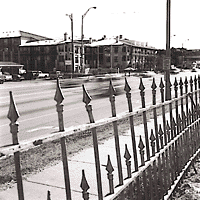 Jefferson on Congress luxury apartments |
developments like The Gables, next to Central Market, or the Lorenz/Barnstone
project at Ninth & Lamar, Jefferson on Congress — as a beachhead of a major
corporate builder, presumably unswayed by the romance of local planning vision —
gives grounds for real faith that living in Central Austin is not limited to
members of the venerable central-city subculture. (This is, of course, the same
subculture, of which the Chronicle is the putative house organ, that has
kept the visions of Austin Tomorrow on life support throughout two decades of
abuse. But if the prog-left-hippie-artist-student ‘n’ faculty scene were strong
enough to keep Central Austin alive and healthy, there would be no need for, or
talk of, an infill boom.)
Presumably, the current and future tenants of
projects like Jefferson on Congress will come from a pool of citizens immune to,
or unable to afford, the charms of Central Austin’s established neighborhoods,
where such amenities as a sound roof and foundation, central air and heat, and
freedom from vermin are often not standard features. In a part of town where even
crappy hovels are scarce and dear, JPI is banking that its lux interiors and all
mod cons will bring into the core folks who’d otherwise be living on the fringe.
It probably has no choice in this strategy, since in Austin as in most of the
country, renting at upscale developments like Jefferson, regardless of their
location, is more expensive than buying in a subdivision.
JPI marketers,
quoted in 1995 in American Demographics, note that today’s apartment
business throughout the country “is an amenities battle and a service battle.
It’s tough out there.” The AD article notes that, due to the increased
cost of building nationwide, developers of new apartment complexes have to target
the upper 25% of the renter market to have any hope of profit. This fortunate
fourth has traditionally been ill-represented in Austin, where the rental market
has mostly been dominated by students and low-wage government workers, and where
the baby-boomers with money are more prone to have kids, and thus homes, earlier
than elsewhere. The ReBoom, however, has done much to change that tune. Even if
high-techers are induced to relocate from California or New York or Massachusetts
by Austin’s more realistic potential for home ownership, they have to live
somewhere in the meantime. And for people used to hour-long commutes into town, living in the center and driving out to their chip plant on the fringe
makes no less sense than being trapped by traffic in Cedar Park.
But of
course, Jefferson is selling more than just this kind of logic, even if they
aren’t selling the traditional Central Austin subculture. The billboards read
“Downtown Living with an Uptown Attitude,” and there’s nowhere else in town where
you can live in an apartment complex with a health club and concierge service
and walk to the Continental Club. If indeed Jefferson on Congress becomes
a template for the Central Austin multi-family project of the future, it can’t
help but rewrite our definition of who, as well as what, makes up our city
within a city.
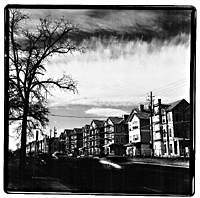 The Gables condos next to Central Market |
Exhibit C: Central Park
Even if Old Central Austin isn’t bigand strong enough to support a healthy urban core, it’s plenty big enough to
support Central Market, which over the past three years has become an Austin
landmark with far more semiotic power than most any grocery store anywhere.
Having succeeded — at least, according to recent market-research reports, in
public perception — in whipping Whole Foods’ hippie ass on the retail front, the
Central Park development anchored by Not-Just-Any-Old-HEB is now expanding its
scope to include The Gables and other building blocks of a multi-use
community.
The 38th Street PUD, known to laypeople as Central Park, is
doubtlessly the granddaddy of the current infill boom, having been proposed in
1991 when no one in their right mind wanted to drop money in what all hands
thought was a dying central city. Had the PUD not been proposed for public land
— the underused corner of MHMR’s Austin State Hospital facility — it would
never have happened, period. If a private lender had been interested, they would
likely have been scared away by the then-substantial objections of local
neighborhood associations and their members, who were displeased with the PUD
from the git-go and downright inflamed when a destination-retail magnet erupted
within its original master plan. Today, of course, folks in Hyde Park and
Rosedale are noticeably less aggrieved by Central Park, since they shop at
Central Market as much as anyone, if not more, even though it has indeed
generated every bit as much traffic as they feared, and clearly changed the
character of the area.
It’s easy to read the initial objections to the 38th
Street PUD as exactly the sort of NIMBY nay-saying pointed to by the real-estate
industry and its political lapdogs as an impediment to infill. If you build on a
greenfield in the perimeter, the neighbors — many of whom have four legs, or six
legs, or wings — don’t object, unless they’re on the endangered-species list and
have public defenders to object for them. And it is undoubtedly true that, in
most cases, neighborhoods will eventually become accustomed to whatever is dumped
upon them, just as the Inner East Side has gotten used to Disch-Falk Field and
the Erwin Center, just as the other side of Hyde Park — after much now-forgotten
strife — got used to Hancock Center. (See “Corner to Corner,” p.26, for more on
Hancock then and now.)
But what’s happened with Central Park, and indeed what
happened to Hancock, is more than just grudging tolerance. These projects have
been adopted by their neighborhoods as enhancements and landmarks. “We’ve been
very lucky in the case of Central Market,” says Ben Heimsath, who in addition to
being a pivotal figure in the compact-city public-policy debate is a past
president of the Hyde Park Neighborhood Association. “HEB and C.P. Oles [the
developer] did an excellent job putting the commercial strip together — even
though it deviated from the master plan and caused some consternation for the
neighborhood. Overall, it’s definitely helped the local neighborhoods. If you
stay still, you’re going backwards — there have to be new things in order
to have either rebirth or continued vitality.”
This is not to say that the
“compatibility” issues raised vis-a-vis Central Park were not worth raising.
Unlike Sixth & Lamar, which despite being a key traffic nexus generated,
before its recent projects, little traffic itself, 38th & Lamar — also a key
crossroads — was already home to Seton Hospital, one of Austin’s largest
institutions of any kind. Since 1991, area residents have wrestled not only with
Central Park, but also a major expansion of Seton which never happened, and later
the Heart Hospital, which after site-plan wrangling and financial troubles for
its parent company may also not happen. A spit to the north is the Triangle
development (see accompanying story), which promises to generate plenty of impact
itself.
Though neighborhood activists are often depicted by developers as
fickle and unpredictable, ready to wail like banshees at any infill project for
whatever reason seems handy, there are only three ways to really piss a
neighborhood off. One is to destroy its cherished local landmark — a tree, a
park, an old house. Another is to expose it to real danger — flood waters,
escaped felons, toxic waste. The third is to increase traffic, and this is a big
problem for most infill projects — even, as we saw in last year’s Mesa Drive
battle, outside the inner city proper. Almost by definition, most private-sector
projects, whether commercial or residential, get built along major thoroughfares.
The problem with infill begins when the streets of established intown
neighborhoods become major arteries. Infill development often puts more cars
where they’re least wanted, at least in the absence of any real transportation
alternatives, and that includes Capitol Metro. That may change if and when we see
light rail, but that debate is open to all comers, including folks who at
the moment have little concern for the central city, certainly none that connects
to the interior of their wallets.
Exhibit D: East 11th Street
The city-at-large also gets afree pass into public-sector development debates, and East 11th Street — the
southern frontier of the historic Robertson Hill neighborhood — has been Ground
Zero for such debates for decades.
Of course, the rancor generated by the SCIP
(Scattered Cooperative Infill Program) housing developments, the Austin
Revitalization Authority, and damn near everything else built or proposed for the
Eastside, transcends mere squabbles over land use, hewn as each project’s
outlines are by conflicts over color, class, crime, and corruption. But the
ongoing drama of East Austin revitalization is also about land use, and it too
puts infill on trial. The terms are somewhat different, given the scale of the
envisioned changes to East 11th Street — while even a project the size of
Central Park is still part of an existing neighborhood, SCIP II and the
ARA could in effect create a new neighborhood on the bones of an existing one.
This naturally torques folks on the Inner East Side who think the area has
prematurely been declared defunct, but Robertson Hill clearly has problems that
Rosedale doesn’t, and the goal of reinventing, rather than preserving, the
district is not an entirely specious one.
As the SCIP and ARA bump along at a
glacial pace, though, they inevitably project two different and incompatible
visions of a New Robertson Hill, both of which also grind against other goals for
a renewed central city. When SCIP II was first proposed years ago, before any
hint of an infill boom or much talk of downtown renewal, there wasn’t much
disagreement that lower-income residential development was, if not the highest
and best use, certainly the most likely and practical use for the Inner East
Side. So block after block of substandard housing between 11th and 12th Streets
was taken over by the city, slated for replacement with what are basically
suburban ranch homes, such as the SCIP I project had built further along 11th
Street in Blackshear. Aesthetically, this may seem stupid, but it’s happened all
over the country, and while SCIP I’s “Heritage Heights” may not be everything it
could be, its location — walled off from the world by Huston-Tillotson,
Blackshear Elementary, and the State Cemetery — helped ensure that it wouldn’t
do damage.
By the time the ARA came along, however, much had changed, and SCIP
II now seems way out of step. When Eric Mitchell ascended to his aspired status
as Eastside potentate, his plans for Robertson Hill were clearly commercial — a
district that, if not actually part of downtown Austin, was adjunct to it, with
chain-store retail, big office buildings, and lots of surface parking. This
created actual physical conflict over land use with Mitchell’s allies behind SCIP
II, who’ve since had to expand their project into adjacent neighborhoods to free
up their suddenly more desirable Robertson Hill land for a commercial corridor.
Still unresolved is the conceptual conflict it creates, as SCIP II is now faced
with marketing low-density single-family homes in a neighborhood that’s being
born with its own set of nasty impacts. Will the owners of SCIP homes have any
recourse to challenge the scale and scope of ARA projects? Probably less
recourse, at best, than Rosedale or Hyde Park.
This is depressing, especially
given that the trends and movements that have borne the notion of a compact city
— traditional town planning, New Urbanism, mixed use, urban villages, call them
what you will — offer an obvious solution to this dilemma. By reconfiguring SCIP
II as a higher-density development, incorporating multiple uses from its
inception, you have a much better fit with the ARA, and by reconfiguring ARA as a
mixed-use suite of projects, offering housing and community retail services
instead of a cryogenically preserved highway strip, you move much closer to the
ultimate goals of SCIP II. If we were talking about purely private-sector
developments, this would already have happened, even if not through a global
plan. But because both of these projects use public funds with their inherently
limited wiggle room — and have been tailored and re-tailored to best fit the
most easily obtained federal funding — their transformation, and inevitable
delay, carries political liabilities that most of their backers would rather not
face.
The Closing Arguments
Trying to turn such dreadnoughts asSCIP and the ARA around is much more difficult than starting with New Urbanist
goals at a project’s inception. The new big-daddy infill project on the block —
the potential redevelopment of Robert Mueller Municipal Airport — has already
been well-defined as a multi-use urban village even before a single architect has
put pen to paper. And if and when the state finally lets go of Camp Mabry —
which may happen as the entrenched neighborhoods around the site see their own
complexions and needs change — you can bet that what goes there will be more a
product of today’s and tomorrow’s trends than of yesterday’s
tried-and-supposedly-true strategies.
While Mueller and Camp Mabry aren’t
exactly greenfields, they do offer the same tabula rasa to developers as
does the perimeter, and the tendency for developers to want to start with a fresh
greenfield rather than building within brown areas has been the standard knock
against New Urbanist projects like Seaside, Florida and Memphis’ Mud
Island/Harbortown. No one quite knows yet how to bring the same mix of residents,
businesses and land uses that used to define every American town back to
neighborhoods from which either people, or commerce, or public space have been
driven. “We’re still seeing piecemeal projects — we don’t know what it means to
have new developments work with different structures in existing areas,” says
Heimsath, who as chair of the Citizens Planning Committee (CPC) is the latest
planner/architect to joust with official planning dragons on the central city’s
behalf. “We still have no idea whether these projects are repairing
neighborhoods, or harming neighborhoods that need to be protected, or just doing
nobody any good.”
Supposedly, that’s what master-planning — the M word — is
supposed to resolve, though most of what we know as “master planned communities”
are gated, homogenized, greenfield enclaves, designed to avoid the collision of
uses you’d expect in a central city rather than to resolve them. But the notion
of master-planning an existing neighborhood, identifying what sorts of projects
will work to fill in its particular blanks, is a valid one that is practiced
throughout the globe. As part of the CPC’s implementation process, the city’s
planning department will select two neighborhoods to work with to create such
neighborhood plans, which would be written into the Land Development Code.
Over time, as every neighborhood does its own plan, the results would comprise a
real, comprehensive plan to succeed Austin Tomorrow. The late-1980s Austinplan
effort attempted this level of specificity — the city was broken into sectors
and subsectors, with guidelines identified for basically each block — but that
top-down, one-shot approach, though it involved the input of thousands of
citizens, helped lead to the public perception of Austinplan as an unworkable
behemoth, which is how developer interests were able to get it shelved at the
eleventh hour before its adoption. As well, the primary variable in Austinplan
was density, without much consideration of types of land use. “We want to weave a
tapestry from the back side,” says Heimsath. “We don’t want to try to envision
the entire city in advance. By taking baby steps, we can deal most effectively
with all the issues that make up a neighborhood vision — service delivery and
character as well as land use.”
Even with general public and political support
for the CPC, and an apparent commitment to making its proposals happen (if only
to avoid the embarrassment of yet another vaporware plan that gets announced but
never implemented), there are still plenty of quarters in Austin where this type
of planning is considered radical. Certainly, it hasn’t been followed with the
City’s own sponsored projects on the East Side, or with its tax-abatement policy
that promotes useless and wasteful sprawl better than any plan ever could. And to
the degree that a compact city is the goal, it’s still appallingly easy for a
developer to avoid doing anything to achieve that goal. The city’s incentive
program for “central urban redevelopment” (CURE) offers fee waivers to developers
that maybe, on a major project, amount to a day’s worth of tax breaks for
Samsung.
This we all understand, but we must acknowledge that Austin is
treading water, with a more retrogressive and, at times, downright corrupt
planning process than not just Portland, but cities all over the country. Part of
this is because Texas is backward as a whole; when California and Florida —
which owe much of their existence to the sprawl economy, developer pillage and
senseless and wasteful growth — start talking at the highest levels of
government, Republicans as well as Democrats, about sustainability and compact
cities, you know the jig is up. As the report of California’s Little Hoover
Commission — handpicked by a GOP governor famous for mainlining real estate PAC
money — neatly put it, “We must either change or die.” We are probably at least
a decade from seeing similar trends out of Texas state government. But even
Dallas and Fort Worth are more hip to the need for better and wiser development
policies, or at least aren’t willing to foster growth throughout the Metroplex at
their central cities’ expense.
It may be shameful enough to be less
progressive than Fort Worth that Austin’s civic powers will get off the dime
where sustainable development is concerned. But perhaps the ad hoc and
entrepreneurial approach taken during the current infill boom is more in keeping
with our character after all, progressive and liberal though we may be. “I’m
pleased, actually, that people aren’t waiting for the legal and regulatory issues
to sort themselves out,” says Heimsath. “We’ve actually embarked on the vision
and the experimentation, and we’ve benefitted from local investors who might not
be looking for what others would call `highest and best use.’ There’s different
options now, and thankfully we have people who have an emotional and visionary
connection to our city, who are more interested in doing than in just
talking.”
This article appears in February 14 • 1997 and February 14 • 1997 (Cover).