


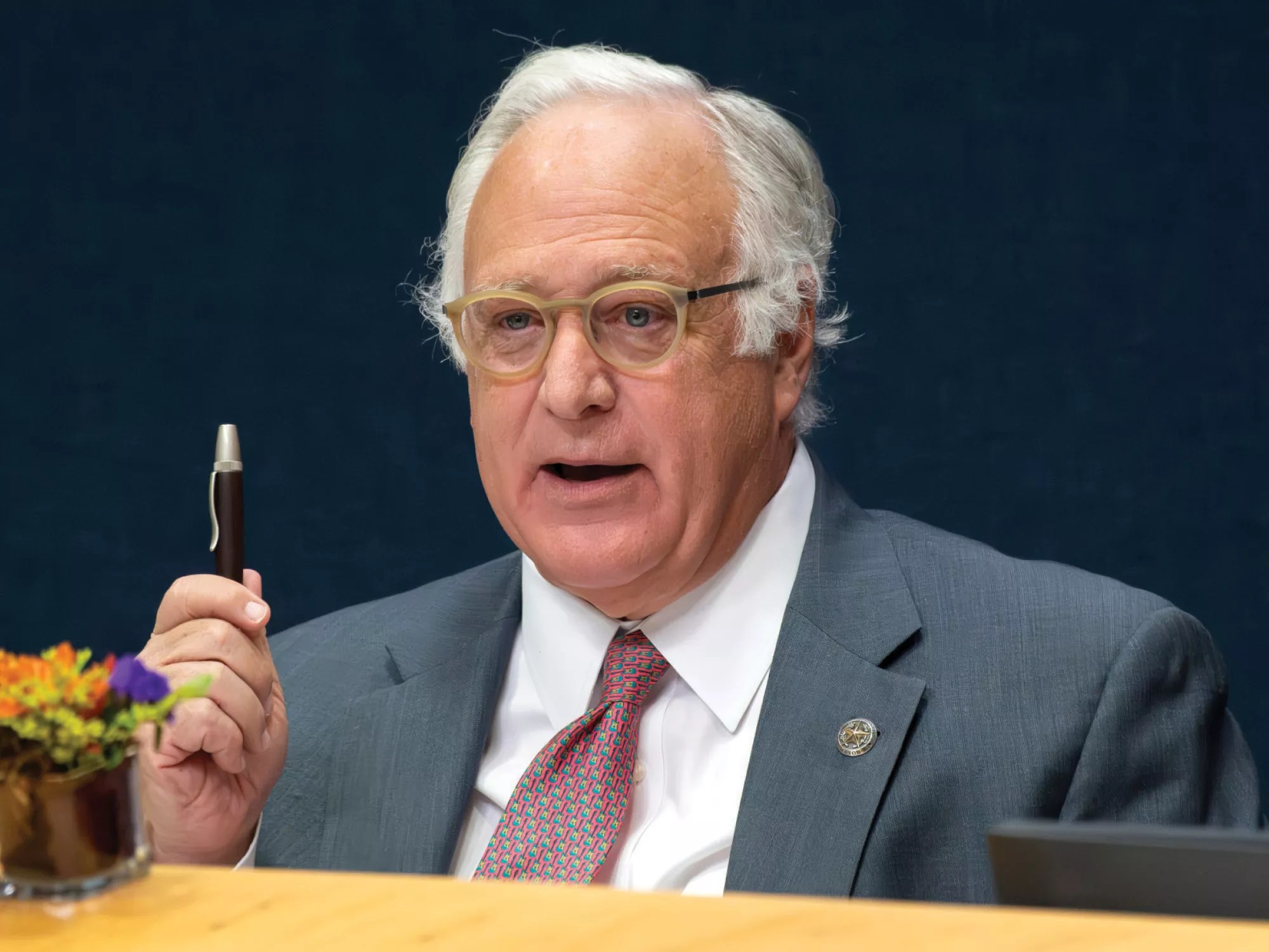
Since he began his second stint as mayor in 2023, Kirk Watson has been considered a pragmatist, a problem solver. So the way he talks about homelessness is a bit surprising. Watson doesn’t open with how much money homelessness costs Austin residents or how it affects the city’s image. He begins by saying it hurts people.
“I truly believe that we have a humanitarian tragedy here,” Watson told the Chronicle in early September. “And we’re the only ones in a position to fix it. The federal government is cutting assistance programs, including rental assistance. The state is essentially doing nothing – it’s providing us no tools, no money, even in a time of great surplus – and it is going to make homelessness worse. We need to be prepared to try to help.”
The city’s homelessness problem is the principal reason Watson is asking Austinites to vote to raise property taxes. This summer, he and nine of the 10 City Council members passed a budget for the 2025-26 fiscal year that calls for a tax rate election in November. If voters approve the TRE, the city will increase taxes 5 cents more than state law would otherwise allow on each $100 of property value. A person who owns property worth around $500,000 would see an increase of $300 on the city’s portion of their annual property tax bill. Two hundred of those dollars would come from the 5-cent TRE. Advocates for the TRE kicked off a campaign this month – the “Love Austin So Much” Proposition Q campaign – to convince voters to support it.
If voters approve the tax, it will bring the city an additional $110 million. The extra revenue would go to public safety, like extra EMS technicians and 911 responders. It would go to parks and pools. It would go to programs that combat family violence and help people recover from trauma. It would go to a grab bag of small projects designed to save the city money. But about half of the additional money – $51.5 million – would go to getting homeless people off the streets.
Fewer Homeless People on the Streets
Homelessness was already a problem during Watson’s first go-round as mayor in the late 1990s, but it had become much more divisive by the time he ran again in 2022. The year before, Austin voters had overturned a 2019 city ordinance which briefly decriminalized camping and panhandling in public places. The ordinance led to homeless people pitching tents in parks and becoming a constant presence Downtown. After his election, Watson pledged to honor the voters’ decision to ban camping, but he also wanted to reorganize the city’s provision of homelessness services, which were spread across different departments and not tightly coordinated.
“I felt like the system was badly broken, and it even kind of set us back in terms of our city’s empathy toward people that were homeless,” Watson said. “It was disjointed. It didn’t focus on the entire continuum of needs that people have. Every department had something they were doing in homelessness, and it was not organized in a way that was going to get us good results. So one of the first things that we did was we set up a Homeless Strategy Office.”

The Homeless Strategy Office came online in November 2023 and brought the city’s various efforts on homelessness into one department. This April, the HSO released a plan urging the city to invest in the entire continuum of homelessness services, from helping people avoid becoming homeless in the first place to providing long-term housing and services for those who have lived on the streets for years.
The plan distinguishes between what it calls downstream, midstream, and upstream interventions. Downstream interventions are what most people imagine when they think of homelessness services. They are long-term housing, known as permanent supportive housing, and shelters, like the Austin Resource Center for the Homeless, the Eighth Street Shelter, and the Marshalling Yard. These shelters provide wraparound services – showers and restrooms, three meals a day, health care, and more. The comprehensive nature of the services makes them expensive. Together, the shelters and permanent supportive housing account for close to half of the budget’s homelessness funding.
Midstream interventions are a more recent approach to homelessness and are less expensive. They include rapid rehousing – a strategy to move people into apartments and help them to become self-supporting quickly – along with emergency shelters and short-term housing. These kinds of services are currently provided at the city’s Northbridge and Southbridge shelters. Council Member Chito Vela described the Northbridge Shelter, located in his district near St. Johns Avenue and I-35: “It’s an old hotel that we bought and converted, and it’s got 60 to 70 rooms,” Vela said. “They take a camp, and they basically put the camp into the hotel and get them into living indoors with rules. They’re usually there for about 180 days or so.” The new budget provides $3 million for such shelters and $12 million for rapid rehousing.
And then there are the upstream interventions, designed to keep people from falling into homelessness in the first place. Council Member Ryan Alter told us the city has never consistently funded these kinds of interventions, but they are very effective and much less expensive than shelters. Alter described an upstream homelessness initiative in his district called the Wayfinder program, run by the Sunrise Homeless Navigation Center.
“Someone comes to them and says, ‘I just lost my home, and I would get myself into another home, but I don’t have enough money for the security deposit,’ or, ‘I have an outstanding utility bill that’s preventing me from getting a utility hookup.’ And so Sunrise says, ‘Great, you go find an apartment you can afford and qualify for, and we’ll cover that marginal cost.’ And they have gotten hundreds of people into housing, and 94% of them have stayed housed. It only costs about $800 a person, and that’s a one-time cost, as opposed to waiting a year for them to languish on the streets and us having to spend $35,000 per year to get them housed.”
During the budget negotiations, Council Member Vanessa Fuentes was a strong advocate for the city’s Family Stabilization Grant program, which operates in a similar fashion. Run by the nonprofit UpTogether, it provides no-strings-attached money to families who experience sudden financial emergencies. “It recognizes that many of our families are living on the edge, meaning that they are one emergency away from falling into homelessness,” Fuentes said. “They have an unexpected medical bill pop up, or the car breaks down, or they need to pay for child care that month, and they can’t make ends meet. And oftentimes, when you don’t have stable income, you resort to desperate measures, and that sometimes forces families into living in their cars or living on the streets.”
Fuentes and Alter were able to get $1.3 million and $500,000, respectively, allocated for these upstream interventions. The money will likely go to UpTogether and Sunrise Homeless Navigation Center, but the nonprofits themselves aren’t named in the city budget, because the services provided are open to a bidding process. However, a service specified in the budget often implies a recipient, because many of the city’s nonprofits run specialized programs for distinct populations. For example, the Salvation Army runs two shelters, one for families and one for women and children. The SAFE Alliance runs a shelter for victims of domestic violence. Casa Marianella runs several shelters for immigrants and people seeking asylum. Altogether, over a dozen nonprofits will get money to provide homelessness services if voters approve the TRE.
Some of the amounts budgeted are quite small. Council Member Krista Laine got a $27,000 appropriation to provide showers for homeless people in her Northwest district, work that will probably be carried out by the Charlie Center on Research Boulevard. Laine told us her part of town has had the second-fastest growth in homelessness since the 2021 camping ban. “There are very few service providers in the northern suburbs of Austin, and the Charlie Center provides a lot of services for each dollar spent,” Laine said. “Expanding the funding for showers there will help people struggling with housing insecurity be more equipped to do things like find jobs, use the computers at the library, that kind of thing.”
The budget also provides $925,000 to hire 12 new Homeless Strategy Office workers to do camp outreach. Watson told us that Austin had only two employees performing the work last year, far fewer than Houston and Dallas. “The thing about these outreach teams is that it builds trust with the communities that they’re reaching out to,” Watson said. “Some of these encampments, they aren’t thought about that way, but they’re communities. They’re a neighborhood, if you will. And the outreach teams allow them access to services they otherwise wouldn’t have.”
The homelessness funding is supported by every member of Council except Marc Duchen. He argues that Austin has spent much more than any other Texas city on homelessness, but doesn’t have visible results to show for it. Duchen doubts a bigger investment will produce those results. “I’d be surprised, in four years, if we had dramatically turned the corner,” he said. “And part of that’s because we’re still behind on solving some of the key underlying drivers, like mental health issues, right? Just providing rapid rehousing or permanent supportive housing isn’t the same thing as providing mental health resources to address people’s underlying issues.”
Alter disagrees. “Someone asked me the other day, ‘What’s going to be different? We’ve been spending on homelessness forever, and nothing’s changed.’ And my answer is that we have never, at scale, invested in all the interventions. We have typically really committed to one – sometimes that’s been housing, sometimes that’s been shelter. But this budget doesn’t just invest in shelter or just invest in housing. It invests in preventing people from becoming homeless, getting people right back into a home, should they fall into homelessness. You know, the whole range, the whole spectrum. I think if the TRE is approved, it will result in decreasing our homeless population.”
Considering the history of homelessness in Austin, that’s a bold statement. But Watson seconded it, making a prediction that, right or wrong, will not be forgotten. “There’s no question that fully funding our homeless strategy plan will result in fewer homeless living on the street,” he said.
Reimagining Public Safety
Five years ago, in the wake of the police killings of George Floyd in Minneapolis and Mike Ramos here in Austin, a coalition of social justice groups began advocating for what they dubbed a Community Investment Budget. The budget proposed a reimagining of public safety: reducing funding for police and reallocating it to mental health services, violence prevention, and assistance for low-income families.
Austin has had a hard time reining in spending on APD, in part because of a 2021 state law that threatens to withhold sales tax revenue from cities that cut police spending. Advocates say the law contributed to the adoption of last year’s expensive police contract, which has exacerbated the city’s budget deficit. Nonetheless, the work of reimaging public safety continues, and this year’s budget incorporates more of that work than any other to date.
One of the public-safety innovations proposed by advocates in 2020 was to give callers to 911 the option of having a mental health professional sent to help them, rather than a police officer. The city began implementing the proposal in 2021. People requesting 911 services were asked, “Are you calling for Police, Fire, EMS, or Mental Health Services?”
In the first years of the program, mental health clinicians were only available Monday through Friday from 6am to 10pm and Saturday and Sunday from 10am to 8pm. This year’s budget provides over $3 million to extend the program 24/7. Responders will be provided by the Expanded Mobile Crisis Outreach Team, a group of clinicians from Integral Care, the city’s community clinic specializing in mental health and substance-use disorders.
The EMCOT clinicians respond to calls singly or alongside police or EMS, de-escalating situations, counseling people, and connecting them with treatment. According to a study from Cornell University, Indiana University, and UT-Austin, which is awaiting peer review and not yet publicly available, more than 80% of the calls diverted to EMCOT clinicians over the last five years required no police response at all. When clinicians accompanied police on calls, the officers’ time on scene was cut in half, as was the likelihood that they would make an arrest or involuntary detention.
Austin’s 911 mental health response has been praised by the federal government and embraced by APD leadership, and it has Council’s full support. “It is central to the vision we set in the Community Investment Budget,” Council Member Zo Qadri said. “Calls for this service continue to rise, and residents in crisis deserve trained clinicians who can provide care. By sending the right responders, we reduce pressure on police, improve outcomes for residents, and save taxpayer dollars.”
Many of the mental health calls EMCOT hasn’t had the resources to field over the last several years have fallen to the city’s Emergency Medical Services, which Vela describes as “almost the front line of our health care system nowadays.” Calls to EMS rose sharply during the pandemic and have stayed high, but most are for relatively simple complaints. Austin-Travis County EMS Chief Robert Luckritz told KVUE News in April that only about 55% of the people who receive care from EMS wind up going to the hospital. So the department is evolving, rolling out a pilot program this year to send cheaper ambulances, staffed with one paramedic rather than two, for these less critical calls. Council is enthusiastic about the innovations and is pushing them further. Council members Laine, Qadri, and Mike Siegel offered amendments during the budget negotiations which bumped EMS’s budget up by over $6 million, funding 62 new EMS positions and 12 new basic life support ambulances.
“These are in contrast to our advanced life support ambulances,” Siegel said. “They’re a little bit less expensive, they have fewer bells and whistles, so they’re a more cost-effective response tool. This investment allows us to respond more quickly and effectively to emergencies that don’t require a police officer. There’s a lot of calls we get like that, where someone can’t find their medicine, or they’re having some sort of pain – something else that isn’t life and death, but we do want to dispatch a resource. And this is budget efficient, because police salaries are one of the biggest cost drivers in our budget.”
Council also appropriated $8.3 million in one-time funding for the Austin Fire Department, to allow the department to continue sending four, rather than three, firefighters to calls. Laine strongly supported the funding, but said Council will continue to fine-tune the city’s emergency response. “Seventy percent of the calls that the fire department responds to are medical, and it costs $2,000 to send a fire truck with four firefighters to each of those medical calls,” she said. “So that is a very expensive model for responding, and we can do better.”
Public safety is also about preventing violence and supporting victims, Council Member José Velásquez told us, which is why Velásquez worked to fund the establishment of a Family Justice Center during the budget debate. There are about 150 FJCs in cities across the country, which are credited with lowering domestic violence; establishing one in Austin has been a priority for County Attorney Delia Garza. If voters approve the TRE, the project will be a collaboration between the city and county.

“It is going to be a one-stop shop for folks that have experienced domestic violence, sexual assault, stalking, or human trafficking,” Velásquez said. “In San Diego, domestic violence homicides decreased by 90% after opening their FJC. For Austinites, this model means less retraumatization, stronger support to rebuild lives, and faster access to services that can deliver justice.”
Velásquez also supported allocating $1 million to replace cancelled federal funding for the Community Violence Intervention program overseen by Austin Public Health. He praised his colleagues for appropriating $350,000 to shelter victims of domestic violence, a program that will probably be provided by SAFE Alliance in East Austin. He joined Laine and other Council members in supporting $300,000 in one-time funding to help children who are victims of violent crimes, work that will likely be done at the Williamson County Children’s Advocacy Center.
Fuentes fought hard to include $500,000 in the budget for the Harvest Trauma Recovery Center, a branch of the African American Youth Harvest Foundation. The first program of its kind in Texas, the TRC has helped crime victims and their families since 2023 but has been funded each year with one-time appropriations. “If an individual is a victim of violence they can go to the trauma recovery center, they can get counseling, they can get legal services, they can have health care, they can have housing assistance, they can have food assistance,” Fuentes said. “I mean, the TRC is now being talked about as a national standard for trauma recovery centers. And if the TRE passes, that’ll be another program that we can turn into a permanent program of the city.”
Smart Investments
Austin’s city leaders began the budget negotiations with a $33 million deficit. Dallas is facing a similar budget crisis, but leaders there are not asking voters to raise taxes. Instead, they passed a budget this summer that funds public safety but cuts support for libraries, arts programs, and parks. As part of the cuts, the city is considering closing all nine of its community pools over the next three years to save $3 million.
CM Vela told us it’s difficult to imagine Austin closing one pool, let alone nine pools. The city just opened a new pool in his district at Colony Park, east of Highway 183, in a working-class neighborhood. The new budget provides $125,000 to support and maintain it. Vela said parks and pools are an investment in the people of Austin and absolutely essential to maintain the city’s quality of life.
“We definitely have more parks per capita, and more park acres per capita, than any other city in Texas. Our aquatics department is one of the biggest aquatics departments in the country. We have like 35, 36 pools, of which we only charge for six of them. The vast majority of our pools are completely and totally free – which is awesome, you know? I mean, that’s just spectacular.”
Over the last decade, Austin has acquired 96 new parks and more than 1,500 acres of additional parkland. But funding to maintain the parks has remained flat, Council Member Paige Ellis told us. So she and her colleagues voted to provide $5.9 million in the budget to bring the city up to what she called a gold standard for parks maintenance. “That $5.9 million gets us back to where we have wanted to be for about 10 years,” Ellis said. “And then there’s also other line items, like land management and wildfire mitigation efforts that are also really important.”
The budget includes other Austin-centric priorities, like $800,000 in one-time funding for animal adoption services, to relieve pressure on the Austin Animal Shelter. It has a 4% pay bump for city employees. Vela offered an amendment to provide a one-time stipend for employees who can’t work from home. Velásquez got a “bad weather” payment for workers he describes as “the folks that have to come out on the streets when we have inclement weather, while some of us get to be at home.”
The CMs also funded a variety of what they call “low-dollar, high-impact” projects. Velásquez proposed a $619,000 allocation to support the Austin ISD’s Parent Support Specialists, outreach workers who help families in low-income neighborhoods find assistance for food, utilities, and health care, to keep kids from missing school. Siegel and Laine supported a related $300,000 project to bring food pantries to the schools in those same neighborhoods.

“We call this a small-ticket item that promises big results,” Siegel said. “The idea is that the city will help elementary schools serving low-income students purchase infrastructure for food pantries – we’re talking about a large fridge, a large freezer, and shelving. And then the Central Texas Food Bank will stock the food pantry throughout the school year with quality proteins and produce for children and families. This program builds on a great pilot program at Galindo Elementary School on the Eastside that has been a part of the school improving its grade under the state accountability guidelines from an F to a C. Because, it turns out, hungry kids can’t learn.”
Siegel joined Alter in proposing $300,000 for the creation of what they call a climate revolving fund, to make one-time investments to increase energy efficiency in facilities across the city’s various departments. The cost savings from these investments will be held in a special account and reinvested into more climate-related projects down the line.
“It’s based on a model that’s been successful in places like Harris County and San Antonio,” Alter said. “In San Antonio, they started out with $4.5 million five years ago, and they’ve turned that into $36 million in investments. They estimate they’ve reduced carbon emissions by 12 tons a year through this program.”
The messaging from Alter, Siegel, and Laine on these small investments is almost identical: Austin is in a serious budget crunch. It will likely continue for years. Now is not the right time to make big expenditures but smart investments. “I will continue to advocate for those kinds of investments and solutions,” Alter said. “What can we do to bend the cost curve down? That’s something that I think you’ll find throughout this budget.”

Love Austin? How Much?
Paige Ellis said city leaders have long known a budget cliff was coming. She was first elected to Council in 2019, the same year Republicans passed a law prohibiting Texas cities from raising taxes by more than 3.5% per year without the approval of voters. In half of the years since the law went into effect, inflation has been higher than 3.5% – in 2022 it was 8%. That means that even as Austin has raised taxes by the state maximum, it has lost buying power. Sales tax revenue didn’t hit expectations this year either, and city leaders calculate that Donald Trump has yanked close to $200 million in grants that would have helped the city fund building projects, public health, and homelessness services.
“The budget process this year was tougher than I have ever seen,” Ellis said. “We saw this perfect storm. We were put in a spot where the only way to be able to continue providing the great level of service that the city wants to deliver is to go to the voters.”
In early September, city leaders unveiled a campaign to persuade Austinites to support the tax rate election. They dubbed it Prop Q, in contrast to the usual Prop A’s and Prop B’s of past ballot propositions. The campaign’s slogan is “Love Austin So Much,” borrowed from the “I Love You So Much” mural first painted on the side of Jo’s Coffee in 2010 and memed frequently ever since. The campaign’s designers are explicitly framing support for Prop Q as an act of defiance against Trump and Gov. Greg Abbott. A promo sent out the first week of the campaign shows the two Republicans with scowling faces. The text below makes it personal: “Tell Trump and Abbott: Austin takes care of its own.”
The campaign is being led by two Watson allies: Mark Nathan, the veteran media strategist, and Joe Cascino, the young organizer who helped Watson squeak by Celia Israel in the 2022 mayoral contest. Cascino acknowledged that there will be opposition to Prop Q but expects strong support from the unions representing city workers, EMS, and AFD. He predicted that some homelessness providers will shut down if Prop Q gets rejected, something he said could lead to four times more homeless people living on the streets. And he reiterated the campaign’s central message. “This is about Austin,” Cascino said. “It’s about Austin being able to choose its values, and not Donald Trump.”
Marc Duchen said the city’s legal department has advised him and his colleagues not to get directly involved in the Prop Q campaign, but he continues to believe that approval of the TRE will worsen the city’s affordability crisis. He said that is especially true when you consider that other local governmental entities are also raising taxes and that utility fees are going up as well.
“This plan essentially places the burden on the people that are on the verge of being pushed out of the city,” Duchen said. “When you’re adding up what the county is doing and what AISD is doing and what Central Health is doing and what the city fees and utilities are doing, you’re talking about another probably $1,000-a-year increase – over last year’s $1,000-plus increase. So these are double-digit increases for people locally. And I guarantee you, if you raise taxes again, rents will go up.”
Duchen said he would prefer to address homelessness the way Houston is, with money provided by philanthropists, along with the federal, state, and city governments. He said before proposing the TRE, Austin’s leaders should have conducted an efficiency audit, another recent Houston initiative, which, according to news reports, found between $100 million and $300 million in possible savings for that city. He also discussed a message he sent to Council in August, before the budget vote, warning that raising taxes runs the risk of turning Austin into San Francisco, a beautiful, wealthy city which has thousands of unhoused people living on its downtown streets.
“I made that allusion to San Francisco only because I think it’s a worst-case scenario or hyperbole of a city that’s got an incredible wealth divide, where they’ve run out the middle class, and the only people that can really afford to stay there are the extremely wealthy people,” Duchen said. “We’ve got the most expensive housing in the state, and they’ve got among the most expensive housing in their state, too. It’s not the parallel that we want.”
Fuentes says Duchen’s comparison doesn’t work because San Francisco is in California, a state that supports its cities. “We are in the state of Texas, where lawmakers have made it their mission to control what cities can do, while they sit on billions of dollars of surplus that could be helping us solve our challenges,” Fuentes said. “The state is intentionally sabotaging our cities. It is a war on urban living. They could be funding and expanding access to health care and robustly funding education, instead of starving our schools. They instead choose to spend their time passing policies that limit how we fund city services. They want more control, and it’s very clear that is their mission. And we have to fight back.”
Fuentes and others we spoke with emphasized that Austin is on its own, that our values are under attack, that if we don’t approve Prop Q our community’s social safety net will be shredded. “We have to invest in ourselves,” Vela said. “We have to invest in our people, in our departments, in our infrastructure. We’ve got to pass this TRE. Honestly, I would say this is up there with Project Connect. If there’s two things we’ve got to do in the next three and a half years that I have on Council, we’ve got to get Project Connect under construction, and we’ve got to pass this TRE.”

Vela said that if voters reject Prop Q he will have to spend the remainder of his time on Council cutting services. Alter ticked off the reductions to public safety and parks that would have to be made, along with the dismemberment of the homelessness plan. Siegel told us, “Name your program or service and imagine it getting worse.” But the Council members also said they believe voters will support Prop Q. Velásquez said he trusts Austinites to have each other’s backs. Fuentes said she recently attended the Hillside Concert Series at Pan Am Park, in Velásquez’s Eastside district, and found support for Prop Q that she wasn’t expecting.
“I went with a little microphone and talked to random people. And these are old-school Latinos, a lot of native Austinites, people who you wouldn’t think would support a tax rate increase on the face of it. But I was pleasantly surprised and reassured. They truly understood that this is a fight back against the Trump administration, of how they are intentionally cutting funding to our city and cutting funding to services that are important for us.
“And the underlying sentiment was that, Austinites, we care for one another, and we are there for our neighbors, and that they would support a tax increase. So I really am confident that Austinites will show up.”
Tax Costs for an Austin Resident With the 5-Cent TRE
It’s worth noting that taxes fluctuate depending on the value of your home. The general local trend has been for those values to go up year over year, which is good for your resale value but bad for your tax responsibility at the end of the year. These numbers are based on an average property evaluation estimation for Travis County. That average ranges slightly depending on the entity doing the taxing, but hovers a bit over $500,000. We say this to make clear that these numbers aren’t exact but our best estimate based on recent data from various sources.

* If the TRE fails, the city will lower the tax increase to 3.5 percent*, which doesn’t require voter approval.
** Utilities are not on tax bills. Services like electricity, water, waste removal are billed monthly, but we figured the increase was of note. These estimates fluctuate significantly based on use.
What Else Is on the Ballot?
Oct. 6: Last day to register to vote
Oct. 20-31: Early Voting
Oct. 24: Last day to apply for ballot by mail
Nov. 4: Election Day
In addition to the special tax rate election, Texans will vote on 17 constitutional amendments. You can find brief explainers of those statewide propositions below, but we’ll have more on the merits of those statewide propositions when we do our endorsements. – Chronicle News Staff, Riley Walsh, and Felicity Guajardo
Prop 1: Technical College System Fund. Creates a permanent fund for the Texas State Technical College System.
Prop 2: Ban of Capital Gains Tax. Prohibits taxes on realized and unrealized capital gains. Texas doesn’t currently tax either of these.
Prop 3: Denial of Bail for Certain Offenses. Judges would be required to deny bail to individuals accused of certain violent offenses.
Prop 4: Texas Water Fund. Ensures a special fund that assists in financing water projects.
Prop 5: Animal Feed Tax Exemption. Unless you’re storing a bunch of animal feed, maybe don’t worry about it.
Prop 6: Securities Tax Ban. Would prevent taxes on securities transactions. Texas doesn’t currently tax these transactions.
Prop 7: Tax Exemption for Spouses of Deceased Vets. Would allow a property tax exemption to spouses of veterans who died from a
service-related condition.
Prop 8: Inheritance Tax Ban. Prohibits imposing a “death tax” on estates. Texas doesn’t currently tax inheritances.
Prop 9: Business Inventory Tax Exemption. Increases a tax exemption for business equipment.
Prop 10: Tax Exemption for Homes Destroyed by Fire. A temporary exemption from property taxes for homesteads completely destroyed by fire.
Prop 11 : Increased Tax Exemption for Elderly and Disabled. Folks over 65 or disabled would be taxed less as a result of a larger homestead exemption.
Prop 12: State Judicial Conduct Commission Changes. Increases number of appointees by the governor (and eliminates Texas Bar appointees) to a commission that investigates judicial misconduct.
Prop 13: Bigger School Tax Exemption. Homeowners would pay less for schools.
Prop 14: Funding for Dementia Prevention Research Institute. Money would be set aside for research into and prevention of
dementia-related illnesses.
Prop 15: Defining Parental Rights. Affirms that “parents are the primary decision makers for their children.”
Prop 16: Citizenship Requirements for Voters. While you already have to be a U.S. citizen to register to vote, this spells out that non-citizens cannot vote in state or local elections.
Prop 17: Property Tax Exemption Near Border Wall. If the value of your house goes up because of the border wall, you might be able to avoid it.
Editor’s note: An earlier version of this story incorrectly stated in the chart “If the TRE fails, the city will lower the tax increase to 3.5 cents, which doesn’t require voter approval.” That should have read 3.5 percent; the story has since been corrected.
This article appears in September 26 • 2025.
