

Karen Davidson couldn’t cut her hair or wear shorts or pants, even on the weekends. She was a member of the Church of Puritan
Rebirth, or some such, and her religious observances lent her — a pale, dull
third-grader — an air of mystery. When she invited a group of us girls to a
“children’s revival” at her church, a gathering where parents would be banned,
I thought, “All right. Cake and punch. Childish bedlam. A little singing and
maybe some games. I might have to read a Jesus brochure or something, but the
cake’ll make it worth it.”
Foolish, foolish child. There was no cake, no punch, no singing, but bedlam
aplenty. Tiny heathens jammed the pews. The front doors of the plain white
church were shut and bolted, the lights dimmed, and teenagers in black shrouds
guarded the fire exits. A black light illuminated the pulpit along with the
only adult in the room, the preacher. He was like a Beatnik pirate, dressed all
in black with a patch over one eye and a hook for a hand. He immediately
launched into a boisterous tirade against the most heinous sins of youth — the
desire to be popular, coveting a classmate’s lunch, cheating on tests,
disobeying parents — accompanied by the encouraging squawks of a parrot puppet
that hopped around on the edge of an overturned card table. Some kids started
to cry. A few crawled under the pews. I was sufficiently frightened, but not
terrified, clinging to an ever-dimming hope for a cake and punch reward.
Besides, this was some production, the likes of which LaPorte, Texas hadn’t
seen since Mrs. Filson actually fainted on stage during the final scene in the
community theater performance of The Monkey’s Paw.
Then I saw The Doors.
The one marked “Heaven” opened to reveal a group of teenagers, all dressed in
white, laughing and hugging in the bright glow of several bare bulbs.
“This is where all God’s little lambs will go when they accept the light of
the Lord,” shouted the pirate at the pulpit as the door to heaven slammed shut.
The light leaked out underneath.
Then the door marked “Hell” flew open. Ghouls writhed in the heat of flashing
red lights. People screamed and pulled their hair. Two of the shrouded
teenagers emerged from the hideous inferno and began to make their way into the
throng of quivering, howling munchkins.
“And Hell is for those who do Satan’s bidding. Like you, Julie
Farrington. You paint your fingernails. You play your rock music. You want to
be popular! Atone! Atone for your sins. Or you are destined for the
bowels of Hell!” the pirate bellowed. The ghouls snatched poor Julie from the
crowd and started dragging her towards Hell. She pleaded for forgiveness;
obviously Julie knew the rules, for her soul was spared and she knelt at a
bench at the front of the church where she sobbed and mumbled her apologies.
The pirate patted her head, then returned to his hook-pointing and name
calling: “James McCormick! You love your reflection more than the Lord Jesus!
Glenda Walker! You stole 11 dollars from your sister’s piggy bank. Your mother
knows it and God knows it! Confess and save your soul!”
Most of the accused wisely repented immediately, before the teenage ghouls
could reach them, but a couple of belligerent kids were actually tossed into
Hell where their screams nearly drowned out the accusations of old Reverend
Sinbad. I had a feeling in my tiny skeptic’s heart, however, that these
hell-bent youngsters were knowing agents of the pirate. If you asked me, they
overplayed their scenes, but it must’ve fooled some of the more guilt-ridden
kids, who — without a word or a hook pointed in their direction — bolted to
the front of the church and flung themselves to their knees alongside Julie and
the other sinners snatched from the audience.
When there was no more room for repenters around the bench and the yowling
from Hell had died down and the air was filled with the sobs of youthful
despair, the pirate and the parrot led the wrung-out audience in a somber
rendition of “Jesus Loves the Little Children.” Personally, I had my doubts.
For the last 29 years, these doubts have been nurtured by less dramatic, but
no less compelling encounters with organized religion. Like the Catholic priest
in my hometown who wouldn’t perform a funeral service in his church for a high
school boy who was killed in a drunken, high speed chase. I don’t remember the
reason for his refusal, but whatever it was, was it worth completely crushing
the devout mother? Then there was the incident with the father of one of my
good friends in school, a deacon in the Lutheran Church, who was constantly
warning me I was damned to hell because I hadn’t been baptized, not to mention
the fact I wanted to go to college at the University of Texas, a “hot-bed of
commies.” I ran into this self-righteous fellow when he had fallen off his
Bible thumping turf at a Houston Astros game where he had evidently been
partaking heavily of the symbolic blood of Christ. Or Budweiser and bourbon. He
hung all over me, trying to talk little 17-year-old me into meeting his
50-year-old lecherous self out at his car in the parking lot.
But did this disillusionment and doubt turn me into an atheist? Hell no! I
once had the occasion to interview Jon Murray O’Hair, and he convinced me of
only two things: 1) atheism, at least his brand, was as rich in dogma,
hypocrisy, and intolerance as the most nefarious religion, and 2) he had the
worst case of dandruff I’d ever seen; it piled up on his shoulders like snow
drifts while I watched him as he droned on for three hours.
Worse yet, did my doubts numb me into an agnostic stupor? Hell no! I believe.
I believe deeply. Just because my parents chose not to have me baptized, just
because they didn’t force me to attend a church they themselves questioned,
just because I was taught to think for myself, this doesn’t mean I was raised
without spirituality.
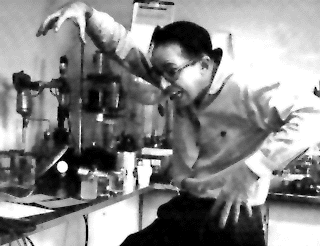 The author’s father, pictured 40 years ago at his lab, passed on his rebellious nature and his love for science. |
My mother was raised by her widowed mother on a ranch in West Texas during the
Depression; even during the best of times, Aspermont, Texas, ain’t exactly a
strong argument for the bountiful nature of God. In the hard-scrabble years of
the 1930s, there were few opportunities for worship and a whole lot of time to
question a dusty existence. But my mom never questioned the affinity she felt
for all the animals on the ranch and the wildlife that surrounded her. She
passed her reverence for nature on to me.
My grandfather on my father’s side was a missionary in India and a minister in
the Christian Church for years. My father, a scientist to the core, probably
born with an ohm meter in one hand and a wad of stranded wire in the other, was
forced to go to church eight days a week. He rebelled against the church and
passed his rebelliousness on to me, but not without also handing down his love
of science.
So, call me a heretic; I worship at the altar of nature and science. Faraday,
Muir, and Edward Abbey are my prophets. The seasons, the elements, the animals,
and plants are the constants in my life, the framework on which I hang my
questions, my beliefs, and my conviction in a supreme force. If the Pope popped
up in my garden right now, in his silly hat, swinging a smoking censer,
mumbling in Latin, I’d be surprised, certainly, but not inspired. I’d probably
ask him to step aside so I could get a closer look at that ruby-throated
hummingbird buzzing the morning glories, or that praying mantis deliberately
stalking an aphid. No matter what the Pope said to me, it could never strike me
as more profound than a spider’s web or a scrub oak growing through solid
limestone.
I’ll admit my personal form of worship leaves a lot of the hard questions
unanswered. It doesn’t matter how fascinated I am by radio waves or how long I
stare at the moon, I can’t figure out why people hurt their children or shoot
their neighbors or blow up airplanes. But, conversely, no organized religion
has coughed up a philosophical rationale for suffering I can swallow either. If
I’d lost a loved one in the ValuJet crash or the Oklahoma City bombing, and
someone told me it was God’s will or part of Allah’s big plan or karma, I’d
throw him into the swamp with the alligators. Maybe some questions aren’t meant
to be answered.
But I don’t have to have all the answers, in order to believe. Isn’t that
called faith? So I have faith in the unconditional love of a dog, the magic of
a cardinal’s flash, and the sanity gathered on long walks spent staring at
unknown tiny plants. I believe in the stars and the planets, the laws of
relativity, and the grace of a long-burning light bulb, a bulb as bright as the
light behind heaven’s door.
This article appears in December 27 • 1996 and December 27 • 1996 (Cover).