

|
Hays County Comissioner Jefferson Barton says that when Travis County |
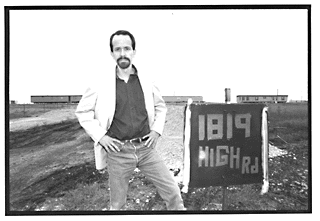
“I-35 South Ranches” lies on acres of beautiful, rolling Hays County
countryside. Like a lot of rural subdivisions, however, the pleasing name is a misnomer —
the development is a patchwork of mobile homes and poorly built houses. The
aesthetics aren’t the biggest problem. In digging septic-tank holes in the region’s
blacklands clay soil, the developer — Robert Sweeney of Del Valle — loaded much of the
out-fill into county ditches, which caused flooding, created stagnant pools of water,
and damaged the abutting county roads. The heavy rains in early June only
exacerbated the problem, turning huge stretches of the development into impassable mud
fields and pools of water into ponds.
“Despite the name,” Hays County Commissioner Jefferson W. Barton
dryly noted in a memorandum to the Conference of Urban Counties this year,
“I-35 is nowhere near, and nothing about the lots could be mistaken for a ranchette,
much less a ranch.” (An unofficial developers’ manual must have this rule:
The shoddier the development, the more grandiose the name; in Nueces County, the court
public works director says that similar problems exist in the Tierra Grande
development and at Country Club Estates West, which is in a low-lying area with unpaved
roads and no water, sewer, or drainage.)
The 35 South Ranches are an example of what’s becoming known around the
state as “Elgin Bank” subdivisions. The name comes from a court case,
Travis County v. Elgin Bank, which the Texas Supreme Court made final in January
1996. The Elgin Bank case gutted county authority in unincorporated,
non-municipal areas, and a year and a half after the decision became final, the case has
taken on a descriptive character of its own, like a Miranda warning. Some so-called
Elgin Bank developments are a shorthand way of describing substandard
developments with bad roads, drainage problems, and eyesore housing. It’s brought a kind
of subdivision hell for county commissioners and, more importantly, their constituents.
The problem started in a case brought by the Elgin Bank of Texas in a
dispute over its plan to subdivide land for a Travis County development. The county
won at the trial court level, but the Austin-based 3rd Court of Appeals held that a
county doesn’t have the power to require an owner of a tract of land to prepare a
plat, or a subdivision plan, of a subdivision when the owner doesn’t plan to lay
out streets or parks or other parts of the tract dedicated to public use.
In non-development-speak, the opinion means that as long as a developer
extends part of a subdivision to an existing street, he doesn’t have to get
subdivision approval from a county. Such lots are often called “flag lots” because long,
thin strips of land, resembling flagpoles, are extended to existing roads. As long
as lots are “flagged” to an existing road, the developer can escape
virtually all county supervision.
At the 35 South Ranches, the lots are “flagged” to two existing
public roads, which lets the developer off the hook with respect to virtually all
county regulation. Blacklands clay also is a bad surface on which to maintain and
build roads. The two existing county roads were already of questionable quality,
and the influx of residents has made them worse. Besides crumbling roads, there are
no turnarounds for school buses and other large vehicles. And with no streets built inside
the subdivision, emergency vehicles have an almost impossible job finding the correct home —
assuming, that is, that they can maneuver through the muddy ruts that lead back to
residents’ houses.
Sweeney is matter-of-fact about his development’s shortcomings. “We
build that way to save us from the expense of building roads. We can offer more for
less money,” he says. “We are targeting the market that is less capable
of spending money on a home.”
“If we had to build roads out there, it would put these people in a
different pricing category,” Sweeney says. “If you want to make a first-class
subdivision, fine… it would make a little more sense to put in good roads.”
Sweeney has little patience with county officials’ complaints about the
inaccessibility of the development to emergency vehicles. “We continue to nurture the
weak and to mollycoddle people who will not insist on taking care of their
responsibilities,” he says. “It’s not my responsibility to build roads for the county or
for those people.” County officials, Sweeney gripes, “are just social
engineers” who need less power, not more.
Hays County commissioners twice rejected approval of the early stages of
the 35 South ranches, but when the Elgin Bank case became final with the
Supreme Court’s decision not to hear the case, commissioners had no choice but to
approve the development. “It’s not a good subdivision, but it’s a legal
subdivision,” Commissioner Barton lamented in July 1996, when approval was reluctantly
granted.
Hays County contains some extreme examples of Elgin Bank-type
problems, but the county is by no means alone. About two dozen counties reported
similar problems to the Texas Association of Counties and a related group, the Conference of
Urban Counties. The two groups backed unsuccessful legislation in the
just-concluded legislative session that would have cured some of the regulation problems caused by the
decision (see sidebar).
The free-market rule sparked by Elgin Bank has also put a new twist
on the brewing “property rights” movement in Texas, in which
landowners have claimed that governmental actions that adversely affect their land are
unconstitutional “takings” of property. In Hays and other Texas counties, property
owners who live near unregulated subdivisions are experiencing their own form of
“takings” — reduced property values. In a countryside that was fairly pristine,
longtime landowners have found that shoddy subdivisions bring eyesore housing — sometimes with
malfunctioning septic systems — and county roads that become less passable with increased
traffic. The counties, in turn, find their costs skyrocketing in the form of road
maintenance.
As a result of Elgin Bank, colonia-type developments are spreading
far beyond the Texas-Mexico Border — in fact, it’s a fallacy that severely
substandard development is just a Border problem; most urban and high-growth counties can
point to a number of developments that are a short step up the development ladder
from colonias. In the heart of fast-growing Hays County, a half-hour drive south
of the state Capitol, developers have rushed in to take advantage of the decision —
in some instances, says County Commissioner Barton, actually brandishing a copy
of the court opinion as they inform the county that they know how big a loophole
Elgin Bank created.
The Elgin Bank decision stemmed from an unwieldy and confusing
section of the Local Government Code that governs preparations of plats by landowners
who divide a tract of land. Elgin Bank wanted to subdivide a 150-acre tract of
land without filing a plat. Travis County officials, as counties across the state have
done for decades, read the law as requiring a plat to be drawn up for almost any
instance where land was being subdivided. Elgin Bank’s argument was that the statute
should be read to require a plat only if two conditions were met: The land was being
subdivided and new roads or utility improvements were being constructed in the
subdivision. The interpretation of the word “and” became the element on which
the case hinged. Elgin argued that since its developments would not be providing
roads, then the filing of a plat was not required.
But Travis County District Judge F. Scott McCown gave Travis County the
victory in the case. Faced with two different interpretations, and given the
vagueness of the statute, McCown decided to rely on legislative history. He found that the
Texas Legislature, in a 1927 act concerning city land development, always intended
to make it unlawful to provide public utilities without approval of a plat. McCown
also found that the county statutes were modeled on the city statutes — and that both
were intended to give local officials a degree of control over development. But
the Austin-based 3rd Court of Appeals refused to hark back to the legislative history and
sided with Elgin Bank’s interpretation. The court reversed McCown, and the Supreme Court
declined to review the case.
So far, Elgin Bank has declined to take advantage of the loophole the case
provided for it in Travis County. Rather than develop the land itself, the bank
subdivided the 150-acre lot — located at the edge of Travis County on Highway 290 East
between Manor and Elgin — into 10 lots and sold them. To date, only one lot has been
developed by its owner. However, Commissioner Barton warns that Elgin Bank has
set a bad precedent, and that Travis and the surrounding counties’ futures are
“co-mingled.” Travis County should take note of what’s happened in his precinct in northern
Hays County, he says, which contains some of the prettiest country around Austin.
Barton says it is that proximity, as well as its beauty, that makes it so attractive
to developers. The same market forces that drive the creation of colonias —
scarcity of affordable housing, developers who offer homeowners
little-to-no-money-down deals, proximity to jobs — are at work in Hays County. To most city dwellers of at
least modest means, the 35 South Ranches must look like barely habitable eyesores.
But the demand for this type of housing clearly exists; the development started
with 46 lots last summer and all sold out in a matter of weeks.
In the wake of the Supreme Court’s refusal to hear Travis County’s appeal
of the case, County Judge Bill Aleshire blasted the decision as “disastrous
public policy…. Instead of weakening the power of county government, we ought to
be strengthening it to make sure we don’t have colonias all over,” Aleshire told the San Antonio Express-News.
Elgin Bank gives developments like the 35 South Ranches a chance to
proliferate, to be established almost overnight — and to put quality developers at a
disadvantage. Since the Legislature didn’t overturn Elgin Bank in this session, the
next opportunity to rein in development won’t come until the 1999 regular session.
When it comes to developing unincorporated areas of a fast-growing county, that is
an eternity.
In the booming 1980s, Hays County’s population soared by 62%, to 65,614
residents in 1990. Already this decade the county population has increased to about
88,000. That’s a big market for developers who work fast, sell hard, and move on to
the next parcel of land.
Elder is a columnist and senior editor for Texas Lawyer.
This article appears in June 27 • 1997 and June 27 • 1997 (Cover).