

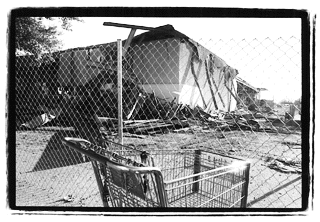
 photograph by John Anderson |
started as a feature has turned into a eulogy, now that the bulk of Hancock Center has heard
the call of the wrecking ball. The site signs promising a “major redevelopment”
now overlook fields of rubble where once stood Austin’s toniest stores and
trendiest shoppers, the shock troops in the postwar consumer revolution. Sears
is staying put, the HEB will move around the corner to new and much
bigger digs within the new Hancock Center, and everything else between 41st
and 43rd, Red River and the interstate, will morph into what, despite certain
glamorizations, is a strip mall with even more surface parking than the current
Monaco-sized pavement. That’s progress for ya. (And worse yet, its main
frontage will be on 41st, thus turning that once-quiet semi-residential street
— which runs just north of the Chronicle offices, you may know — into
a driveway.)
It’s plain fact that the new Hancock Center, as described by its developer to
the Chronicle, the local neighborhoods, and others, doesn’t wear well
the labels that, elsewhere in this issue, we see hung on central-city
redevelopment. Innovative? Revitalizing? A step toward sustainability? Highest
and best use? Compatible with its surroundings? Pedestrian- and
transit-friendly? Mixed-use? A community crossroads? If all this New Urbanist
compact-city traditional-development rhetoric gives you hives, the new Hancock
Center promises to soothe your painful rash better than Gold Bond.
Is this a drag? Sure. Could it be otherwise? Probably not, at least not yet.
It’s one thing when you’re dealing with local owners and developers who know
their city and their market, or with “alternative” financing sources for whom
“return on investment” may mean something different than it does to your
average bank. And in Austin, you’d be hard-pressed to find an architect who
wouldn’t itch to convert a 34-acre site, squat in the city center, bridging a
preserved heritage neighborhood and a high-impact commercial corridor, into an
award-winning progressive planning hallmark. It’s different if you’re Pacific
Retail Trust, the out-of-town REIT (real estate investment trust) that ended up
with Hancock after the usual passel of post-bust portfolio swaps. All they have
is a formerly hot property that’s lapsed into dereliction, without either an
instrument or an incentive — like, say, a city-wide comprehensive plan, or
building and zoning regs that promote infill development, or even (egads!)
design guidelines — to make it into anything but a sure-thing
lowest-denominator project. Who can blame them?
So Lincoln Property Corp., the Dallas-based manager of the Hancock project, is
moving forward into, if not the distant past, at least the middle of last week,
without (at least to this point) more than a low-frequency grumble from its
neighbors. And central-city partisans can call Hancock the one that got away,
consoled by the notion that anything is better than the nothing that Hancock
had become. But before we forget about Hancock Center, we should remember how
Austin’s first shopping mall got there in the first place. The once-beautiful,
later-homely and now-dead pile of brick occupies a niche in River City history,
not just as a landmark of commerce, or even of Central Austin, but as the
arguable progenitor of every neighborhood-vs.-developer contest that’s left
blood in our leafy streets. The story of Hancock’s creation shows us how little
difference 40 years makes — perhaps the death of the center has spawned so
little noise because its birth spawned so much.
Royally Consummated
Back in 1946, what is now Hancock Center was part of the grounds of the oldAustin Country Club, a 92-acre tract owned and developed by former Austin mayor
Louis Hancock, perhaps the very first of the River City’s subsequent legions of
golf nuts. The City of Austin paid $175,000 for the whole property, which it
subsequently rechristened the Hancock Golf Course, even though the actual links
only occupied some 58 acres. The remainder, known inevitably as the Back Forty
though it was in actuality only 34.2 acres, was naught but a sandlot, and when
the City Council finally got around to dedicating the Hancock property as
parkland, in 1951, it specifically excluded the Back Forty from that
designation. To not do so would have required, then as now, that the public
vote on any proposed sale of the property.
Nearly a decade later, in December 1959, the districts around Hancock Golf
Course had seen limited residential growth (mostly in multi-family complexes
such as pockmark Hyde Park today) and substantial commercial growth along the
old Interregional Highway, including Delwood Center (sometimes claimed as
Austin’s first shopping center, as opposed to a “mall”) across then-US87
from what had by then been dubbed the East Forty. During the 1950s, the city
had turned down two offers for this surplus land, including a $375,000 bid from
Safeway, but in October 1959 it was approached by Sears, Roebuck & Co.
through its Homart development subsidiary. The locals, having become accustomed
to both a large vacant tract in their midst and a lack of city desire to do
anything with it, were both stunned and offended when the Planning Commission
rezoned the property for high-powered commerce, without disclosing that this
change had been requested by Sears. Come December 8, the East Forty was
auctioned, with Sears as the only bidder, and as the Austin American reported, “The sale was consummated in less than two hours.” In the view of
many citizens, “consummated” was an aptly metaphoric euphemism for what
actually transpired.
The 28-store, $9 million “mall” proposed by Sears, while becoming a fixture in
the sprawling suburbs of the big cities, was still a fairly novel concept in
smaller, more compact towns like Austin, where most people still did most of
their shopping downtown on Congress Avenue. To many local eyes, the Sears
project was a behemoth, inappropriate for Austin and designed to meet
commercial needs that didn’t exist. Opponents ranged from local retailers, to
neighbors who considered the East Forty an undeveloped park and theirs a purely
residential neighborhood, to golfers who foresaw the degradation and
destruction of the Hancock course, to forward-thinking planners (professional
and armchair) who envisioned higher and better uses of the tract, to
taxpayers’-rights advocates (then often known by the simpler label of “cranks”)
who felt the city was getting, well, consummated by Sears and its high-priced,
big-city lawyers.
So off to court they went. On the day before the city’s December tryst with
Sears, a sortie of citizens filed both a petition with the city clerk and a
lawsuit with the district court, both calling for a public referendum on the
sale. The city laughed heartily, disqualified the petition in record time,
pointed to its 1951 vote to exempt the East Forty from parkland protection, and
proceeded to spend Sears’ money hither and yon — but never asked Judge Herman
Jones to dismiss the suit. While that dormant legal action cluttered up the
judge’s desk for three years, Sears could not obtain financing, sign contracts,
or break ground.
Goliath Won
In 1962, an impatient Judge Jones reversed the sale of the East 40 and ordereda public vote, declaring that the tract was indeed parkland, since it had been
used as a park both when the city bought it and since. The ensuing election
battle, in reflection, should belie any notion that — as we moderns are often
told by our traditional elite interests — Austin used to be a happier place,
where issues of public import were resolved by polite gentlemen and ladies in
an atmosphere of consensus. If anything, Austin today is more civil than it was
in early 1962, if only because our activism and vitriol is today reserved, at
least at the citywide level, for matters larger than a 34-acre tract of land.
Even in present-value dollars, $800,000 and a parcel the size of Hancock Center
do not today add up to an incendiary political issue.
But back in 1962, this called for breaking out the War-Declared type and
full-page-ad political hype. “Your council has acted in the public interest,”
said the Vote-Fors, organized as the “Hancock Election Committee,” pointing to
the usual fruits of progress. More jobs, both in construction today and in
retail tomorrow. More tax revenue, and money for improvements to parks all over
the city. (That’s where most of Sears’ $800,000 had been spent three years
earlier.) The city already has 50 acres of parkland in the area, they argued —
how much more do you need? And other points that could have been written by
Ronney Reynolds, including the wonderful clincher, “We should support the
judgment of the men we elected as our city council!”
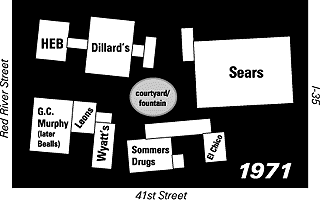 |
 Hancock Center is being partially demolished to make way for a new HEB Superstore and other retail space. The Hancock Center of 1998 stands in stark contrast to the original site plan from 1971. |
groups roused their troops with these sorts of gracious subtleties: “David,
Throw Your Stone — The Giant Can Be Stopped!… Vote against a giant
corporation and a city machine taking over our city! WAKE UP! WAKE UP! WAKE
UP!” Heady stuff for the Capital City during the Connally administration. The
Vote-Againsts called into question the legality not only of the Sears sale, but
of the city’s original takeover of the Country Club 16 years earlier, pointing
out that Sears had failed to obtain title insurance and had no redress if they
lost the land, and otherwise rehearsing the objections we already know. Too
big, too expensive, and we don’t need a new shopping center. It’ll without
question ruin the neighborhood, while something else could easily be a boon.
The land was worth more than Sears was paying, they argued, especially if
something more constructive were built there. That is, if we were to build
anything there, and why is that inevitable?
We wouldn’t be talking about this if the alarums of the Vote-Againsts had not
failed, albeit narrowly, to persuade the electorate. And certainly in hindsight
we know that the worst of their fears were not realized, no matter how bad
traffic gets at 38th & Red River. By May 1964 Sears’ grand creation opened
its doors, hailed by the press, the business community, and the city government
as a wonder of the modern world. Even without the heavy leavening of
boosterism, Hancock Center turned out to be pleasantly surprising to its
detractors. To tastes of the time, it was mighty attractive, with its
“parklike” setting, famous fountains, tinkling background music. Its
subterranean Town Hall promised to be a crossroads and gathering place for the
same citizens and neighbors who had expected the center to turn its back on its
surroundings. And Austin, used to development that was even more ad hoc and
nearsighted than what we see now, had never seen anything so big — at 500,000
square feet, Hancock was possibly the largest purely private-sector project in
Austin at that time — that had been master-planned as a whole and built out to
its full future size by Opening Day.
Pulling the Plug
It seems unlikely that the creators of Hancock Center thought their “oasis ofgrandeur,” their “unsurpassed pleasure” in “a setting to dazzle the
imagination,” would exhaust its design life in less than 30 years. Or perhaps
even more quickly than that — as late as the 1980s, most of Hancock was still
occupied (although one of the original buildings had already been razed), all
the anchor department stores were in place, the HEB was just a grocery store
rather than a mega-market-extravaganza, and the fountain still worked. It
wasn’t until the current decade — when many of the trends we presume killed
off Hancock Center, like megamall competition, the flight to the suburbs, and
The Bust, had already begun to diminish in their impact — that Hancock slipped
from an underperforming retail complex to a terminal case.
This would imply that large-scale development projects are really a lagging
indicator of trends on the ground in Austin, which should come as no surprise
to anyone who wonders why, for example, we’re still fighting about unbuilt
subdivisions in the Barton Creek Watershed that fewer people by the day
consider convenient or attractive or worth their retail price. And ironically,
even if we concede that a dramatic transformation of the old East Forty into a
New Urbanist showpiece was never likely, a lot of the things we now look for in
developments, and can’t find very readily in what we’ve seen of the new Hancock
Center, were part of the old Hancock Center from the beginning: a
self-contained, master-planned project, complete with public spaces, multiple
uses, and native plants. Ditch the massive uninterrupted parking lot and add
some small-scale buildings around the property’s interior edges (on Red River
& 41st Street), and Hancock Center would have been a quite decent hub for
an urban village.
But such is not to be. Instead of a physical legacy, we are left with a set of
lessons. Like how nothing ever changes, how the way we used to build things is
the way we should build them, how neighborhoods have always fought for
what they see as their integrity, how power interests have always fought the
neighborhoods, how the most heated and bitter conflicts are repeated endlessly,
as if they were being slugged-out for the very first time, even as the wounds
and scars of last year’s battles not only heal but disappear. Everything old is
new again — a fitting sentiment for a eulogy, don’t you think? Hancock Center,
may you rest in peace.
This article appears in February 14 • 1997 and February 14 • 1997 (Cover).