

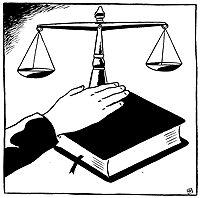
 illustration by A.J. Garces |
Commandants are inscribed. Aside from being a sprightly departure from the
usual courtroom drabness, the painting has inspired creative lawyering. One
Houston attorney tried to stop Devine from presiding over a wrongful-death
lawsuit on the basis that the final commandment — “Thou shalt not covet thy
neighbor’s goods” — is not the message you want a jury to have in mind when
they’re debating the amount of damages to levy against a defendant. (A federal
judge rejected the motion to kick Devine off the case.)
Devine flaunted his religious beliefs long before he assumed the trial-court
bench in 1994. He made his name as an anti-abortion demonstrator; he was
arrested several times and ran against a judge after she issued rulings in
favor of Planned Parenthood in an abortion-protest dispute. Last month, just
halfway into his four-year term, he sought an even higher calling — a
Houston-area congressional seat — but finished well behind the runoff
candidates.
Devine’s inspired artwork, his courting of powerful religious right operatives
in Houston, his history of street-fightin’ activism — it all adds up to an
ugly mix of faith and law. The nexus of faith and law, however, is rarely as
stark as it is with Devine. Indeed, the legal world is having a more open, and
certainly a more intelligent, debate on faith than other sectors of public
life. There’s always been a skepticism about the search for meaning in a life’s
work. “As for the Business of an Attorney, I think it unlawful for a Christian,
or at least exceedingly dangerous,” warned a 19th-century preacher. “Avoid it
therefore, and glorify God in some other station.”
Chronicle editor Louis Black argued the other side of that coin in an
editorial last spring when he criticized attacks on city council candidate, and
lawyer, Jeff Hart. Black, who did not support Hart’s candidacy, still came to
his defense when Hart’s opponent, former Chronicle columnist Daryl
Slusher, ran attack ads ripping Hart for representing a plant in Bastrop County
accused of polluting the environment. In Black’s view, Hart was a good man
despite his client roster. But, lawyers are not — as Black would have it —
hired guns who litigate bloodlessly, without conscience or soul. A lawyer’s
clients can tell you something about that lawyer. If Hart has spent his career
representing corporate interests, then that says something about him — not
everything, but something. Certainly he is different than a career legal-aid
lawyer.
To extend Black’s reasoning, a lawyer would hardly be able to integrate his or
her faith with legal work. Yet, this summer, the Texas Tech University law
review published a remarkable collection of essays in which 44 practitioners,
academics and judges wrote about just that struggle. The law review issue was
the basis for a three-week online symposium I moderated in August on Counsel
Connect, a national legal online service affiliated with Texas
Lawyer. What I found so challenging about the law review was that the
authors wrote very personal narratives — story-telling — rather than
jargon-laden essays on the state of First Amendment law.
Texas Tech law professor Timothy Floyd, a faculty advisor for the issue and a
panelist in the Faith and the Law online symposium, wrote that he had “a
nagging worry that I am fooling myself when I assert that law practice can be a
calling from God.” The law review issue flowed from that doubt, and the
“story-telling format,” Floyd says, seemed the best way to do it. “Stories are
how we learn to live as we should,” he wrote.
One law review author was Texas Supreme Court Justice Raul Gonzalez, whose
speech to a Christian Coalition meeting in San Antonio a year ago solidified
his position as the most openly religious judge in the state. To those of us
who had written about Gonzalez’s 12-year tenure on the high court, the speech
was no big surprise — a pretty standard Bible-thumper spiced with a few
observations on who and what is causing Western Civilization’s decline and
pending fall (among other atrocities: MTV, gangs, and Harvard Law School’s
rejection of theology-based legal teachings in the 1800s, in case you’re
wondering).
In my office file marked “Gonzalez/ Born Again/Opinions” — to which I’d added
every time I felt the justice suffused his opinions with fundamentalist dogma
— there was plenty of evidence to back a claim that Gonzalez’s judicial
writings could resemble religious jeremiads. From his very first Supreme Court
opinion in 1984 to a case just last year, Gonzalez has been a strident voice on
abortion. The 1984 opinion — in a case where abortion was not even the core
issue — complained about abortion’s contribution to a “disposable society;” 11
years later, the justice cited a 1965 Life magazine photo essay, of all
things, to bolster his belief that “it is beyond dispute that human life begins
at conception.”
Yet despite his strong words on abortion, his apparent na�vete about the
crass political motives of the Religious Right, and his belief that Christians
are a “disfavored class,” Gonzalez is not an automatic vote for positions
backed by religious interests. And I agree with him when he says that all
judges are “more influenced than they care to admit” by their faith. “I am
transparent,” Gonzalez says. “I acknowledge that this, my faith, is part of the
mix.”
And how different, really, is the born-again Gonzalez, a Roman Catholic, from
Catholics in the liberal activist tradition? At St. Mary’s University School of
Law in San Antonio, the dean, former UT law professor Barbara Bader Aldave, has
based her school’s mission on the life of Mary, mother of Jesus. “After all,
for whom is our school named?,” Aldave said in a 1994 speech, “The Reality of a
Catholic Law School.”
Aldave said that whenever she hears complaints about the school’s focus on
clinical education — on immigration, capital punishment, human rights,
economic justice — “I have a ready answer.
“Once we strip away the heavily romanticized tradition that surrounds her,
what does Mary mean to us Catholics? In the early part of the New Testament,
Mary is introduced to us as an unmarried, pregnant teenager. When we last hear
of her, she is an old woman, at least by the standards of her time — a widow
who looks to friends for sustenance and support. Between her major appearances,
she has searched for shelter, fled from persecution, and watched the execution
of her son.” Seen in that light, Mary’s life is a liberal activist’s call to
arms.
A very different kind of Catholicism has been advocated — brandished, his
critics say — by U.S. Supreme Court Justice Antonin Scalia. In his speeches
outside the court, Scalia takes the same tone that marks his opinions: He
displays a certitude that’s more than strident; it’s scary. “We are fools for
Christ’s sake,” Scalia told a Christian Legal Society meeting in Jackson,
Mississippi, in April. “We must pray for the courage to endure the scorn of the
sophisticated world.” (One Washington columnist spoke of his temptation to
rework Scalia’s comment with a comma after “fools;” another said Scalia is
apparently under the impression that the godless Senate would have confirmed
him even faster than they did had he been an atheist.)
Scalia also played a role in a milestone event in the court’s religious makeup
this summer when his ideological soulmate, Clarence Thomas, returned to the
Catholic Church after a 28-year absence. When Thomas took Communion in a
Massachusetts church, the high court for the first time no longer had a
Protestant majority. (Thomas, Scalia, and Anthony Kennedy are Catholic; Ruth
Bader Ginsburg and Stephen Breyer are Jewish). In June, Thomas attended the
first mass celebrated by Scalia’s son Paul, a newly ordained priest, an event
that reportedly helped move him to a final decision to rejoin the church.
Our Judge Devine, meanwhile, has another two years on the bench. In the online
Faith and Law Symposium, a lawyer who is a former seminarian noted that the Ten
Commandments painting in Devine’s courtroom may not be quite the Religious
Right billboard it appears to be. “The practitioners of all major religions
believe these directives to be the divinely inspired Word of God,” he wrote.
“The problems arise when those in authority force their views of how these
commandments are to be interpreted or enforced upon those whose interpretations
are different,” he said. “In such an event, the courts of America may resemble
those of Iran, where religious dissent is vigorously prosecuted.”
Bob Elder is news editor of Texas Lawyer, the legal affairs weekly,
and an online editor for Counsel Connect.
This article appears in December 27 • 1996 and December 27 • 1996 (Cover).