

 |
Club decorates the southern bank of the Colorado River. Further up is a thick
plateau of evergreens, here and there broken by the rooftops of the rich and
sometimes the famous, such as Luci Baines Johnson and Doug Maund of the Maund
auto empire. These are the suburban dream homes of the Davenport Ranch
Municipal Utility District (Davenport MUD), where residents have basked for
years in Austin’s cultural and economic glow without the inner-city headaches
of crime, crowds, cacophony, and so on. But the sounds of the city are, like
the swollen Colorado’s olive-green waters, lapping ever-louder at the MUD’s
edge. The MUD, too, has grown, from 568 acres of wilderness in the early Eighties to
a sub-city of more than 1,000 residents today. In the beginning, life was
simple. The MUD built and operates a water and wastewater treatment plant to
encourage the area’s development, servicing surrounding entities like the Eanes
Independent School District and the Austin Country Club. Though annexation into
Austin was a condition of Davenport’s creation, the treatment plant has
afforded the MUD a bit of independence from the city. An outbreak of homes and
buildings occurred across Highway 360, too, among them St. Stephens School, the
Riverbend Baptist Church, the Davenport West development, and the Hermosa PUD.
They use septic tanks for their sewage needs, and, so, like the MUD, don’t need
to rely on the city for its plumbing provisions.
But the MUD board, and the surrounding entities, say that doing their own
sewage treatment is becoming less and less feasible. There are increasingly
stricter regulations mandated by the Texas Natural Resources and Conservation
Commission, and as the wastewater facilities have aged, the potential for
liability in the event of pollution has increased. Thus, more than a year ago,
the MUD board requested sewage service from the city.
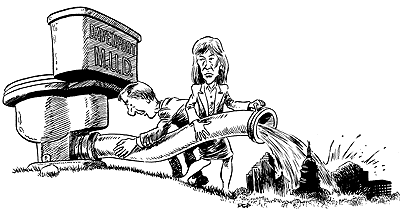
Since the MUD said it would pay the $5 million needed for the pipeline and
pumping facilities, staff went ga-ga, the Water and Wastewater Department
screaming joyously that the deal would bring in between $250,000 to $500,000
annually for the next 25 years — sans expense. City staff happily drew up a
contract last December, but language concerning the agreed future
annexation plans caused the Davenport MUD to recoil from the deal in horror.
You see, the city had the gall to include a so-called “terminator clause” in
the proposed contract which said that, should the MUD be exempted, for whatever
reason, from the agreed September 1997 annexation deadline, Austin could cut
off wastewater service to Davenport after giving the MUD a four-year warning
notice.
The Davenport MUD turned up its nose at the contract and its terminator
clause. “Someone in Dallas could have persuaded the Lege not to annex certain
MUDs, and, if we would have been exempted, we wouldn’t have been able to flush
our toilets,” explains MUD boardmember Claude Ducloux. However, that’s not
exactly true. A four-year notice would have been more than enough time for
Davenport to either rebuild its old plant or construct a new one. Of course,
the MUD residents could always have saved themselves the trouble by passing on
the exemption status altogether and sticking with the original annexation
agreement. (Sure, that last scenario isn’t likely — but a city can always
dream, right?)
After the MUD board dropped out of the negotiations last December, Mayor Bruce
Todd revived the deal. According to MUD boardmembers, Todd called and invited
them to a meeting in his office, and asked what could be done to continue
negotiations. The threatening terminator clause was immediately dropped,
and negotiations continued apace. In January, Todd and staff took out the
offending terminator clause and replaced it with some weak language about the
MUD board agreeing not to pursue a legislative exemption from annexation. Big
deal — individual members of the MUD can still use their personal wealth to
pay lobbyists to engage in some Austin-bashing annexation exemptions. Not that
there’s anything wrong with that — it’s a free country. The point is, city
policy clearly states that Austin should annex all areas within the ETJ that
receive or have access to city water and wastewater service — that’s according
to a memo by assistant city attorney Nancy Matchus. So if it’s city policy, why
are we about to give away the store? Let’s get some assurances that if the MUD
reneges on the annexation deal, we get to stop taking their shit — I mean
effluent.
The councilmember raising the biggest stink about this is Beverly Griffith,
who has been tireless in her efforts to get more information on just what kind
of a deal Todd has cooked up for Austin. What she found is that the $12 million
over a 25-year period that our utility stands to gain from not tying our
annexation rights to service is peanuts to what we would get if we did. It
seems there’s been a cost/benefits analysis floating around since early
December that councilmembers never saw until last week at Griffith’s
insistence. Not only were councilmembers kept in the dark about the financial
ramifications of the terminator clause back when the deal first came up in
December, but so were the two boards — the Environmental Board and the
Planning Commission — which were entrusted with the job of making a
recommendation on the proposed contract to council. According to the
cost/benefit analysis by financial analyst Bill Derryberry, if the city annexes
the MUD and the surrounding entities, we stand to gain $60 million after 25
years. If we annex just the MUD, which has numerous million-dollar homes, then
the revenues to the city from the property and sales taxes and utilities would
be $43 million after 25 years. A little better than the $12 million deal on the
table now, don’t you think? Too bad the Statesman didn’t mention that in
its editorial or article on March 18.
So why is all this coming up now, so late in the game, just days before
council is to vote on the deal? Maybe it’s because most councilmembers weren’t
privy to either the cost/benefit analysis, or any of the secret negotiations
going on between Todd and the MUD over the past several months. How were they
to know that Todd was working on a deal to give away our annexation bargaining
chip — a chip that might make the contract actually worth something to this
city? Instead, Todd worked alone, but he acted as if the entire city was behind
him. For example, in a letter to the Davenport MUD dated December 19, Todd
wrote, “Austin wants to reaffirm Austin’s readiness to complete negotiations on
the wholesale wastewater agreement…” It would have been nice if Todd had told
the rest of the council that negotiations were taking place. It would also be
nice if cost/benefit analyses would be provided to the council and appropriate
boards and commissions before negotiations between staff and the entity
requesting service are past the point of no return. Then maybe dissenting
councilmembers like Griffith wouldn’t be in the position, once again, to look
like johnnie-come-latelys, ready to throw a monkey wrench into a process in
which staff has already invested tons of time.
So now, even though both the Planning Commission and Environmental Board have
now recommended against extending sewer service without guaranteeing annexation
— since doing so would conflict with city policy — the item was posted for
first and second reading at yesterday’s worksession and today’s council meeting
(Thursday, March 20). Todd, Eric Mitchell (man, is he glad there’s
something else to write about this week), Ronney Reynolds, and Jackie Goodman
are expected to go for the deal, with Griffith, Gus Garcia, and Daryl Slusher
likely in opposition. Goodman is doing her usual powerbroker routine, caught in
swing voter hell again, and landing on the wrong side. She defends the deal for
environmental reasons, interestingly enough. “Old septic plants and package
treatment plants have never been a good thing for the environment,” she says.
In other words, we should pick up Davenport’s slack at very little cost to the
MUD. Of course, enviros counter that giving the MUD sewer service is basically
guaranteeing that it will grow, and, without annexation, out of our control to
boot.
But Goodman and others worry that the Lege will get pissed at Austin and
extend Davenport’s September 1997 annexation deadline if we don’t do the deal.
Currently there are two bills pending at the Lege that could extend the
annnexation deadline. Griffith argues that it would be more prudent to wait
until after the session ends in June to negotiate a deal. Say the MUD gets an
extension for two years — so what? It will still need service, and the city is
still more likely right now to be able to provide service than the Lower
Colorado River Authority. If no bills pass, then we can talk turkey once
again.
“No service extension without annexation” should be the council’s rallying cry
today. We love Davenport and want them to stay linked to us. Think of the
alternative. Like Griffith says, “If we keep the growth of the city limits and
the service area together, we can keep a healthy inner city and a healthy
surrounding urban area. Otherwise, you have cities like Atlanta, Cleveland,
Miami, and Boston that have a few hundred thousand people in the city ringed by
millions.” It’s a scary thought.
Editor’s Note: Audrey Duff contributed to this report.
This article appears in March 21 • 1997 and March 21 • 1997 (Cover).