

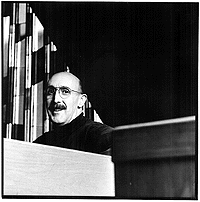
 Richard Bates believes St. Luke’s United Methodist Church should become a Reconciled Congregation — one that is intentionally inclusive of homosexuals. photograph by Minh Carrico |
the subject of becoming a Reconciled Congregation — one that officially
welcomes gays and lesbians. Bates’ idea was as likely to pass as a rich man
into Heaven.
“My perception is that gays and lesbians have always been welcome in
this congregation, since I was knee-high to a grasshopper,” protested Dick
Barrick, the church’s choir director. “I’m not sure we should be involved in
political activism and turning our name over to someone pushing their own
agendas.”
“What would you have us do?” asked another skeptical board member. And
when St. Luke’s member Ray McCune, who is openly gay, suggested conducting a
service on homosexuality, the board member shot back: “We ought to have
services glorifying Jesus Christ, our Lord, not homosexuality.”
In Methodist terminology, a Reconciled Congregation (R.C.) is intentionally
inclusive of gays, lesbians, bisexuals, and transgendered people. The Clintons
attend Foundry United Methodist Church in Washington, D.C., one of the largest
Reconciled Congregations in the country. In Austin (in addition to the
Unitarians and Quakers, who have, for the most part, proclaimed their
congregations open to all people, nationwide), three other church groups have
taken administrative steps through their denominations’ hierarchies to
officially include homosexuals — Trinity United Methodist, St. Andrew’s
Presbyterian, and First English Lutheran. “Austin has three of the major groups
officially declaring they accept homosexuals,” notes Bates, who identifies as
bisexual. “Neither Dallas nor Houston can boast that.”
As an ordained Methodist minister who is appointed by the Bishop to perform
counseling services for church members, Bates, who also has a sex therapy
practice, often visits churches to talk about homosexual issues. He first went
to St. Luke’s two years ago when the church’s pastor, Rev. Terry Dowdy, invited
him to teach a six-week course on homosexual issues. Although the course ended,
Bates continued to attend services. And he, along with a few other vocal church
regulars who are openly homosexual, will not let the R.C. issue drop. “I won’t
become a member until we are a Reconciled Congregation,” declares St. Luke’s
church-goer Chris Logan. “We won’t be relegated to the back of the bus,” adds
Bates.
There has been some response. About a year ago, the church changed its
mission statement to reflect its acceptance of all people, “regardless of age,
gender, nationality, race, physical or mental ability, sexual orientation,
family structure or economic class.” But merely saying folks are welcome is not
enough, Bates says: “A lot of churches say they welcome everyone. But most gays
and lesbians know that doesn’t apply to them. With an R.C. designation, there’s
no question.”
To be fair, Bates points out that St. Luke’s members feel comfortable enough
in church to sit with their partners and pray for HIV-positive friends or those
dying of AIDS during the “People’s Prayers” segment of the service. Indeed, the
church has shown its commitment to serving the community, regardless of sexual
orientation, when it provided temporary office space to an AIDS testing center
after the center had lost its lease on two occasions.
So if St. Luke’s United Methodist is so broad-minded, what’s the problem with
going the extra mile by becoming Reconciled?
Helen Weicker, who has been a member of St. Luke’s for six years, is
sympathetic to Bates’ crusade. “We also say we welcome all handicapped people,
and yet they have trouble getting into our building,” she observes. “What are
we saying when we allow that?”
Although she leans toward accepting the R.C. designation, Weicker says she
has nagging questions. “What will it mean? Will the congregation suddenly
become 90% gay? If so, will that disenfranchise the heterosexual members?” she
wonders. “Do we have to perform marriages?… Two men walking down the aisle in
white dresses — or two women — I just don’t know about that. I need to know
more about what R.C. will mean. We all do.”
To answer that need for specific information, at Bates’ suggestion, the board
agreed to conduct meetings next spring to educate members about how an R.C.
designation would affect all aspects of the church — from its liturgy to its
members.
Rev. Dowdy is not taking sides, but he says he is proud to be the minister for
a congregation that is so ready to grapple with these issues. “Before I came
here, I was at a church which acted very welcoming, but I had a member actually
say to me, `Yeah, everyone’s welcome, just not the queers and the niggers,'”
Dowdy recalls. The R.C. designation “is an emotional question, and it’s raised
fears. But this church is so forward-thinking, it has the ability to engage in
a dialogue. We have a real concern for human need.”
“It’s a first step,” says Bates, referring to the upcoming informational
meetings. “But we are still in the midst of the struggle.”
Bates predicts that one day, the question of whether churches should
officially declare their acceptance of gays will seem silly. “By the year 2020,
this will not be such a big deal,” he says. “Just as people are now apologizing
for how they behaved with regards to blacks in the Sixties, and how they
treated them as second class citizens, so it will be with homosexuals.”
This article appears in December 27 • 1996 and December 27 • 1996 (Cover).