

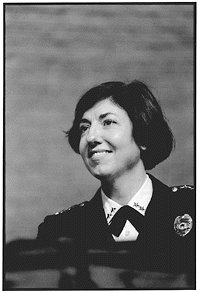
 Former APD Chief Elizabeth Watson may have been right about community policing, but Austin needs a more effective leader to pull it off |
the parking lot of a convenience store at the corner of Manor Road and Loyola
Lane, her death signified more than just another innocent bystander caught
in a flash of gunfire on a dangerous East Austin intersection. It graphically
illustrated to many citizens the failure of the Austin Police Department
(APD), if not of the entire city government, to keep pace with the growing
urban problems of our city. Ward’s death also signaled a major turning point
for the Austin Police Department. Within a week of the shooting, Police
Chief Elizabeth Watson announced her imminent departure by February 21,
and on February 25, the long-awaited APD audit — which is severely critical
of APD’s fiscal policies and management systems — was finally released
(see story below).
In the wake of all this bad news, city leaders met with East Austin residents
on their own turf to talk about public safety (or the lack of it). The crowded
public meeting, held at the Conley-Guerrero Senior Center on Nile Street
on Feb. 27, was more than an acknowledgment of the disproportionate amount
of crime on the East side, or a reaction to an unfavorable audit, it was
an unspoken confession that current policing methods are not working. Citizen
after citizen battered the mayor and councilmembers with complaints about
such issues as environmental racism, their desire for more police presence,
and the need for more crackdowns on rampant drugs, gangs, and graffiti.
The most poignant testimony came when Antoinette Humphrey rose to speak
at the very end of three exhausting hours of public comment. When Humphrey,
33, bought her modest home right across the street from the center, she
told the council, she was elated at finally realizing the American Dream.
That was three years ago.
“I’m standing here today, about to move,” Humphrey said firmly.
“It’s not the same as it was three years ago. There’s shooting at night
around 2am, and my baby’s three months old. I can’t keep her next to the
window because I’m afraid — it shouldn’t be like that.” Humphrey,
employed by the Texas Department of Housing and Community Affairs, broke
down and cried as she related her concerns about the unsafe conditions in
her neighborhood. “I’m proud of this community, but I’m scared of this
community,” she confessed. “I wish I was brave enough to stay
here, but I’m not…. When they said my loan would go through, I praised
God, and I said I’m getting out of here.”
APD leaders are defensive about the latest hoopla, particularly when
the most recent crime stats from 1996 show that violent crime is down by
3.2%, and property crimes are down slightly as well. Austin ranks a respectable
second to last –15th out of 16 comparable cities — with regards to violent
crime, and 11th out of 16 in overall crime index per capita. Indeed, crime
may be slowing in Austin, but the perception of crime is not. The reason
may be relatively simple: Austin’s most troubled neighborhoods do not feel
empowered to stop crime, and their greatest tool for conquering their fear
— a close relationship to the police — remains a distant promise.
Which is odd, because APD was supposed to be making the big switch from
a purely reactive form of policing to a nationally proven method
of crime prevention and crime-fighting called community-oriented policing.
It’s an old idea wrapped in a new package: good, old-fashioned, street-level
police work enabled by a close partnership with the community. It’s the
kind of policing that helps residents like Humphrey remained invested in
her neighborhood as part of “the solution,” instead of as a victim
who can’t wait to move away. APD’s champion of community policing, former
Chief Watson, introduced the idea as long ago as 1992, but in the end, it
never really caught on at the most important level: Among the very officers
who are supposed to carry it out. Despite Watson’s accomplishments in forming
the Chief’s Forum of 24 neighborhood representatives and in restructuring
the department leadership to reintroduce the tradition of “cops on
the beat,” the audit and interviews with APD leadership reveal that
community policing in Austin remains a jingoistic, feel-good concept for
most neighborhoods, successful only in the abstract.
Fear and Loathing in
Your Neighborhood
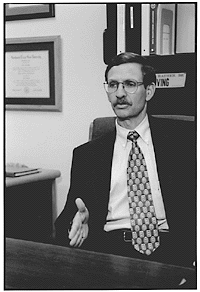 Interim APD Chief Bruce Mills |
of isolation in the Fifties, Sixties, and Seventies within a paramilitary
construct of reactive/response-style policing, police departments across
the nation have had to face the reality of rising crime rates, and a resulting
palpable fear even in safe communities. During the previous three decades,
it could be said, it was criminals who were innovative, not police. Youth
gangs and drug dealers have become better armed and more organized than
the police or the communities in which they operate. In the end, residents
have lost trust in police officers’ ability to protect them. Much of the
problem is a consequence of the isolation, which causes negative stereotyping
on both sides. Within a paramilitary police philosophy, victims and perpetrators
have the same face, and police officers may even tend to blame the victim
for the crime committed against them. In the most dangerous neighborhoods,
the community and the police not only don’t have a working relationship,
they have an adversarial one.
Community policing is supposed to reverse all that by encouraging police
departments to get back to basics with foot patrols, decentralized police
forces, police/resident informational meetings, and resident surveys. For
many cities it works extremely well. San Diego, El Paso, Madison, Wisconsin,
and even New York City have model community policing programs. The biggest
success story seems to be San Diego, in which overall crime incidents have
decreased by 43% since 1992, even with a 4% increase in population, and
with only 1.7 officers per 1,000 citizens — a much lower ratio than the
federal recommendation of three officers per 1,000 residents. (Austin currently
has 1.8 officers per 1,000 residents.) El Paso went “full blown”
on community policing in 1995, according to its police officials, and the
plan is definitely working. Since 1992, El Paso’s population has increased
by 10%, but crime has gone down 16%. El Paso also succeeds with 1.7 officers
per 1,000 citizens. In cities without a working community policing plan,
the contrast is startling. Tucson, for example, a city which has grown 6%
in population since 1992, suffers from an overall crime increase of 23%,
despite having over 2.5 officers for every 1,000 residents. Tucson is coming
around, however, having just developed a pilot program last summer called
Geo-Policing, designed to bring cops closer to the community.
In San Diego and El Paso, officials report that their neighborhoods are
not only safer, but most importantly, residents feel safer. How important
is it that residents feel safer, especially if their neighborhood is not?
Studies from the Police Foundation show that even in communities that improved
their police presence with more officers on foot patrol, communities weren’t
necessarily safer. Yet the studies, conducted primarily in Newark, New Jersey
and in Flint, Michigan, revealed that foot patrols eased citizens’ fear
of crime, made them feel safer, and improved the community’s satisfaction
with police work. And those programs, combined with other community-based
efforts, go a long way toward fighting crime’s greatest enablers: fear and
silence. As noted by the Community Policing Consortium, a division of the
U.S. Department of Justice’s Office of Community Oriented Policing Services
(COPS), such fear-reduction studies “proved the effectiveness of key
community policing tactics like community organizing, door-to-door contacts,
neighborhood mini-stations, and intensified enforcement coupled with community
involvement in reducing fear among residents, improving community conditions,
and enhancing the image of the police.” The hope is that if
fear could be reduced, community residents would be more inclined to take
an active role to help police preserve safety and tranquility within their
neighborhoods. Further, the Consortium determined that “community policing
produces improved relations between people and their police as a welcome
by-product of delivering high-quality decentralized and personalized police
service to the community at the grass-roots level.”
To that end, El Paso officials committed to a restructuring of the police
department, the construction of substations in every sector of town, and
galvanized the entire community to pitch in and help. “An active community
makes it easier to fight crime,” says Sgt. Bill Pfeil in El Paso, adding
that the city has “an extensive volunteer force that complements our
police work.” In all the above model cities, crime prevention duties
through programs and neighborhood meetings became as important as the basic,
but essential, call-response service all departments provide.
You Win Some,
You Lose Some
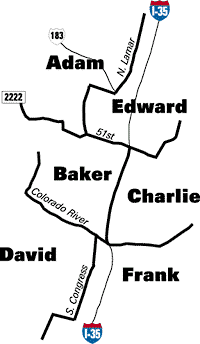 APD uses 6 names to label different areas of the city |
Certainly Watson’s community policing plan had the beginning elements
of success: The police chief changed the department’s mission statement
to reflect a commitment to community service and partnership; she opened
eight neighborhood centers to serve as liaisons between the community and
the police (see box) and created the Chief’s Forum of 24 neighborhood representatives
from the six city sectors, who meet monthly to discuss problems in their
communities with the police; in 1995, she flattened management by eliminating
the five deputy chief positions to encourage the quicker flow of information
from the lower-ranked officers to upper management; and to help maintain
quick response time, Watson won funding for 57 more cops on the street over
the last three years. Finally, she implemented a six-sector lieutenant plan
in 1995, calling it the “flagship” program of community policing
for Austin. In each sector of the city, about 70 patrol officers are designated
within each area under one lieutenant who is accountable on a 24-hour basis
for his “beat.” The idea was to empower the leader of each sector
to come up with crime prevention and crime-fighting strategies specifically
designed for his or her area.
In certain Austin neighborhoods, community policing is working, but only
in the most organized areas. In the “David” sector of central
South Austin — south of the river, between Congress and Lamar — neighborhood
leaders say the police have worked hard with them to clean up long-standing
prostitution and gang problems. The recent sting operation on South Congress
that nabbed Texas State Senator Drew Nixon (R-Carthage) was a high-profile
strategy that worked well with resident support. Chief’s Forum representative
Scott Bennett calls police efforts during that sting “outstanding,”
and says he’s proud of the “two-way communication and partnership between
our community and law enforcement.” Bennett confirms that the neighborhood
started becoming tightly organized around 10 years ago, and that that is
likely the reason community policing works so well for South Austin. Another
Chief’s Forum representative, Jerry Hill of the “Frank” sector
of Southeast Austin, also commends APD for its efforts to help clean up
graffiti and curb truancy. Hill can, like few residents in other areas of
town, name the point officer for his community. “Officer Roger Bahr
came to our meetings, alerted us to problems and was a source of information.
But our neighborhood group is pretty active, so we work well together.”
In other areas of town, namely East and Northeast Austin, neighborhood
groups have sometimes faltered in their attempts to organize successfully,
and in high-crime areas, the priority is reactive policing. Over half of
APD’s crime fighting resources are spent in East Austin alone. As Watson
pointed out in an interview during her last week as chief — along with
a concentration of patrol officers, APD’s gang unit, narcotics unit, and
Crime Net unit each spend 50% of their time on the East side. But those
efforts consist of throwing bodies at the problem without enacting community
policing principles. Making it more difficult is the fact that the areas
that need the most help — such as parts of Coronado Hills, Craigwood, and
the Manor and Loyola areas — do not have well-organized neighborhood associations,
and most of the pressure on police to “do something” about shootings,
open drug-dealing, gangs, and assaults, comes from surrounding neighborhoods.
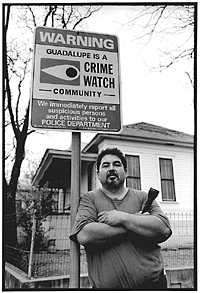 Guadalupe resident David Zapata |
operations — the latest is called “Operation Cleansweep” — in
which “hot spots” are targeted and criminals are rounded up. Such
techniques are necessary, but should not stand as the sole barrier against
crime. As noted in research by Robert C. Trojanowicz, Director of the National
Center for Community Policing at the School of Criminal Justice of Michigan
State University: “Particularly with open drug dealing, the relative
impotence of mass arrests to solve the problem quickly become apparent —
the police swoop down and haul people away, but then in a few days, it’s
back to business as usual. A community policing approach instead relies
on that community officer stationed in the area to develop a comprehensive
short- and long-term strategy to reduce open dealing.”
One exception to the East Austin syndrome of scant community participation
is the Guadalupe neighborhood between East 11th Street — a high crime area
— and East Seventh. Guadalupe residents have been successful in using not
only the police, but city programs and housing codes to clean up street
drug-dealing, prostitution, vagrancy, graffiti, and alcohol abuse that plagued
their historic area near the French Legation. Lifetime resident David Zapata
was a key organizer, who began trekking from house to house in 1991 getting
neighbors to rally around the Neighborhood Watch program. “We have
100% participation in the neighborhood. That’s the only way it will work
— people have to get involved, have to want it. Police can’t be everywhere
all the time. People feel safe now walking around — that wasn’t true ten
years ago.” Zapata took a very personal approach to the problem, as
did his neighbors. “When I first started, I got all the prostitutes
on the corner and talked to them — said you have to do what you have to
do, but not in my neighborhood or I’ll call the law. Out of respect for
our efforts, they didn’t come into our neighborhood. They really just didn’t
want that hassle, so we had an understanding.”
Zapata says he and his neighbors aren’t going to wait for the police
to target their neighborhood, particularly since the neighborhood has seen
a young crack-selling crowd creeping over onto their quiet street recently.
“I’ve parked up on the hill by San Marcos and E. 11th, and seen the
police parked one block down with street people selling crack right near
them. I don’t know if they’re ignoring the problem, or what. To be honest,
we have relaxed and started to see a wave of crime again. Fighting crime
is a constant job. I think I’ve learned a lesson that you can’t ever let
up. So we’re back to fighting crime again, and we’ll need to get it back
to where we had our serenity.”
A Leader of One
Why is community policing reaching some parts of the city and not others?
At least part of the responsibility apparently rests with APD leadership.
Watson’s plan was a progressive start for Austin, but what remained out
of her reach was the one thing all leaders need: followers. Watson’s ability
to lead her police officers suffered often during her four-year tenure —
from a distrust in the ranks over her lack of patrol experience to dissatisfaction
over her implementation of community policing. Specifically, her elimination
of the deputy chief positions rankled officers, since it was a level of
command to which they could have been promoted. The police culture is traditionally
resistant to change, but many police forces in other cities have been able
to overcome fear of change with strong leadership. In Austin, the resistance
continues — perhaps most importantly, say the leaders of the Austin Police
Association, because Watson was unable to communicate her vision effectively.
In the words of one sector lieutenant, Manuel Pe�a, who oversees
the Central East Austin area, or “Charlie” sector, Watson “probably
could have done a better job of selling herself to the force — she ended
up setting herself apart. If a police chief doesn’t enjoy support from the
people they work with, they’re not going to be successful.”
That reason alone made it difficult for Watson and her assistant chiefs
to lead the force into a new era of community policing. It wasn’t that APD’s
957 police officers didn’t agree with her — the audit’s survey of officers
shows that only 1% of them are totally against community policing. Instead,
it seems, the rank and file don’t really understand what they’re supposed
to be doing. According to the audit, major strategies to implement community
policing in Austin have suffered because of a lack of communication, and
a lack of consensus in upper management on how to deploy officers: “Very
little education for decision makers as to the nature of community policing
has taken place. One result of the lack of education is the continuing debate
over the number of officers needed on patrol. APD as well as city policy
makers focus on the number of officers on the street as opposed to the method
in which the officers are deployed, which could have a more significant
impact on crime. In fact, to effectively implement community policing, it
is necessary that nontraditional methods of deployment be utilized since
the needs of each neighborhood will vary.”
Last fall, during the budget season, Watson and APD came under fire from
the city council due to some unanticipated expenses from the prior year’s
budget. It was during this time that the city audit was scheduled, but notably,
the council seemed primarily concerned with sexier topics than finances
— such as increasing the ratio of officers to citizens to improve response
time. Certainly Watson was interested in increasing the number of police
on the streets, but she also took that time to introduce to the council
her plan to commit one-third of the her force’s time to community policing
efforts. It was a politically charged topic: Sometimes community policing
is at odds with a priority in the community for quicker response time (i.e.
a larger police force). Yet studies indicate that fast response time has
no connection to better crime-solving, while crime prevention with community
participation, in fact, does. A Law Enforcement Assistance Administration
project called the Kansas City Response Time Study and a later National
Institute of Justice replication of the study in several other cities indicate
that there is no relationship between a rapid crime scene response and the
apprehension of criminal perpetrators.
APD is currently understaffed, according to the number of officers it’s
authorized to hire, by about 100 officers, a fact that slows APD response
time. The city currently has three cadet classes in training, with 35 of
those cadets hitting the streets this summer. Yet Austin still maintains
a higher ratio — at 1.8 officers per 1,000 residents — than other cities
with successful community policing programs. Still, Austin Police Association
members and middle-command officers cite the missing officers as the reason
that community policing is not possible at this time. “I agree with
community policing to a point,” says APA president Sgt. Mike Lummus,
who was a frequent critic of Watson, “but the real problem is the 100
officers we need to make it happen.” Lummus is pushing a $10 million
plan to provide a police car for every officer (currently the cars are available
only while on a shift) to both patrol on the job and to commute to work.
Lummus adds that his vehicle idea also constitutes community policing since
it improves police presence. In terms of expense, “it’s a front end-loaded
plan, but later it begins to pay off,” he says.
The council is likely to balk at Lummus’ suggestion, but what the APA
leader is definitely interested in, he says, is lifting morale. That’s something
community policing — in its less expensive form of asking police to partner
up with residents on strategies — is not likely to do immediately. Many
officers see that kind of police work as simply “pacifying” residents
while their response time slips through the cracks. It takes more time and
energy than many APD officers are willing to give, or even know how to give.
The Information Vacuum
Certainly, the lack of training on this new thing called community policing
is causing confusion for the officers. But it’s the sector lieutenants,
the “flagships” guiding the officers, who are really not ready
for the new era. Interim Chief Bruce Mills says that community policing
has been “institutionalized” in the force already, but the audit
reveals that “empowerment has been neither adequately defined nor formally
assigned,” among sector lieutenants. The audit goes on to say that
sector lieutenants are divided over whether they feel empowered to do their
job, but certainly “there is some confusion as to the level of authority
and responsibility that has been vested in them. The sector lieutenants
have been submitting official `Sector’ plans since 1993. As of our last
discussions with them in the fall of 1996, none received approval to implement
the submitted plans. The sector lieutenants reported having implemented
varying levels of their plans without approval.” Interim Chief Mills
adds that there is not enough crime analysis or management information given
to sector lieutenants for them to draft effective strategies for dealing
with neighborhood issues, nor is there a system to collect feedback on any
initiatives that might be implemented.
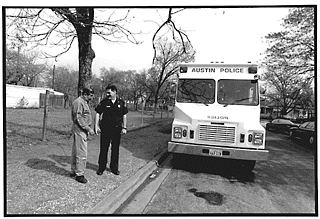 Police Lt. Manuel Pe�a (right) doesn’t think community policing, as a whole, has been a failure, but “it has been a disappointment” |
A visit to the East Austin substation gave evidence to the audit’s results
and Mills’ beliefs. Pe�a agrees that things are not quite as great
on the community policing front as they could be. “More often than
not, we just don’t have the time,” he concedes. But it’s not just the
time factor. “Community policing was never committed to in attitude,”
he confides. “And I just don’t remember any of us being given any instruction
or knowledge of it. They really dropped the ball on this thing.” As
for the rank and file, Pe�a concurs with the audit. “A lot of
officers didn’t see any benefit, and thought that, in fact, it could make
their jobs a lot harder. They really were not educated on how it would help
them in the long run. Unless you have that officer out there dedicated to
seeing some results, no program is going to be successful. In Austin, I
think that’s a problem.”
Community policing, as a whole, has not been a failure in Pe�a’s
opinion, but “it has been a disappointment.” Pe�a says
that as sector lieutenant, he tries to stay in contact with the community
and encourages his officers to do the same, but he acknowledges that there
is no formal structure for doing that. Whenever he can make it to a neighborhood
meeting, he tries to go and listen. But again, that is the only method he
has for receiving information from the community. He points to the Chief’s
Forum as a way for upper management to stay informed by neighborhood representatives,
but he adds that that information, as noted in the audit, rarely makes its
way down to the people in charge of the sectors.
Watson called community policing “attitudinal rather than procedural”
in nature — a concept with which Interim Chief Mills concurs. That definition
may be correct, but it’s telling that Austin’s community policing is not
working in the most troubled neighborhoods beyond the merely hypothetical.
If Austin could get more police officers, if neighborhoods in those areas
were better organized, if APD could choose a new police chief with leadership
skills… if, if, if. But consider the value of using the resources the
police department currently has, and making a commitment to change right
now. The investment could mean lower crime rates for generations.
Imagine how difficult it is to stay straight when you grow up surrounded
by garbage, drug dealers, prostitutes, and drunks. Imagine trying to find
a place for good values in your life if the only people who really make
any money are criminals. In our current urban environment, says Robert Trojanowicz
of the National Center for Community Policing, “the question becomes
why there is any resistance to community policing reform. Part of the reluctance
to make the shift to community policing stems from a basic resistance to
change. Yet resistance also stems from the fact that community policing
is people-intensive, and high-touch is often more expensive than high-tech.
But while a new computer may make police more efficient, when it comes to
helping young people grow up to live within the law, nothing can beat the
human touch.”
This article appears in March 21 • 1997 and March 21 • 1997 (Cover).