

 |  |
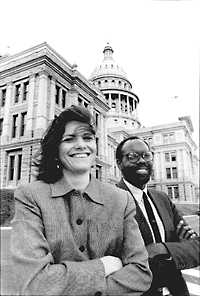
Janee Breismeister and Reggie James of the Consumers’ Union(l), and John Hildreth of the Coalition for Affordable Power-Texas(r) | |
Last session, the gravy train for lobbyists and consultants was casino gambling. This year, it’s
electricity deregulation. Hundreds of lobbyists have signed up to fight over
the issue, and numerous consultants in Austin and elsewhere are collecting
handsome fees for media advice and strategy.
The Texas electricity market is the largest in the country. In 1994, Texas
electric producers sold about 258 billion kilowatt hours of electricity, worth
$16.5 billion. So it’s not surprising that the companies supporting and
opposing deregulation are spending millions of dollars on lobbyists to
represent their interests.
There are more than two sides in the electric fight. But the two main groups
break down like this: proponents of deregulation are aligned in a group called
the Texas Coalition for Competitive Electricity (TCCE); deregulation opponents
are headed by the Association of Electric Companies of Texas (AECT), a trade
group which represents the state’s investor-owned utilities. The combined
assets of the seven members of AECT total more than $70 billion, and their
combined sales exceed $20 billion a year. That kind of money buys high-voltage
advice. Peggy Venable, director of Citizens for a Sound Economy (see sidebar),
says “Any lobbyist or public policy analyst that can be bought, the utilities
have bought.”
Shortly after the last session, AECT scored a coup by convincing Curtis
Seidlits, a respected former legislator from Sherman, to quit the Lege and
become the head of their lobby effort. Seidlits reportedly took a five-year,
no-cut contract with a salary of $250,000 per year, a significant raise from
the $7,200 a year paid to Texas legislators. He now oversees a fleet of
hired-gun lobbyists, including Reggie Bashur, a former aide to Gov. George W.
Bush, former state senator Kent Caperton, longtime lobbyist Buddy Jones, and
John Hall, who in less than two years has been transformed from the head of the
Texas Natural Resource Conservation Commission into one of the highest-paid
lobbyists at the Capitol. According to filings with the Texas Ethics
Commission, in addition to AECT, Hall’s clients — all of whom pay him between
$50,000 and $99,999 — include Diamond Shamrock Refining & Marketing, Fina
Oil & Chemical Co., Lower Colorado River Authority, Pedernales Electric
Cooperative, Inc., and Waste Management of Texas, Inc. One consumer advocate
says of Hall’s experience in state government, “his training may prove very
expensive to the taxpayers.” In all, AECT has 12 lobbyists, including Seidlits
and Hall, on the payroll.
To fight deregulation, AECT can also call on dozens of other lobbyists, who
work for its members. Dallas-based Texas Utilities (TU) has nine lobbyists
under contract, including former House Speaker Billy Clayton and Mayor Bruce
Todd’s father-in-law, George E. Christian. (TU has made it known it would like
to buy Austin’s publicly-owned utility). Houston Lighting & Power has 21
registered lobbyists. New Orleans-based Entergy has 16.
AECT has also hired Public Strategies Inc. (PSI), an Austin-based consulting
firm, to help develop media and lobbying strategy on the deregulation issue.
PSI may be the best-connected firm in the state. Headed by Jack Martin, a
former aide to U.S. Senator Lloyd Bentsen, the firm also has media and campaign
whiz kid Mark McKinnon, White House refugees Jeff Eller and Paul Begala for
national expertise, and former Capitol lobbyist Jack Gullahorn to provide
statehouse savvy.
AECT used local consultant Greg Hartman, who works for MGT of America, to
produce a report released last month which argued that deregulation would cut
state and local revenues by a minimum of $234 million per year. Economist Jon
Hockenyos, managing director of Texas Perspectives, is on retainer to AECT and
is providing research and analysis to the group. (Hockenyos and Hartman are
also associates of Todos, the business alliance Mayor Todd formed with his
wife, Elizabeth Christian, last spring).
The Coalition for Affordable Power-Texas (CAP-Texas), whose interests in
opposing deregulation are virtually identical to those of AECT, has one
registered lobbyist, John Hildreth. The former director of the Southwest
regional office of Consumers Union, Hildreth left the group last May to become
the president of CAP-Texas. Said one consumer advocate of Hildreth’s move, “It
really hurts when the other side picks off one of the people that you thought
was a stalwart for consumers.”
But Hildreth says, “I didn’t switch my position on this issue.” He says that
while with Consumers Union, his position was that “deregulation should only
occur if it’s fair to all classes of customers.” He says that with CAP-Texas he
is “working from a different perspective and it’s a broader perspective than
just residential consumers. We should take a very cautious approach to it, do
it right and learn from the experience of other states before we determine if
we should do it in Texas.”
 |  |
Tom “Smitty” Smith of Public Citizen,(l), and Peggy Venable, head of the Texas office of Citizens for a Sound Economy (r) | |
lobby force is nearly twice as large. The group’s attack is being led by Bill
Miller, the voluble head of Austin-based PR/government relations firm
MEM/Hubble. Miller directs five hired-gun lobbyists, including Steve Bresnen, a
former aide to Lt. Gov. Bob Bullock. But like his counterparts at AECT, Miller
can also tap a fleet of lobbyists who are not working directly for TCCE. One
TCCE member, the Texas Chemical Council, has six registered lobbyists. Mobil
Oil and its subsidiaries have 13, including the City of Austin’s lobbyists,
Adams & Zottarelli (see sidebar). Texaco has four, Chevron has seven, Dow
Chemical has eight, and oil giant Exxon has 21. The Texas Apartment Association
has four lobbyists, including the ever-charming Dick Brown, and the Association
of Chemical Industry of Texas has six. In all, TCCE has at least 124 lobbyists
it can count on when the sledding gets rough at the Lege.
One of the world’s biggest power companies, Enron Corporation, is not aligned
with either AECT or TCCE. That’s because Enron is staking out its own territory
in the power business, and its interests don’t align exactly with the
pro-deregulation forces of TCCE. While Enron, one of the world’s largest
natural gas marketers, would benefit from selling power in a deregulated
world as an electricity marketing business, it also has one foot in the
environmental camp, with interests in alternative energy sources. It moved
recently into the solar power business with a big installation at the Nevada
Test Site, and it recently bought Zond, America’s biggest wind
power company. Enron will field 20 lobbyists, including former city attorney
Diana Granger, who now works at the Austin office of the law firm Akin Gump
Strauss Hauer & Feld.
While big industry has hundreds of lobbyists working on the issue, consumer
and environmental groups, who recently pulled out of talks with legislators on
drafting a bill calling for deregulation (See “Shock to the System” this
issue), will have less than a dozen lobbyists working the halls of the Capitol.
The Texas office of the consumer group Public Citizen will rely on Tom “Smitty”
Smith for its lobbying effort. Consumers Union’s team includes Reggie James,
Janee Breisemeister, Kathy Mitchell, Robert Schneider, and Elizabeth McGiffert.
The Sierra Club has two registered lobbyists, but electric deregulation is a
back burner issue for the group. And the Texas Renewable Energy Industries
Association, which pushes renewable energy, has one lobbyist, Russell Smith.
The Texas office of the Environmental Defense Fund (EDF), one of the country’s
biggest environmental groups, has four registered lobbyists — Jim Marston,
Karl Rabago, Joe Woods and Adrian Saenz. Marston, who directs the Texas EDF
office, acknowledges that consumer and environmental groups are outgunned at
the Lege. But he remains optimistic that they will be able to have an impact.
“We are trying to create strategic alliances,” he said. “And hope that if it’s
a close fight, we can tip the balance one way or the other.”
This article appears in February 21 • 1997 and February 21 • 1997 (Cover).