

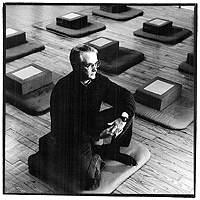
 Daryl Reed photograph by Minh Carrico |
your gift-buying tasks as part of the festive holiday season. Or perhaps you
enjoy — or endure — commuting to and fro on 183 every day. Whatever your
relationship is to 183, you probably don’t realize that nestled in between the
nondescript strip malls, elevated highways, and bumper-to-bumper traffic (by
the Target at the intersection of 183 and Ohlen Road, in fact) there is a
center for an Eastern religion practiced by millions of people all over the
world.
Yes Virginia, there is a Buddha in Austin, Texas.
While many of you probably suspected as much, you may not be aware of the
details. There are a number of Buddhist congregations (sanghas) in the Austin
area, with as many as 200-300 regular members. Most have strong ties to, or are
part of, local Asian communities — the one on 183, for example, is
predominantly Taiwanese, while the one near Leander is Vietnamese. Dharmadhatu,
the oldest and largest sangha in Austin, however, is predominantly made up of
Westerners.
Although Buddhism may seem very foreign and “mystical” in the West, its basic
concepts are straightforward and involve things such as relating to your
thoughts, making friends with yourself, and learning how to become peaceful.
Most Buddhist practitioners subscribe to the philosophy of four noble truths:
There is suffering.
Suffering has a cause.
Suffering has an end.
There is a path that leads to the end of suffering.
These truths may be something you can relate to while you’re stuck in traffic
on 183.
“This isn’t anything weird,” says Daryl Reed, Dharmadhatu’s coordinator.
“Buddhism’s not some big esoteric thing. It’s much more mundane and practical.
There are people who come to the center with a lot of conceptions. After about
10 minutes, they realize, this is just a bunch of folks.”
Reed, who is the morning announcer for the classical station KMFA-FM, says
meditation can make those instances out on the highway easier to handle. “It’s
working with what you have right in front of you. It’s letting go of personal
territory. It’s not about beating yourself up. It’s also about community, being
able to bounce things off each other. That’s why it’s called a path that you
have to walk on one step at a time. It’s not a superhighway. It’s not a
microwave religion.”
Jane Cobb, a member of Dharmadahtu, began her path in Buddhism at age 19. “Out
of curiosity, I read a book called The Empty Mirror, about a Westerner
who goes to Japan and lives in a Zen monastery for a while. About four years
later when I was in college, I studied Japanese and went to Japan. Eventually,
I began to practice a non-sectarian type of meditation known as Shambhala.”
Three years ago, she made the full commitment to being a Buddhist practitioner
after taking her three refuge vows. A psychotherapist, Cobb says being a
Buddhist practitioner helps her with her clients. “I find my job to be very
humbling and rewarding. I feel like my Buddhist practice is very related to
what I do. When I do a good job as a therapist, I realize that their pain and
suffering is not so different from mine. I find that meditation helps me to be
a better therapist. I believe so much in people being able to carry their own
wisdom. At the same time, I also feel like I have a long way to go with
this.”
While many have found Buddhism later in their lives, Austin’s Ken Van Dine
began his interest at age six while growing up in Chicago in a predominantly
Catholic family. “I used to draw pictures of Buddha with a No. 2 pencil, glue
them to cardboard and prop them up like they were a statue. My mom would ask me
why, and I would say because I think they are beautiful.”
A couple of years later, Van Dine convinced his family to visit the Museum
of Natural History to see an exhibit and film about the Dalai Lama. He decided
then and there that he wanted to meet him some day. The years went by. Then in
1990, during a visit by the Dalai Lama to Houston, Van Dine got his wish. “It
was if time stood still,” he says.
An AutoCAD operator/draftsman for a civil engineering company, Van Dine says,
“The whole basis of everything Buddhist is that one should strive higher for
realization of the benefit of all sentient beings. Everyone who is a Buddhist
practitioner begins and ends there. It really changes your life.”
Van Dine begins and ends every day with meditation in front of his altar.
“Altars include pictures and statues of enlightened beings, because they are
windows to enlightenment. The familiar Buddha with a smiling face — this is a
state known in Western tradition as `calm abiding.’ It’s not idol worship,
although it’s very easy for the Western mind to look at it and think that.”
At the same time that Dharmadahtu centers across the country are becoming
more “Western,” some of the ethnic congregations are embracing technology. The
International Buddhist Progress Society (IBPS) at 8557 Research Blvd. —
they’re the one by the Target who are predominantly from Taiwan — has launched
its own web site at http://www.comland.com/~ibps/ Their U.S. headquarters site,
based in southern California, is at http://www.ibps.com
Man Ya, a Buddhist nun, leads IBPS’s Austin congregation. She says modern
Buddhism is very different from years past. “In the traditional Buddhism, there
were monks and nuns who tried to cultivate the high path while having no
contact with the outside world. Nowadays, we want Buddhism to be part of every
day life. There has been a tremendous change in what has gone on traditionally
and what is going on today.”
IBPS member Yung Liao agrees, noting that her group’s branch of Tibetan
Buddhism, Fo Kuang Shan, realizes the significant role of lay people like
himself rather than just focusing more on clergy. “We also are connected to our
newfound country, the United States. For example, our children are in Austin
schools and want things like Christmas trees. Therefore in addition to our
practice of Buddhism we also adopt local traditions.”
Fo Kuang Shan plans to carry its current, open philosophy over to its new
temple at 6720
N. Capitol of Texas Hwy (north of the intersection with RM
2222), when it is completed by April or May, 1997. According to its literature,
it will provide “the people of Austin a place and many opportunities to learn
and practice Buddhist teachings as well as to discover the richness of cultural
diversities.” Covering about 20,000 square feet of construction area on an
11-acre site, it will include a main shrine, meditation hall, dining hall,
conference room, classrooms, offices, and living quarters.
For more info on Buddhism in Austin, contact: The Dharmadahtu/Shambhala
Center, 443-3263; The International Buddhist Progress Society, 836-7459; or The
University of Texas Buddhist Society at http://ccwf.cc.utexas.edu/~buddhist/
This article appears in December 27 • 1996 and December 27 • 1996 (Cover).