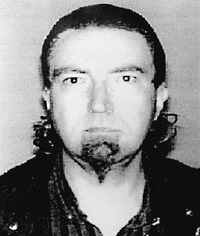
 Bruce Becker |
the afternoon of July 14, 1996, Bruce Becker wanted two things. He wanted the company of a man
and he wanted some fresh white corn that reminded him of summers growing up in
Pennsylvania. He knew where he could find both.
He met up with Daniel Carl Greeley, a good-looking young man who was out of
work and living on the streets; the men had met once before on the Drag on
Guadalupe Street. The two rode together to Central Market where Becker selected
several ears of corn from a newly arrived bounty that spread like a great,
green field before him. After a quick stop at Albertson’s for bread, milk, and
ice cream, they headed to Becker’s house in a Southeast Austin neighborhood of
gentle hills, Doyle Wilson homes, and yards rich with cedars.
The unlikely duo — Becker friendly and talkative, Greeley quiet and
well-mannered — were getting along nicely as they headed home. Their lives
seemed as open as the road that day.
But something, somewhere, went terribly wrong. When it was all over, Becker, a
36-year-old government employee and Penn State graduate who loved fine scotch,
Tom Waites, British comedies, and the Republican party, lay dead in a pool of
blood in the TV room of his $100,000 home. Greeley, 26, stands accused of
killing Becker by slamming a metal bar, or club, against the victim’s head and
stabbing him in the throat with a kitchen knife.
The murder was, tragically, what Becker’s friends feared would someday happen
if he continued cruising for sex with strangers. But for Becker, the routine
was old hat — one that he had grown accustomed to as a semi-closeted
homosexual living in Austin. Only the year before, Becker had taken the bold
step of coming out to his parents and his brother during a family visit. The
four were watching a football game on television when Becker broke the news. It
was a tremendous relief for Becker, says a close friend, Christopher Bordovsky.
“His parents had a hard time with it because it was a relatively new thing for
them, but they didn’t shut him out. They were dealing with it as well as could
be expected,” he says.
Indeed, living in fear of one’s sexual orientation being discovered can be a
scary thing in a society that does little to accept or legally recognize
homosexuals. While pick-up encounters exist in both straight and gay worlds,
the covertness of sex with strangers can figure more prominently into a gay
man’s inability, for whatever reason, to fully accept his sexual orientation.
In Becker’s case, he’d had meaningful relationships with men in the past, but
one-time encounters seemed much less complex. It was, for all intents and
purposes, a good way to compartmentalize being gay. “Because he was in the
closet for as long as he was, it was just easier for him this way,” reasons
Bordovsky.
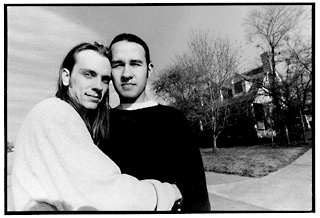 Christopher Bordovsky, left, and partner Paliman Habibi were friends with murder victim Bruce Becker |
of Texas (LGRL). There were suggestions that Becker was the victim of a hate
crime. And the calls kept coming. In the 28 days that followed in July and
August, two other gay men turned up dead in the Austin area [See story on
Austin’s gay murder victims and proposed legislation against hate crimes].
Hate Crime or Self Defense?
Was Becker’s murder motivated by hate? That’s a tough call, but the questionis not expected to play into the courtroom drama when the case moves to trial
sometime before summer. Police and prosecutors are sticking with robbery as a
motive because of credit cards and other items stolen from Becker’s home. As
for Greeley’s defense, it’s possible he will say he acted in self-defense, that
Becker came at him with a club. It is a claim he made to friends after the
murder, and the friends in turn told police, according to a source familiar
with the case.
To be sure, self-defense claims don’t generally wash with gay rights groups
because they are made all too often — and often successfully — in homosexual
murder cases. And Hardy-Garcia points out the deeply ironic fact that female
defendants accused of murdering white heterosexual men haven’t been as
successful in asserting the same self-defense argument.
By the accounts of those who knew him, Becker was a model citizen with an
exemplary work record as a computer trainer and network troubleshooter at the
Internal Revenue Service, where he had worked for 10 years. His wit and wisdom
gained him many friends among the tightly knit group that worked with him. He
was the one who held his coworkers together — the one who organized birthday
lunches and office games to break the tedium of working for the IRS. Becker
“was the office comedian, the one who kept us all lighthearted,” says co-worker
Pam Johnson. “We were like a family. Now we’re like strangers.”
Becker’s grief-stricken parents, June and Albert Becker, retired and living in
Winter Springs, Florida, declined to discuss their son’s death out of concern
that they might jeopardize the case before it goes to trial. Becker’s father,
however, offered these words: “Bruce was a wonderful child. We loved him very
much, he loved us, and we will miss him forever.”
Those who knew Becker are baffled by the defendant’s claim of self defense,
given Becker’s small build and his non-violent, non-aggressive countenance.
Bordovsky says that Becker had relayed countless pick-up stories to him, and
never once did any tale involve physical conflict. “Bruce usually made it clear
to the person what he was looking for early on in the discussion. That was his
M.O.,” says Bordovsky. “If the guy said no, then that was that. He wasn’t the
type to get all flustered. Bruce was just not a violent person.”
Plus, if Greeley was defending himself, why, then, did he not summon the
police? Why did he allegedly clean up the murder scene? Why did he
allegedly steal credit cards, the car, and other items from the house, and stow
the body in a shallow grave in a remote site in the Texas Panhandle?
Clearly, defense attorney Tom Weber — himself a former prosecutor — knows
Greeley’s self-defense stance will be a hard sell, but he refuses to comment on
the case. “His guilt or innocence will be decided in the courtroom,” Weber
says.
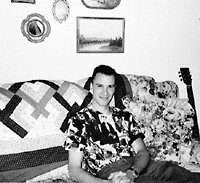 Daniel Greeley stands accused of murder in the death of Bruce Becker |
with the law. From what police can tell, he has pretty much kept his nose
clean, save for a minor scrape when he briefly went AWOL while in the U.S.
Army. As an enlistee stationed in Germany, he was a trusted driver for a
general, according to his parents, Virgil and Carol Greeley of Olympia,
Washington. He stayed in shape by running, and had participated in a number of
10K and 5K races during his tour of duty. He was last stationed at Fort Hood,
just north of Austin in Killeen. Greeley’s life after the army was one
hard-luck tale after another. He and his wife had split up, he couldn’t find
permanent work, and he was living on the streets.
Two days before Becker’s death, Greeley, one of four children, had called his
parents to tell them he was giving up on Austin and returning home to Olympia
to look for a job. “He was always a very hard worker,” says Virgil Greeley.
“You can’t call Danny lazy by any means.”
Greeley’s parents also vouched for their son’s non-aggressive behavior. “He’s
kind of a shy person who avoids confrontations. He’d rather walk away from
trouble,” his father says.
“Danny has always been a very quiet and very likable kid,” his mother adds.
“So we are naturally just flabbergasted by this charge. This ordeal has cast a
shadow on our lives, and our hearts certainly go out to [Becker’s] family.”
The Greeleys say they will be in court when their son goes to trial. “We’re
hoping and praying that justice will be done. That’s our prayer,” Virgil
Greeley says. Even if it means the murder conviction of his son? “That might be
the case,” he says, “but we want everything to be fair on both sides, for the
defense and the prosecution.”
Fear and Dread
On the Sunday when Becker was murdered, Bert and Bennie Carlisle, Becker’snext door neighbors on Sunridge Drive, off of East Oltorf, were at home,
unaware that the neighbor they could always count on to feed their cat when
they were away was in danger. At about 9am the following Monday morning, Bert
Carlisle glanced over and noticed Becker’s car still parked in the driveway.
Strange, he thought. Becker should have already left for work by this time.
Twenty minutes later Bennie Carlisle set off on her morning walk around the
neighborhood. “I remember seeing somebody, but not Bruce, backing out of the
driveway in Bruce’s car,” she says. “I didn’t think anything about it. I
figured he was a friend of Bruce’s.”
On Tuesday, Becker’s friend Bordovsky got a frantic phone call from a worried
co-worker of Becker’s. He decided he needed to check on his friend, and, when
he entered through the side door of the house with a spare key, Bordovsky got
his first surprise: The alarm had not been set — very unusual for Becker, who
was always so meticulous about his home’s security. What’s more, the air
conditioner had been left on a low setting and the house was freezing. Becker
always turned his AC off completely before leaving home.
Those two out-of-the-ordinary facts set Bordovsky’s nerves on edge. “I had
this overwhelming feeling of fear and dread,” he says. Bordovsky grabbed a
baseball bat from a collection of sports equipment Becker kept in the garage.
He tried to steel his nerves before beginning a very slow walk through the
house. “Bruce! Bruce! Are you here?” Bordovsky called over and over. “I was all
but singing his name at the top of my lungs,” he says. “I walked into the TV
room and there was this huge stain on the floor. It didn’t look like blood, it
looked like somebody had spilled a big pot of tea and had tried to clean it
up.” The stain carried a foul odor. The sudden ringing of the telephone jarred
the eerie silence of the house. It was Becker’s parents, hoping to find their
son at home for lunch. They were calling to finalize plans for a family
reunion. Bordovsky told them Becker had not reported for work for two days and
was nowhere to be found.
Later that afternoon, an Austin police officer arrived at the house to take
Bordovsky’s missing persons report. At the time, Bordovsky had yet to assess
whether anything was missing. The officer noted the large stain on the floor,
but it neither looked nor smelled like blood. The officer wrote in his report
that the stain smelled like a cat box.
In the days following Becker’s disappearance, Bordovsky began to notice things
missing from the house. There was the black footlocker missing from the room
where the stain was located. Becker had used it as a coffee table. There was
the kitchen trash can — gone; the guitar — gone; a keyboard to a computer, a
priceless collection of baseball cards, an autographed photo of Oliver North —
gone, gone, gone. Nothing made sense.
Perhaps the most frustrating thing about missing person cases is that it’s not
a crime for an adult to just take off and disappear voluntarily. It happens all
too frequently, says Lt. Charles Johnson, who oversees the Austin Police
Department’s missing persons division. More often than not, the person turns up
unharmed. Of the 603 missing adult reports filed in 1996 with the Austin Police
Department, only 16 remain open. “We get tons of reports on missing adults all
the time,” Johnson says. “We have to assess whether they chose to leave on
their own, even though family members always insist that their disappearance is
out of the ordinary.”
The happy endings to most missing persons’ cases was of little comfort to
Becker’s family. Becker’s frantic father and brother had hopped on a plane to
Austin on July 18 to await news of their son. They met with detectives the
following day. Finally, on July 22, a team of forensic investigators arrived at
Becker’s house.
“They took one look at the stain on the floor and closed the place down,”
Bordovsky recalls of investigators’ determination that the stain was blood.
“They impounded my truck. They were all over the place with dye, fingerprint
dust; post-it notes and circles on the floor where footsteps had been. They
cataloged it, booked it and took it away.” Police also questioned Bordovsky and
his boyfriend Paliman Habibi for several hours, finally eliminating the pair as
suspects.
Picking Up the Pieces
This is the scenario police have laid out: After Becker’s killing, Greeleydrove Becker’s car to fetch a friend, Johnny Ooten, and the two returned to the
murder scene to clean up the mess. Police say they placed the victim’s body in
a footlocker, drove 360 miles northwest to Armstrong County and buried the
trunk, with Becker’s body inside, at a roadside park overlooking the Palo Duro
Canyon. The pair returned to Austin and came upon two other young Drag
transients, Alan Johnston and Melissa “Fix” Manilio, who, along with Ooten, now
stand charged with illegal use of Becker’s credit cards.
Police landed their first solid lead in the case on July 27 when an Oregon
police officer found Johnston behind the wheel of Becker’s car in Arlington,
Oregon, about 130 miles outside of Portland. Johnston had run out of gas.
Arlington police confronted Johnston about the stolen vehicle and at that
point, Johnston spilled what he knew. The pieces began falling together. Police
picked up Manilio the next day in Austin, and Ooten the day after that. Ooten
gave police the location of Becker’s body and on July 31, Austin detectives and
a cross-section of West Texas law enforcement officers fanned out to search for
the body on the south rim of a canyon off of Texas State Highway 207. They
found the footlocker, with Becker’s decomposing body inside, buried in what had
been a coyote den. The shallow grave measured about three-and-a-half feet wide
and four feet deep.
Police tracked Greeley down in Salt Lake City, Utah where he had been laying
low at a friend’s house. He was arrested on August 5 without incident, and has
since been transferred to the Travis County Jail.
In late August, after the last arrest had been made, and after a small
reception in Bruce Becker’s honor, Bordovsky and Habibi, along with Bordovsky’s
mother, took a long road trip west. One of their stops along the way was the
roadside park where Becker’s body was found. Bordovsky hiked around the park
with his video camera in search of the make-shift gravesite where his friend
had been hidden. There, about 100 yards uphill, just beyond a clump of cedars,
was a small wooden stake that marks the spot. The site offers a spectacular
view of Palo Duro Canyon. “It was a beautiful spot that they picked,” says
Bordovsky. “They at least had the decency to pick a nice place to bury him.”
As a gift to Becker’s family, his co-workers put together a 17-page book of
memories. Jackie Antweiler wrote that her fondest memories were “all tied to
laughing until we would practically cry. You know the kind — when you get
tickled and can’t stop just like a little kid in church. You know that nothing
in the world is that funny, but you just can’t stop laughing. Bruce laughed
from the bottom of his feet; his whole body shook as he tried to get himself
back in control. Sometimes we couldn’t even make eye contact, or it would set
us off again. God, it felt so good to do it.”
Last October, Becker’s family chartered a boat off of New Smyrna Beach on
Florida’s northwestern coastline, a favorite vacation spot for Bruce. Three
miles from shore, the boat slowed and Becker’s family members scattered his
ashes to the wind. The ashes glistened briefly in the sunlight before settling
gently over the waters of the Atlantic.
This article appears in March 14 • 1997 and March 14 • 1997 (Cover).