

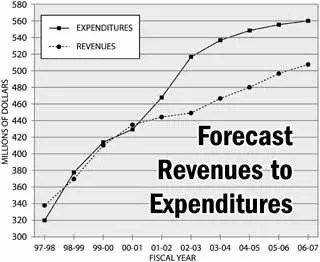
It wasn’t all a bad dream: The city of Austin really is facing a $68 million budget shortfall for the upcoming fiscal year. Thus spake City Manager Toby Futrell and her financial staff as they presented their five-year financial forecast to the City Council last week, the first step in each year’s summerlong budgeting process.
The “structural funding gap” in the city’s taxpayer-supported General Fund was first broached back in January, when plummeting sales tax revenues combined with skyrocketing security costs to force the city to borrow money with a “tax anticipation note” (along with some serious budget scrubbing) in order to meet its obligations for the current fiscal year. (Council approved the current, FY2002 budget on Sept. 11.) The sales tax numbers have just gotten worse since then, and Futrell and her staff now estimate that the General Fund will take in only $449 million in revenue for fiscal 2003 (starting October 1) to cover $517 million in spending.
These numbers presume the city’s current property tax rate of just under 46 cents per $100 valuation, a 10% increase in the value of the tax rolls, a modest 2% growth in sales tax receipts (compared to the double-digit growth we saw just two years ago), and both fees and transfers from city-owned utilities into the General Fund remaining at current levels. That’s not enough to cover the city’s increasing public safety bill, which already consumes 97% of the city’s total property and sales tax collections. Were it not for the Austin Energy transfer, we would have no parks or libraries, no planning, and far fewer public health or social services in Austin. The costs for all those things, needless to say, remain “at current service levels” in the forecast.
Add in things like insurance that the city can’t really avoid, and the city remains $60 million or so in the hole throughout the five-year forecast (see chart), which is why staff calls it a “structural” gap. During its “budget retreats” this month and into June, the City Council gets to tell Futrell what to do about it, since the proposed FY2003 budget she’s scheduled to present on July 31 must be balanced.
This is already a change from the Jesus Garza era; under Futrell’s predecessor, staff presented council with a “policy budget,” the council applauded or grumbled about specific items, Garza made some changes in the proposed budget, and then council tinkered around the edges from the dais. Despite recurrent complaints from both council and citizenry that Garza had too much control over the budget process, his approach worked pretty well when things were fat and happy.
But closing this year’s gap is going to require “hard choices” that Futrell is unwilling to make without the council’s explicit okay — like increasing the Austin Energy transfer, eliminating scores of staff positions (vacant or even filled), freezing city employees’ pay, raising property taxes more than a cent or two, or increasing fees across the board. “In the past, we’d do a policy budget, and we’d make a guess on these issues,” says Council Member-elect Betty Dunkerley, the city’s former finance director. “Now, we — the council — are being asked to tell staff what we do and don’t like up front.”
What will council members tell Futrell and her budget team that they don’t know already? Probably not much, since the council’s goals have been made pretty clear and public, particularly during the just-concluded election season. “One of the goals for most of us is that we don’t want to see any layoffs,” says Council Member Raul Alvarez. “To a certain degree, we’ll try to do what we did with the tax anticipation note — it’s not all going to be cutting, and it’s not all going to be tax increases, and it’s not just going to hit the employees and our staffing. We’re going to try to make sure we’re spreading it around.”
Though Dunkerley is currently between jobs — she officially retired from staff in April, and doesn’t get sworn in as a council member until June — she’s been invited (begged?) to attend the council’s budget retreats and will assuredly play a big role in translating the council’s policy wishes into city-staff language. “I could just balance this budget myself, if they’d let me, but we have a team of seven [council members],” she laughs. “I really hope I can add something. If nothing else, some calm — I’ve been through situations far worse than this. It’s going to be tough for 18 to 24 months but it’s doable. It’ll just be hard. I’m hoping that will be some kind of help.”
This article appears in May 17 • 2002.