

 |
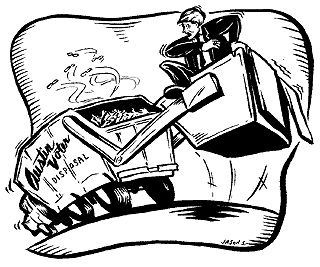
Ronney Reynolds considers himself an easy target, and not just because he weighs 240 pounds.
The mayoral wannabe prides himself on consistency, and while you may have
knocked his politics in the past, you could at least be sure of where he stood.
“I put my rudder in the water and stay the course,” he often says.
But these are desperate times. Reynolds is in the political fight of his
life. The winds are kicking up as the mayoral race escalates, and the resultant
waves have apparently slapped the Skipper from the helm. He must have been
blown off course last week, when he shocked us all by withdrawing support for
the city’s “Pay As You Throw” garbage program. The pride and joy of many a
garbage department, the program is the national trend in waste reduction
— over 1,600 cities across the U.S. have implemented the program, whereby the
more you discard, the higher your pick-up rates. Presumably, it will encourage
composting and recycling. Both are needed, since Austin must rent private
landfill space when the city dump tops out in 1999.
To prompt lower rental costs, garbage gurus at the city’s Solid Waste
Department began considering the program a decade ago. The original proposal
was simple: Households requiring bigger city-issued garbage cans would pay
bigger monthly pick-up fees, while households with smaller garbage cans pay a
smaller fee. Oscar the Grouch sold separately. Simple enough? Yes, but
simplicity is often not an option for local governments. The city has put off
implementing this program for years, claiming that the billing department
didn’t have the technological know-how to charge different “Pay As You Throw”
rates on utility bills, so that idea was tossed out with yesterday’s shredded
documents.
A solution evolved. Different-size households would get different-size garbage
containers, meaning a family of six would get a larger container than say, a
single-person household. Each household would be charged a $12.99 monthly fee.
But for every trash bag that doesn’t fit into the can, residents would have to
put a $2.16 sticker on it before Mr. Garbage Man would take it away.
Essentially, the program is a tax, and when it began citywide two weeks ago,
residents, especially those with smaller garbage cans, started bitching.
Everyone knows that taxes and candidates go together like tequila and beer.
Only the strong survive. Though Reynolds had joined all his colleagues in
approving the policy several times, the last time as recently as September, and
had even granted $150,000 to advertise the program, he now wants to suspend
“Pay As You Throw” and take public input at an April 3 hearing.
Not surprisingly, many feel that Reynolds’ about-face is merely a ploy to cash
in on voter discontent to gain support at the ballot box. “It’s very
upsetting,” says Anita Fadun, Beverly Griffith’s appointment to the Solid Waste
Advisory Commission (the SWAC team). “It’s presumably because of politics that
Reynolds wants to throw out this program after years of planning.”
Reynolds says it ain’t so: “I’m just listening to the community.”
Whatever, responds Wendy Audette, Daryl Slusher’s appointment to the SWAC
team. “This is something that has gone through several public hearings, and
it’s been before council a number of times,” Audette notes. “Ronney has had
several opportunities to question the program’s effectiveness, but it hasn’t
been an issue until he’s running for mayor.”
But Reynolds says he simply made a mistake in voting for the program in the
first place. It’s not his fault, though. “The inequities in the program were
not brought to my attention in September.” (That is, the last time he voted for
it.) Reynolds apparently couldn’t figure it out for himself, but now that he’s
been adequately briefed, he says the fee is not applied fairly because it
charges every residence, regardless of size, the same monthly garbage fee. “We
have not developed a variable rate, so it’s not fair,” he says.
Reynolds’ plea of inequity doesn’t exactly wash, when you consider that the
program — which charges each residence for every extra trash bag that doesn’t
fit into its container — was specifically designed to be a variable rate
program, as opposed to the flat rate we have had in the past, says Fadun.
Reynolds has also failed to mention that households with smaller trash cans may
trade up for a 60-gallon container, with only a phone call to the city. Also
unmentioned: by the 1998 fiscal year, under the new program, households with
30-gallon cans were to receive a rebate for keeping their trash
generation down. “The city hasn’t done the best job in getting the word out and
making sure people understand the program,” says Audette. “This has only been
in place one week. That doesn’t seem like long enough to make a judgment on the
effectiveness of it. I hate that politics is getting in the way of policy.”
To give Reynolds the benefit of the doubt, it’s not entirely impossible to
believe that the Skipper simply didn’t have foresight enough to envision the
program’s unpopularity. After all, Reynolds has had similar problems with
vision in the past. For one thing, he has none. Remember the baseball stadium
debacle? The former football jock, along with Mayor Bruce Todd, led the fight
to issue $10 million in debt without voter approval. He — and everyone else on
the council who had supported the stadium — backed down as an opposing
petition drive neared fruition. Then there was the time Reynolds wouldn’t put
the Save Our Springs ordinance to a vote. Voter backlash from that may have
cost him two of his developer-friendly colleagues in 1993. Reynolds now
concedes only that “politically, it was mistake.”
Strike three might come for Reynolds this May. After the clerk’s office
invalidated the Fair Campaign Finance Ordinance petition last year, and after
the petitioners, Priorities First!, showed that the clerk’s office likely
erred, Reynolds joined three of his colleagues in approving the ordinance on
first reading. But the next week, during the second vote, Reynolds said he had
made a mistake, and the initiative failed for lack of a fourth vote. Priorities
First! now hopes to get a court ruling in time to put the proposed ordinance on
the same May ballot that has Reynolds’ name on it. In any case, the group is
hoping to make Reynolds their prime target in the mayoral race, and are calling
on the more than 30,000 petition signees to throw Reynolds out with the coffee
grounds.
So if Reynolds isn’t playing politics, he does seem to be lacking in vision.
He’s admittedly made mistakes on some of the biggest issues that the city has
faced but says, “Does consistency mean that you never made a mistake? A man who
says they never made a mistake, made a mistake when they said that.” 
This article appears in February 28 • 1997 and February 28 • 1997 (Cover).