

 |
Cherrywood or Windsor Park or Ridgetop. You know, where the deals are, now that
the airport’s moving. Buy now, avoid the rush. But wait. What’s that sound?
That, friends and neighbors, is the sound of the City of Austin being strafed
by the low-flying puddle jumpers of the State Aircraft Pooling Board. The what?
Think of it as Billy Clayton’s Flying Circus.
Bill Clayton, as he is formally styled, though most refer to him as Billy, is
a former Speaker of the Texas House of Representatives (from 1975 through
1982), hailing from the remote West Texas hamlet of Springlake, now comfortably
ensconced in Austin as a lobbyist, consultant, et cetera. (See sidebar, p.20,
for more on the Billy Clayton Experience.) He is also chair of the
little-known and poorly understood State Aircraft Pooling Board, which is the
Texas state government’s private fleet of 50 or so corporate planes that state
employees — especially legislators, university regents, agency heads, and
other high muckety-mucks — use to conduct official business throughout the
state. Indeed, Clayton helped create the Pooling Board during his
Speakership, at which time he appointed his friend and neighbor, Rep. Pete
Laney of Hale Center, to chair the board. When Laney himself became Speaker,
after the lengthy Gib Lewis interregnum, he returned the favor by anointing
Clayton to the post. Both men are themselves pilots — a handy skill when you
live in places like Springlake and Hale Center — and avid supporters of the
general aviation community, i.e., folks who own their own planes.
Right now, most of the Pooling Board’s fleet is parked out on the north edge
of Robert Mueller Municipal Airport, off 51st Street. Over the last year,
Clayton, with the not inconsiderable backing of the general aviation community
and their scary-ass lobbying group, the Aircraft Owners and Pilots Association,
have made noises about keeping their Cessnas and King Airs at Mueller when the
rest of Austin aviation packs up and moves to the new Austin-Bergstrom
International Airport. This would seem like a stupid thing to want, considering
how firmly and repeatedly we’ve been told — by the city, by the Federal
Aviation Administration, by the Air Force, by the bond underwriters, even by
the Legislature — that Mueller is history once Bergstrom opens, and that a
large and growing segment of planners, developers, institutions and
entrepreneurs are licking their chops at the prospect of reworking 711
tabula rasa acres of Central Austin. “The ballot language on the
Bergstrom referendum said clearly that, when [Bergstrom] opened, Mueller would
cease to be an airport,” says one of the Mueller-area neighborhood
activists. “I guess that doesn’t mean [Mueller] couldn’t re-open the very next
day.”
 The new tower construction at Bergstrom. Bergstrom’s old tower is in the background. photograph by Kenny Braun |
it for its own use, which it’s free to do as long as it pays the city fair
market value. (So far, the FAA has said it’s “not quite sure” how it feels
about this possibility, a caveat that gives city and community leaders the
willies.) To this end, the state General Services Commission engaged an
independent appraiser to value the airport, coming up with a figure of $18
million. This eye-poppingly low assessment presumes that, after it closes,
Mueller will merely be a ghost airport, ignoring all the talk of mixed-use
developments, job training centers, business enclaves and theme parks for the
Mueller site. The city’s best guess, which admittedly doesn’t mean squat at the
conference table, is that Mueller is worth twice that much. Nevertheless, the
$18 million figure has gotten Clayton and the Aircraft Owners and Pilots
Association all excited that keeping Mueller open isn’t such a pipe dream after
all.
Why in hell, you may ask, would the Pooling Board and the general aviation
community want to stay at poky, dorky and unpopular Mueller, and face a
contentious Legislative floor battle, inevitable court challenges, and the
wrath of a 747 full of opposing interests, when a brand-spanking-new and
glorious airport awaits them? When this story first broke in the spring, the
popularly discussed reasons seemed transcendently petty, even given their
origins within Capitol Candy Land. Bergstrom was a whole 10 minutes farther
away, we heard. The state’s handful of weekly flights would have to share
runways with the commercial jets (a far greater handicap for the jets, and
those of you on them, than for the Pooling Board). The proposed location for
the Pooling Board operation at Bergstrom was on the d�class�
southeast side of the airport, without direct access to the airport’s front
door on Highway 71. (The Pooling Board is similarly sited at Mueller now, but
oh well.) Even the daily’s editorial page, not normally keen to dispense
insults to the powerful, described Clayton’s case as “a fit of pique.”
As it turns out, it’s a little more than a hissy-fit — not enough to actually
justify keeping Mueller open, but not complete bloviating either. Clayton has
to go to the Legislature in the session just begun to ask for a healthy new
appropriation for the Pooling Board — which currently supports itself on
transferred funds from the agencies who use its planes — to pay for either a
Bergstrom move, or a Mueller takeover, or a third-party option such as
relocating to the Austin Executive Air Park off Dessau Road. “Time has crept up
on us,” Clayton says. “The city has been hustling us along, expecting us to
sign contracts, and we knew that something had to be presented to the
Legislature, and… as we realized what the city is willing to offer and what
we need and want, we felt it only fair to present all of the possible options
— move, stay at Mueller, or go to Executive. We need alternatives in case they
ask us, and they ultimately have to decide in this session.”
The cost of a Bergstrom move depends on numerous arcane factors, such
as whether the state would own its parcel at Bergstrom (as it does at Mueller),
whether the city would buy the state’s Mueller property, whether the state’s
facilities would be within Bergstrom’s fence or adjacent thereto, and whether
the Texas Air National Guard, which currently shares some Mueller facilities
with the Pooling Board, would likewise move to adjacent quarters at Bergstrom.
Clayton has sounded alarms about Austin’s losing the Air Guard entirely if
Mueller closes, since the Defense Department has so far allotted no funding for
its relocation to Bergstrom. “According to the appraisal, the cost of a
condemnation of Mueller isn’t going to be as steep as was contemplated,”
Clayton says. “It might be cheaper than a Bergstrom move if we factor in the
costs for not only the Pooling Board but also the Guard — especially if the
alternative is losing the Guard unit entirely, which no one wants to happen.”
However, the prospect of the Feds’ stiffing the Air Guard doesn’t seem worth
losing sleep over. The U.S. Department of Transportation has already sent extra
sugar Austin’s way, culled from a fund ostensibly intended to ensure that
airports like Bergstrom remain usable by and accessible to the military should
the need arise. This, combined with the FAA’s desire to deep-six Mueller and
the Air Force’s terms for turning Bergstrom without strings back to the city,
would imply Washingtonian willingness to keep a uniformed presence at Austin’s
airport du jour. Some of the couple-a-mil thus disbursed, it’s been
suggested, might end up buying off Clayton and the Pooling Board with
gold-plated facilities at Bergstrom. The list of requisites delivered last
month by Clayton to the city includes, along with a prime location off Highway
71, such niceties as insulated and climate-controlled hangars — more
elaborate, and more expensive, digs than the Pooling Board currently has at
Mueller, or than it indicated it would need at Bergstrom in the 1993 Bergstrom
master plan.
Given the contingencies, and assuming that the question of the Air Guard’s
fate is a red herring, a ballpark figure for relocating the Pooling
Board to Bergstrom seems to be between $5 million and $10 million, which is a
lot less than it would cost to condemn, purchase, and operate Mueller even if
all parties agree to the specious ghost-airport assessment. Enter the aircraft
Owners and Pilots Association and the general aviation community, who have made
no secret of their distaste for relocating to Bergstrom, and who formed a major
chunk of the Keep-It-At-Mueller forces in the Thirty Years’ War over the
airport. (We now hear from certain Keep-Its, who used to assert ad
nauseam that Austin didn’t have enough traffic for a new airport, that
Austin needs two airports.) If the state takes over Mueller and rents
space and landing rights there to the general aviation forces, those proceeds
could bring costs closer to par with relocating the Pooling Board to
Bergstrom.
Now, the reasons the general aviation community wants to stay at Mueller are
hard to describe as anything but self-interested. As one can imagine, those who
have the cash to drop on this very expensive hobby tend to congregate in the
north and west parts of town, to which Mueller is admittedly somewhat more
convenient than Bergstrom will ever be. (The Executive Air Park is even more
convenient, and has made its desire for increased general aviation business
perfectly clear, but it lacks the plusher amenities, like instrument-landing
systems, that the general aviators can use if they piggyback on a
commercial-carrier airport.) And unlike the Pooling Board and Air Guard, the
private jet-set has no sugar daddy to underwrite its move to Bergstrom, where
hangar space, landing fees and fuel charges will all be higher than currently
paid at Mueller.
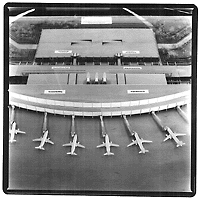 Mueller’s information desk boasts this model of the new Bergstrom Airport. photograph by Kenny Braun |
comes from this general aviation community — thus implying that those folks
are getting a prima facie raw deal at Bergstrom — the private pilots
have contributed far less than their numerical share of the cost of either
operating Mueller or building and operating Bergstrom. In other words, their
hobby is, and has long been, subsidized by commercial carriers, their
passengers, cargo operators, and federal and military aviation funding, and the
revenue the private plane owners might provide to a state-run Mueller will in
the long run be wiped out by the then-unsubsidized costs they generate. So few
folks are too choked up on their behalf. Indeed, the ugly and obvious class and
color differences between the local general aviation community and Mueller’s
neighbors — who’ve already witnessed more small-plane crashes in their front
and back yards than they care to — make the thought of carrying the pilots’
water on the local level more than merely distasteful.
But the Airline Pilots and Owners Association is one of America’s most
aggressive and efficient interest groups — comparable to the National Rifle
Association in both legislative presence and constituent demographics — and
they’ve successfully thwarted local efforts to shut down unwanted airports. For
instance, the City of Chicago has just reluctantly settled a lawsuit brought by
the State of Illinois, with extensive Pilots Association support, and agreed to
keep Meigs Field, the Windy City’s oldest airport — and, with its lakefront
location, its windiest — open for use by the general aviation community, who
balked at the inconvenience and expense of relocating to another of
Chicagoland’s five(!) airports. The challenge in Austin is somewhat greater,
given the degree of resistance, both local and official, to keeping Mueller
open. But the pilots are not to be trifled with, especially with friends like
Billy Clayton and Pete Laney.
Opinions differ, however, on who is actually in the cockpit — some observers
describe the Owners and Pilots Association as a pawn in the state’s game, ready
to be dispensed with, or screwed, with equal vigor, once the state takes over
Mueller. “The state has gone to the pilots and said `Here’s a shot at keeping
Mueller open, but we can only make it work if we all — the (association), the
Pooling Board, the Air Guard — stand together,” says one local airport
activist. “If it happens, though, the state is going to realize that either
it’ll have to charge the pilots far more than they’re paying at Mueller now, or
pass the cost on to the taxpayers. Guess which option they’ll be more willing
to do.” Clayton, on the other hand, says that the Owners’ Association came to
him with proposals for mounting a lobbying effort on the Pooling Board’s
behalf. The Association “has been interested in staying all along,” he says,
“and they wanted to know what we’d do… if the best alternative was for us to
stay at Mueller. Naturally, they would like to see us do that.”
In either case, there is clearly a convergence of interests here. There
is also agreement between the state and the general aviation community that the
city Aviation Department and the Bergstrom planners have been both insensitive
to their interests and dishonest about the city’s intent. In typically awkward
fashion, the various city personalities involved — the mayor and city manager,
the aviation department, the Bergstrom managers, and the city’s Airport
Advisory Board — have indicated that, well, maybe they could have done things
better, and yes, maybe they were far more concerned about cargo and commercial
carriers’ needs and timelines, and they’ll appoint a study, but that’s no
excuse for Clayton’s extortion tactics, even though they’ll try to give him
everything he wants to avoid another Austin-bashing frenzy, especially one that
pits the city against Speaker Laney. “It’s a crying shame,” Clayton says, “that
the city has just now decided to study needs of general aviators; it always
seems with the city like the cart’s dragging the horse.”
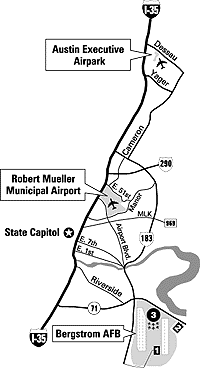 The site where the Pooling board wants to build its hanger (2) is substantially closer to the terminal (3) and represents a shorter drive to the State Capitol building than the site of the Pooling Board’s hangar according to the Bergstrom plan (1). |
committee vote, let alone a floor vote, on a proposal to spend even $18 million
— which is more than the state spends per biennium on public libraries,
immunizations, mass transit, or any number of other Mom ‘n’ apple-pie issues —
to provide certain state fat cats with door-to-door plane service, at a time
when tightening the government’s collective belt is the order of the day. In
addition, the masters of that order, like Governor George W. Bush and
Comptroller John Sharp, themselves eschew the State Aircraft Pooling Board’s
services. (Notable Pooling Board air hogs, on the other hand, include UT and
A&M officials and regents, TxDOT higher-ups, and Railroad Commissioner
Carole Keeton Rylander.) If, as is likely, this Mueller price tag gets pushed
up toward, say, $50 million, reflecting a more sensible assessment of the
land’s value and the ancillary costs of taking it over, one imagines we can
forget about this folly. Indeed, Clayton has no interest in pursuing a kamikaze
mission. “Since everything right now is still on the table, if the city comes
up with a package that meets our needs, I have no choice but to recommend it
wholeheartedly,” he says.
Those ancillary costs could include fighting the city and community
groups in court, and paying for whatever the FAA might require to allow Austin
to have two airports (even if, as Clayton and the Pilots Association suggest,
both airports are operated from the Bergstrom control tower, an idea the
air-traffic controllers vehemently oppose). There are also obligations imposed
by the Legislature itself via HB 2848, the 1993 bill carried by former state
Rep. Wilhelmina Delco that required Austin to either move the airport or pay
for enormous noise-abatement projects in the area. These costs, which
themselves derive from FAA regulations, would presumably pass back to the state
if it operated Mueller, though without jet traffic the area subject to
abatement would be much smaller.
Another handicap, though more political than financial, is flak from the
commercial carriers, who’ve ponied up large amounts of change to create
Bergstrom according to the specs of the 1993 master plan, which called for two
ready-to-roll runways on opening day to accommodate Austin’s anticipated air
traffic. If the private pilots of the general aviation community find a way to
bail out of Bergstrom, especially at this late date, the commercial carriers
are stuck with hefty investments in building, and ongoing fees for maintaining,
an airport far too large for their needs alone, as far as actual flight
operations (as opposed to passenger services) are concerned. This would not
make the likes of Herb Kelleher, CEO of Southwest Airlines, very happy at all,
putting the kibosh on the farfetched hopes of Mueller partisans that SWA would
consider keeping its operations at Mueller as well.
At present, Clayton says that, while he hasn’t lobbied any lawmakers directly
on the matter, he sees no pro forma objection to taking over Mueller if
it were the best deal the state could achieve. Though one is loath to
second-guess Billy Clayton’s sense of Legislative imperatives, this seems a
romantic notion. If the political cost of a high-profile, high-dollar
expenditure on what most voters would consider a self-aggrandizing government
frill is too high, the House and Senate are likely to be unswayed by mere
facts. Indeed, if, as has been speculated, the Mueller dogfight generates
enough heat to call into question the very existence of the Pooling Board —
especially in light of such peccadilloes as the indictment of Texas A&M
regent Ross Margraves, accused of illegally using a state plane to fly to his
son’s college graduation in New Orleans — Clayton and Laney might be quickly
persuaded that Bergstrom ain’t such a bad place after all.
Does this mean you should go ahead and put down your earnest money on that
Ridgetop bungalow? As long as Mueller’s closure has seemed a certainty, there
have been those in the community who wouldn’t believe it until they saw it. And
as long as barnstormers like Billy Clayton can prolong Mueller’s death throes,
the chance that Mueller will be promptly redeveloped into a more positive
community asset are likewise forestalled, as developers and lenders get all
nervous about dropping money there. So even if the State Aircraft Pooling Board
ends up in luxury accommodations at Bergstrom, the ongoing antics of the Flying
Circus have probably already guaranteed that Mueller-area neighborhoods will
remain more depressed, and for longer, than they need to be. Consider, instead,
investing in, say, Clayton’s hometown of Springlake — 15 miles from the
nearest airport.
This article appears in January 17 • 1997 and January 17 • 1997 (Cover).