

 |
the police audit finally came out on February 25 — just days after former police chief
Elizabeth Watson cheerfully kissed the force goodbye — a subcommittee met to
wade through the report on what’s wrong with the Austin Police Department
(APD). At the meeting, audit subcommittee member Ronney Reynolds noted to
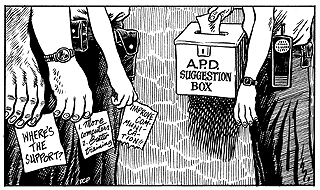
interim police chief Bruce Mills that communication, according to the audit,
appeared to be exceptionally bad. Mills’ response? Suggestion boxes. That’s
right, suggestion boxes. APD wanted to improve communication with patrol
officers, so it installed suggestion boxes.
“The suggestion box seems like an old idea,” explained Mills, “but we treat
suggestions at our staff meetings very importantly. The first thing we do is
read them, and discuss each one.”
Sound lame? Maybe, but the Austin Five-0 claims it’s in modernizing mode,
shaking off the shackles of conventionality in the wake of the city’s audit.
Scant communication between divisions — and even less between upper and lower
levels of the department — is just one of the factors that have led to low
morale and sub-par operations, the audit warns. Combine that with “inadequate
financial planning and control, unreliable financial analysis, uncollected
revenue, and inattention to pursuit of potential donations,” as the audit says,
and you have a financial management system at APD that is more than just
shoddy; it’s wholly inadequate. Factor in the department’s prehistoric
equipment, and it’s no wonder that “effective operations” is more a dream than
a goal.
The latest round of trouble for the APD began surfacing shortly before city
auditors initiated the review a little more than a year ago. Then-Police Chief
Watson had received a vote of no-confidence from the powerful Austin Police
Association. An unexpected rash of retirements left almost 100 positions
unfilled, and the force almost 10% below authorized strength. Bulletproof vests
were past warranty, yet still being used, with duct tape playing a linchpin
role. All this, despite the fact that APD now spends 50% more ($79.3 million a
year) than it did just six years ago, and has hired 47 police officers a year
for the past five years.
But while throwing more bodies in blue at the problem has been the council’s
primary reaction to complaints about APD over the past five years, the audit
points out that such a strategy may have done more harm than good. That’s
because the increase in the number of police officers has not been accompanied
by an increase in managerial support. In other words, making the force larger
without proper communications, financial management, and equipment, was simply
a useless gesture. And get this, according to the audit: “Crime statistics show
that the number of officers on the force has little correlation to the amount
of reported crime.” In fact, reports on other cities which have been successful
in reducing crime show that it’s community policing, not a full-to-busting
police force, that keeps crime in check. (For more on APD’s efforts in this
area, see main story.)
Clearly, something is wrong at APD, and the root of ineptitude seems to stem
from the ivory-towered suite of management. For starters, advancement to the
upper echelons is based on tenure, rather than ability. The scant management
training that APD requires focuses more on crime fighting rather than on fiscal
oversight. Little wonder, then, that last year, the Alarm Unit, which issues
fines for false alarms, didn’t keep proper receipts. No one knows how much was
actually made, or how much could have been made, from the program. We do know
that the unit failed to collect at least $1.5 million in revenue, apparently
because of an easy-come, easy-go attitude. In another fiscal abomination, an
APD financial analysis predicted that the License and Weight Unit, which
regulates commercial traffic, would reap $9 million a year from citations. The
income in its first full year, 1994, totalled a paltry $151,000.
But the lights aren’t entirely dim at APD administration. Remember, the budget
has grown terrifically over the past six years, and guess where the lion’s
share has gone. Yep, salaries — specifically for upper-level management.
Between 1980 and 1996, wages increased $5,500 per employee, while equipment
“support” decreased by $600. Meanwhile, “executive staff” spent beyond its
means more than any other division. Between 1992 and 1995, on the average, it
cost taxpayers $1.3 million a year, nearly twice its $673,000 budget. To cover
that, management took the pruning shears to the front lines, the patrol unit,
which had to give up an average of $932,000 a year from its budget to cover the
posteriors of the executive staff and other divisions similarly over-budget.
APD administrators may seem like keystone cops, but the audit makes it clear
that the financial management system is stacked against them. Since the
development of sound financial management has not kept pace with the growth of
the department for the past 15 years, administrators don’t receive the
financial information necessary to properly plan for APD’s future.
 | |
| Salaries and benefits for APD employees | |
| APD money spent on support | |
| Note that while salaries have risen dramatically, support has maintained a low level. | |
or “never” get sufficient funding, according to a survey reported in the
audit? In the three years between 1992 and 1994, unmet needs, like new radios
and building repairs, totaled $3.1 million. In 1995 and 1996, those needs were
ignored when the budget was approved. In fact, preparing new budget requests
each year was such a waste of time that some unit managers submitted budgets
from previous years and simply changed the dates.
With so few needs met, it’s not surprising, then, that 81% of police
supervisors say that equipment, including technological support, is inadequate.
While APD has begun purchasing laptops for officers, it has yet to provide
e-mail, though it should be available later this year. There is no APD
mainframe computer, and obtaining crime information from the existing
system is sometimes impossible. Detective Bob Buck, of the theft unit, says,
“Very little property is returned to victims because the computer system is
slow with searches, and we can only search two categories.”
Sector radios often break down, so two sectors may have to double up on one
channel, increasing the workload of dispatchers. And the department does not
have the technology to perform detailed, neighborhood-specific crime analyses.
Vehicles are hard to come by, or in disrepair, slowing operations. “We have
three detectives per car,” says Buck. “Two detectives can’t get out until the third returns.”
“Some of the equipment we have is at best pathetic,” adds Sean Mannix,
in-service training instructor, which he says is functioning with the most
minimal of resources. “The pistol range is completely inadequate. We have a
Hogan’s alley there because training officers got lumber and built it.
But it’s at best a makeshift course. It’s a sad state of affairs.”
While the problems outlined in the audit are formidable, APD has begun to
implement 37 of 38 suggestions to, among other things, improve financial
management, enhance communications, and update technology. (The department is
unable to find any resource to implement one suggestion, which calls for
training in the area of staffing decisions for specialized units, investigative
services, and administrative support functions.) And although the audit makes
no mention of needing more officers, last year APD created an extra
training class to bring in more rookies in order to meet the staffing levels
authorized by council. The department is expected to be fully staffed by
October, 1998.
An improved 911 system is due to come online, as well as computer-aided
dispatch; however, none of this new technology will be ready for use until
1998. “We’re trapped in time right now,” says Assistant City Manager Joe
Lessard. “But at some point, we’re going to make a leap forward in technology.”
Mills concurs: “We know we’re not there yet, but we know what we want to be:
the best police department in the nation.”
Despite the promised revamping, City Manager Jesus Garza warns that change
could take years, or even decades. In addition to the technological
advancements, the department must still build an entire south substation, a
$3.5 million expenditure that has been delayed for nearly four years. And
within the next five years, Mills predicts, two more substations will be needed
— in far southwest and far northwest Austin.
Meanwhile, history doesn’t bode well for promises of change. Many of the
problems found in this audit were also pointed out in the last two APD audits,
completed in the 1980s. Of the 28 major recommendations made in the last two
audits that are still applicable and can be assessed, only nine were
implemented.
The lack of follow-up on the 1988 audit is being blamed for the current
crisis, so Mayor Bruce Todd and the council gang are trying to keep a close eye
this time around. Todd has ordered staff to return by late this month with a
time frame for implementation. Moreover, further audits have been requested,
since this one focused only on management. Mills, City Manager Jesus Garza, and
Councilmember Beverly Griffith are asking for a department-wide audit by the
International Association of the Chiefs of Police, the same organization that
completed the 1986 audit.
And with a new commitment to communication, maybe the cries of the front lines
will this time be heeded. Already, in the event that money becomes available by
the mid-year budget, APD program managers have compiled a list of needed
equipment that will cost more than $2.8 million, approximately $900,000 of
which is “critical to continued operations.” In the past, suggestions for
improvement, like sector lieutenants’ plans for crime control, have frequently
been lost up the chain of command, with no response coming from the powers
above. But now that there’s that suggestion box….
This article appears in March 21 • 1997 and March 21 • 1997 (Cover).