




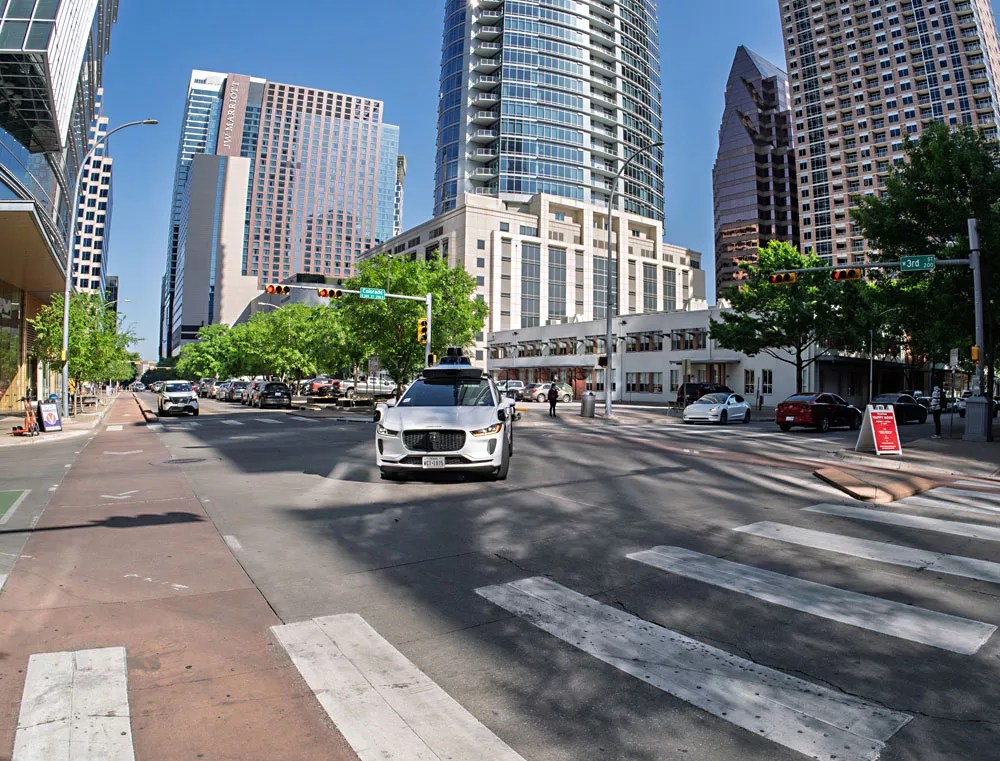
Amid a slew of autonomous vehicles descending into Austin, the city government still has no role in regulating or permitting their inevitable arrival. The future of AVs is largely left to the hands of state politicians. But the Mobility Committee (made up of five out of 10 City Council members) heard an update last month outlining how local permitting systems can operate and prepare for vehicle companies to expand, mostly in competition with Waymo and Tesla.
Senate Bill 2807, signed by Gov. Greg Abbott in June, was the biggest point of discussion on the docket. It throws a wrench in how quickly AV companies can expand the number of deployed vehicles through requiring approval by the Department of Motor Vehicles. The bill, which will take effect in September, also requires a first responder safety plan, outlining how firefighters, police officers, and emergency workers will instill a standardized response procedure to AV wrecks and incidents.
“We’re starting to see the industry emerge, and they are very interested in Austin,” said Lewis Leff, a director with the Transportation and Public Works Department, at the meeting. “We are seeing rapid growth.”
Rachel Castignoli, a senior consultant with the Smart Mobility Office, still believes that local organizations can have an impact on AV city policy, and SB 2807 is an example of that.
“No law requires anyone to tell us how many vehicles they have.” – Smart Mobility Office’s Rachel Castignoli
SB 2807 was championed and advocated for by Castignoli alongside many of Austin’s first responders, establishing a permitting system for all vehicle companies looking to deploy or test self-driving cars in Texas. Before going through the three mandated stages required for all self-driving cars – mapping, testing, and eventually deploying – AV companies will have to submit an application to be approved through the DMV and the Department of Licensing and Regulation. The DMV will then have the power to suspend, revoke, or cancel permits.
Some AVs, such as Tesla, are doing two steps at once, by testing nearly 100 vehicles while deploying a dozen.
“Our expectation is that AVs can operate in the right of way without any data from the city of Austin,” Castignoli said.
Castignoli detailed the city’s expectation list: that vehicles must be able to recognize lights and sirens, school zone signs, stop signs, and an emergency scene without mapping aid from the city. Although, despite that expectation, the city will still share critical information with companies to support citizen safety.
Castignoli pointed out that, for now, Austin is the only city in America that issues citations to AVs that don’t correctly adhere to traffic laws.
“We are really focused on the geography aspect of [incidents],” Castignoli said. She noted the city’s documented AV incident dashboard – which currently totals about 130 – is updated after each AV incident, and is available for the public to view. Most have occurred near Moody Center and Barton Springs. Currently, AVs seem to struggle most severely with following police hand signals directing traffic.
The total number of AVs deployed and accepting commercial passengers in Austin is also unclear.
“No law requires anyone to tell us how many vehicles they have,” Castignoli said. Still, she documents that there are over 100 Waymo vehicles deployed, and that number is expected to double in mere weeks, and there are about 12 Tesla robotaxis deployed, with another 100 in the testing phase approaching deployment. A couple of other companies have vehicles in the testing phases, such as Volkswagen ADMT and Zoox Highlander, expected to reach deployment next year.
This article appears in August 8 • 2025.