

|
“They are naturalizing because of fear, the fear of potentiallly |
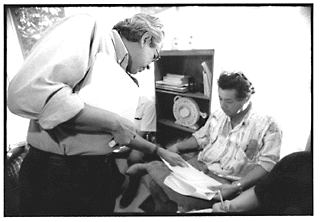
taken away by her boyfriend, and she is looking for help to get them back. Jung is
a legal immigrant from Korea who receives food stamps, but she seems completely
surprised by the suggestion that she might be losing those benefits soon. Considering
her other difficulties, it is not surprising that food stamps would be the last thing
on Jung’s mind, but according to Dana Nelson of Legal Aid, Jung’s ignorance is all too
common. The welfare office “doesn’t ask any questions until she’s up for her
annual certification appointment. They’ll verify her immigration status and the next
words out of their mouths are `Do you have 40 quarters?'” says Nelson. Jung
does not have the 10 years of work experience, so if she does not meet any of
the other exceptions — veteran or dependent, refugee or asylee — she will be dropped
from food stamps immediately without any recourse. Unlike food stamp clients, SSI
recipients have at least begun to be informed by letter, but because discussions about
the law change SSI eligibility almost daily, the letters have temporarily stopped
being issued.
“We are dealing with a large community who is totally confused about
the changes in the law and about the impact,” explains Nidia Salamanca,
director of the Political Asylum Project of Austin. In sharp contrast to the lack of
information in many communities, however, the tighter-knit Hispanic community is
suffering from information overload. On the Spanish-only Univision network, daily news
reports have been filled with hysterical exaggeration and fear tactics about welfare
reform, including a daily countdown to April 1, the day that the welfare clock began ticking on
most benefits. The vast majority of legal immigrants in Texas are Hispanic,
upwards of 90%, and volunteers are finding that many of them are terrified to seek help
with questions about welfare reform changes because of their fear of deportation.
“My biggest problem right now is that I can’t get the clients in the door. I know
the projected food stamp cut off for Travis County is 1,988 people, but where the
hell are they?” wonders Nelson, whose Legal Aid project focusing on the 40
quarters provision has seen only two clients in three weeks.
Whether it stems from a lack of information or too much of the wrong
information, it is not only welfare clients who are confused about changes in the law.
“It’s totally up in the air. The Social Security Administration has no idea what’s
going on right now,” says Nelson. They’re not the only ones. With the budget
debate raging on the floor of Congress, news about what provisions may be made to
either reinstate or extend benefits to legal immigrants is nearly impossible to
follow. “I’m giving presentations and I’m having to say `This is what the law
says today‘,” explains Legal Aid volunteer Lourdes Flores.
Social Insecurity
Adding to the confusion is the fact that immigration is generally a family
affair, and family members do not usually share the same immigration status. “In
any immigrant family you could have a U.S. citizen, a legal resident (green card
holder), another in the process of gaining legal residency, and another who is
undocumented. So, for those who thought this law would impact only illegal immigrants, that
is not the case,” says Lopez. The family combinations of legal status
account for infinite scenarios. Quite common are the legal immigrant parents with
children who are citizens, due to the fact that they were born in the U.S. Those children
will be able to continue receiving public assistance, but their caretakers will be
cut off. Also common is the citizen husband with the undocumented immigrant wife
caring for their children. In many cases, it is the wife or other family caretakers
such as grandmothers and aunts who are facing both deportation under the
Immigration and Nationality Act, and being cut off of the public assistance rolls. According
to Lopez, the family pressures are leading to increased spousal abuse in immigrant
communities, which is further complicated by going unreported due to fear of
deportation.
Also going unreported is the undocumented work done by legal immigrants
which these new federal laws will wipe out. This undocumented labor is known as the
“gray economy,” according to Dunkelberg. She describes it as the underground
network of undocumented labor which shores up the mainstream economic life of the
nation. From construction to cleaning services to child care, undocumented, untaxed
immigrant labor is the backbone of our economy in many arenas. Unfortunately for the
immigrants, however, if it isn’t taxed, it doesn’t count.
For example, the new welfare reforms may result in the loss of family
caregivers who are either forced to take jobs or to return to their countries of origin.
However, the government is not taking into account the fact that stay-at-home mothers
who collect welfare to care for children who will eventually become productive
tax-paying citizens are the cheapest childcare workers you can buy. Rosemary Patterson,
public information officer of the Dept. of Human Services, points out that the
government allotment of $183 a month is a good deal in a country where child care costs
are prohibitively expensive.
Although many immigrants, particularly migrant laborers, have been working
in the U.S. for well over the 10-year minimum required to continue receiving
public assistance, because their employers were not reliable bookkeepers or
taxpayers, their labor can not be counted toward the necessary 40 quarters. There is a small
crack in the welfare reform armor, however, and immigrants like Banh may be saved
by it.
With painful slowness, Banh relates the story of her move to the U.S. from
Vietnam, as Flores and Banh’s social worker listen, hoping to glean clues to her
residency history. “I want come American and get medicine and my mother say you
come get medicine and I happy. I no food, I too cold some day, very hot some day, my
brother say you don’t need scared anything, just go American and get medicine and I
say okay,” says Banh. Somewhere in her meticulous retelling, Flores begins to piece
together that Banh’s brother, Charlie, is a U.S. citizen who delivers mail in
California, and that her sister is not a citizen, but lives in Austin. These clues will
become very important as Banh, who only has nine quarters of documented work
history, tries to piece together a picture which will allow her to both stay in the U.S. and
to continue receiving her SSI benefits.
The key to Banh’s salvation are the “quarters” of work,
generating taxes which are stored up in the social welfare system like a bank account.
Although Banh may not have a 40-quarter bank account, in response to welfare reform, the
government has softened its stance somewhat, and is now telling social workers and
lawyers that legal immigrants can use “spare” quarters of family members to
augment their own totals. In addition, the history of where Banh has lived, with
which family members, and for how long, will become important in the complex matrix of
eligibility requirements which will allow her to repeal the removal of her SSI
benefits.
Original estimates of the numbers of illegal immigrants in Texas set to
lose food stamps were 141,000 recipients and estimates on the loss of SSI benefits were
38,450. Those working with the immigrant community now suspect that those numbers
could come down significantly as families like Banh’s pool their quarters to keep family
members on the welfare rolls.
Perhaps most confusing is the fact that daily news accounts are constantly
changing the picture of welfare reform, especially for SSI recipients, as President
Clinton and the Republican-led Congress battle it out over reinstating some SSI to
immigrants. “The same group of leaders who three years ago advocated for cuts to
legal immigrants are the ones this year saying maybe we went too far,” points out Lopez,
who is skeptical about the motives of Capitol Hill politicians. Patterson notes
that some reform might have been warranted since the SSI program had grown by
“hundreds of percents” since 1990 and “a large portion of those were
immigrants.” Now, to hear the suddenly contrite politicians tell it, no one could have
foreseen the panic caused by cutting SSI to the immigrant community, but volunteers
who work with immigrants are not buying that argument.
“We had plenty of warnings about the suicides in the Hispanic
community. The only reason that changes to SSI are being made is that it’s gotten such
bad press,” counters Nelson, explaining that even the changes being proposed do not go
far enough. Clinton is arguing for a provision in the new budget which would allow anyone
who was in the U.S. prior to August 22, 1996 to be grandfathered into SSI in case
of future disability, and it looks like Congress may go along with his proposal.
However, no provision is being made for people who are simply aged but not disabled to
be included on the rolls, as they were prior to welfare reform. “We’re
talking a 70-year-old, Spanish-speaking woman with no source of income. What are we
going to do with her? That’s why they start to commit suicide,” worries
Nelson.
Citizen Gain
|
Naturalized American citizen Elena Poutou (center) helps her mother, |
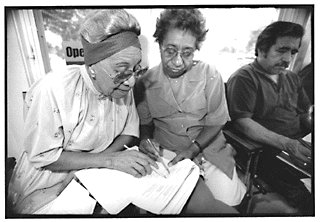
for citizenship all over the U.S. Though not all were seeking citizenship, El
Buen Samaritano served 5,000 people in 1995, but Lopez estimates it will have 12,000 clients
come through the door by the end of this year. In fact, the growing numbers
seeking citizenship have slowed the process in immigrant-heavy states like Texas and California
to as long as two years. That two-year wait means that undocumented immigrants are
in the Catch-22 situation of having applied for citizenship to keep from being
deported, but being forced to leave the country to wait for their processing dates.
Because of the 1994 Act, which says they can only remain undocumented in the U.S. for
one year, if immigrants opt to stay in the country to wait out the two years of
processing, they will be banned from the U.S. for 10 years. The wait also means that
legal immigrants cannot count on simply becoming citizens to save their welfare benefits.
Immigrant advocates complain that pressuring people to relinquish their
native citizenship is cruel. “Immigration should be a very rational decision.
You go through all these emotional phases,” explains Salamanca. “They are
naturalizing because of fear, the fear of potentially losing their benefits,” concurs
Luis Plascensia, who teaches a citizenship class at El Buen Samaritano. Nelson
points out that the issues can often be as practical as they are emotional.
“It’s a particularly big deal with Mexico because there are still issues about being
able to go back and claim property once you’ve given up your citizenship,”
she explains.
In Austin, legal immigrants like 85-year-old Juana Gonzalez, originally
from Cuba, are scrambling to secure citizenship status. She and several other immigrants
recently attended citizenship classes offered at El Buen Samaritano, which is pitching
in as best it can to aid those who fear losing their SSI benefits. However,
Gonzalez’s daughter, Elena Poutou, who accompanied her mother to a class last week, says
that she and her mother are not acting out of fear, but rather from a sense of
responsibility to the country they love. Although Gonzalez has been in the states for 17
years, Poutou says that her mother, who speaks little English, has been afraid to
undertake citizenship classes because she suspected the students would be younger and
would speak better English than herself. After receiving the letter announcing the
end of Gonzalez’s eligibility for the SSI benefits which partially support her
ability to live on her own, however, Poutou felt that it was time to help her mother
to join the rest of the family in attaining U.S. citizenship.
Further, Poutou says that she does not blame the government for
threatening to cut off her mother’s benefits. “I respect all the decisions of the
government. I accept it because we are foreign,” she says. She is concerned, though,
about the lack of information regarding her mother’s SSI status because of
conflicting information from the government and the media. “I don’t know what to do,
and I don’t know what to think, but this is nothing that worries me. It’s a very
common story, it’s nothing exciting. I tell you, maybe she is a little scared
because of her age, but I’m not scared because I can support her, and I accept the
law.”
Unintended Consequences
The full repercussions of welfare reform, in immigrant and citizen
communities alike, will likely blossom slowly like a massive black lotus. While some
lawmakers may have intended to deter future immigration to the U.S., many immigrant
advocates say that the lawmakers’ intentions grew out of incorrect information about
the role of immigrants in the national economy. If recent studies hold true,
slackening immigration could bode very ill for the health of the American marketplace, which
benefits immensely from the influx of foreign labor and investment. On a smaller scale, however,
Dunkelberg and her colleagues predict a “huge impact to community merchants”
as the millions of dollars which had infused welfare-supported communities with
purchasing power is cut off. Without the economic foundation provided by government
subsidies, tight-knit immigrant communities are sure to unravel.
But perhaps most Americans — fed on a diet of media tidbits that play up
the instances of welfare fraud by immigrants — are ready to allow their
deterioration. “A big scandal I read about (was these) classes being taught in
Taiwan about how to get on SSI,” relates DHS’s Patterson. “There are these
people that… push it too far, and then there’s the backlash and innocent people, so to
speak, get caught up in it.”
It’s those “innocent” people, whose drain on the U.S. economy is
but a teardrop in the bucket, who are the victims of what columnist Molly Ivins
calls “welfare deform.” Patterson concedes that “Everything the
government does is full of unintended consequences,” adding that, in her personal
opinion, the reforms are not about budgetary decisions at all, but moral ones. “I
don’t believe that the bottom of all of this is stopping public assistance. At the
bottom is a stereotype that these people are ignorant and lazy and just don’t want
to do work, and somehow that’s un-American.”
This article appears in June 27 • 1997 and June 27 • 1997 (Cover).