Some Austin ISD schools are going to close starting in the 2026-2027 school year in a massive effort to consolidate into a smaller district. As of Monday evening, we now know how the administration is going to decide which ones to close.
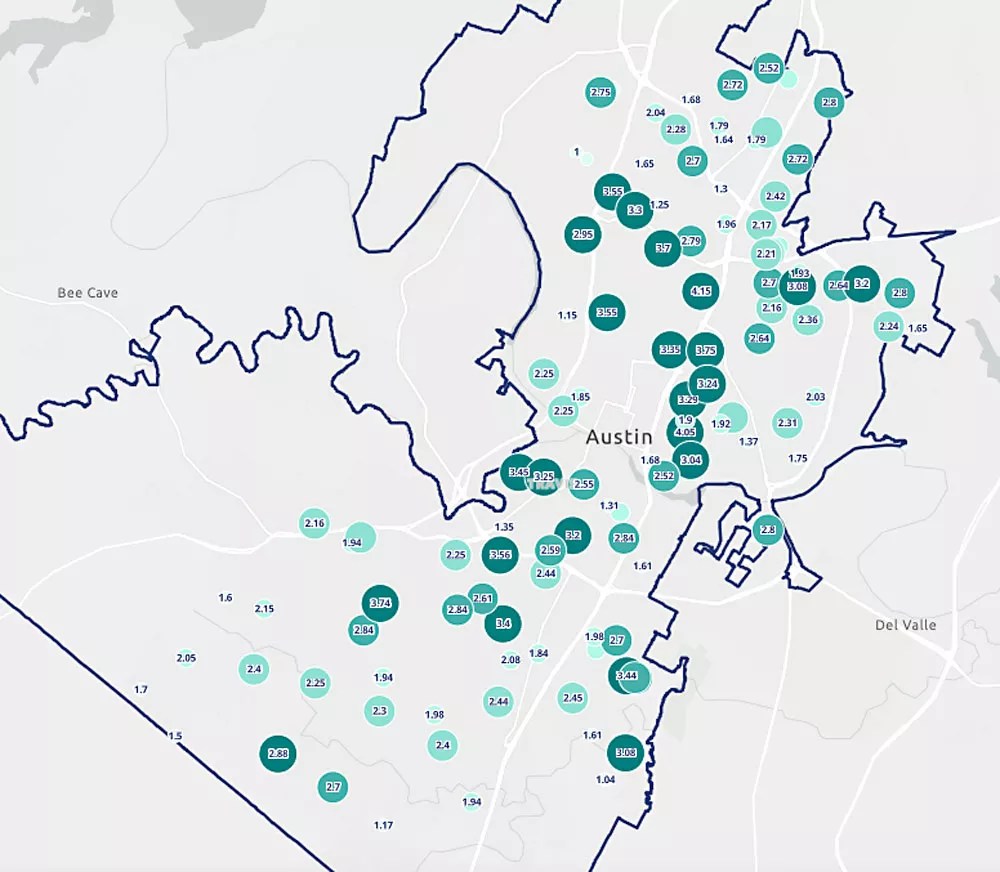
It’s a set of parameters that takes into account how full or empty a school is, the condition of the school building, and what teaching and operational costs look like per student at a given school. All of those metrics are taken together, and the school is given a score from 1 to 5, with 5 being the most “misaligned” schools for the district.
On Monday, Austin ISD also released every school’s score by those metrics, though Superintendent Matias Segura repeatedly emphasized that those at the top of the list, with scores closest to 5, are not necessarily the schools that will be closed or consolidated. “It is very possible that a school anywhere on this list could be impacted. We are a network, and so what you do to one school … is going to have impacts on adjacent schools as well,” Segura said.
AISD is essentially reimagining the district at the whole-scale level: school zones and boundary lines, transportation, reassigning teachers, filling empty classroom seats up to the ideal 80-95% school capacity. Families could see new boundary changes in addition to closures, which would change what school the neighborhood students are zoned for. “What you have to do is assume that no system exists and then begin to build up,” Segura said.
Schools topping the list include Ridgetop, Blackshear, and Maplewood elementaries, Covington Middle School, and McCallum High School, with notes made for each as to whether the building is too full or empty, whether the school zone is too empty or crowded, and if it has a “high building cost” or “poor building condition.”
AISD’s initial announcement to consolidate was met with pushback from parents, concerned that their students’ school will close and their learning will be disrupted as they are moved elsewhere. The district has made efforts to be transparent and hold discussion forums, but parents still don’t know how many schools will ultimately be closed and in what parts of the city. Schools on the Eastside have been disproportionately at risk of closure due to low test scores, as seen when Dobie, Webb, and Burnet middle schools were recently under threat of being dissolved. The three campuses will now undergo an overhaul of faculty and leadership.
The district assured on Monday that they will not “favorite” any specific school or allow for external pressures to influence their consolidation decisions.
This consolidation plan follows the FY 2025-2026 Proposed Budget released at the end of June, which reveals significant slashes in funding at the local, state, and federal levels. AISD faces a shocking 56% decline in federal funding, from almost $20 million last school year to now $8.6 million. At the local level, the school district will be receiving roughly $104 million less than last year, a 6.5% change.
That budget went into effect on July 1. The school district is already under a $19.7 million budget deficit, and these cuts will put further strain on the district’s resources. The district adds that they plan to bring an amended budget to the board in September once they know more about the rules tied to House Bill 2, which increases pay for campus-based staff.
“Right now, we do not have the funds to properly resource all 116 campuses that we operate and maintain,” Segura said. It seems clear that while the consolidation plan is meant to redesign the school district to better serve students and even out the student-to-teacher ratio, it’s also a cost-saving rescue operation, with the district hoping to save $30 million through the process.
The final recommendation for consolidations will be released in October, and the decision vote will be held in November. What will follow, come the 2026-27 school year, will be a delicate process of grandfathering students into their new schools.
This article appears in August 15 • 2025.