

Fifteen
years ago Lou Ann Barton and Paul Ray opened the first Austin Music Awards at Club Foot
by presenting a batch of honors to Austin music’s Class of 1982. Next week, at
the Austin Music Hall, Paul Ray will again emcee, while Barton is due to
perform with Jimmie Vaughan (a previous winner as part of the Fabulous
Thunderbirds that very first year). Seems some things never change.
Nonetheless, 15 years is a long time, and the show’s cumulative list of winners
and performers speaks volumes about the history of local music: Cosmic Country,
Stevie and the T-Bird’s blues explosion, punk, new sincerity,
singer-songwriters, and the rise of alternative. Clearly, the beauty of the
Awards show is that it’s very much an event for the moment, and for the
history books.
Unfortunately for historians, it seems as though most of the big winners and
performers from the early years had too good a time at the Awards show, and
don’t remember many specifics about the shows they attended. For those that do
remember bits and pieces, however, it’s almost as if they were in collusion
when they use the word “magic” to describe some of the more memorable moments
in the show’s history: a surprise set by Stevie Ray Vaughan & Double
Trouble, two Roky Erickson experiences, Jody Denberg’s unlikely jam with the
True Believers, the unveiling of Gibby Haynes’ and Johnny Depp’s P, and Kris
McKay’s Too Many Girls.
But even beyond the awards and performances themselves there’s the fact that
the Awards Show is an event which started as a small and experimental club gig
and is now the South by Southwest kick-off event. As such, it has become the
first truly important musical event of each new year for both the national
industry and the local scene. So to honor an event that is itself about
honoring Austin music, the Chronicle has asked a cross-section of local
winners, performers, and organizers to take a stab at compiling an oral history
— a loose collection of memories that, like the Award Show, have lasted 15
years.
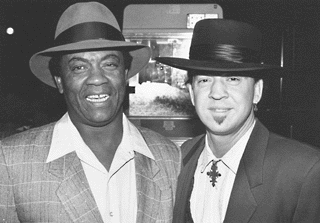 W.C. Clark and Stevie Ray Vaughan backstage at the ’89-’90 Austin Music Awards. Vaughan came back to town specifically for this show. It was his last non-performance appearance in Austin. |
In the beginning…
Margaret Moser: The old Austin Sun had done awards shows in the lateSeventies, but on a much smaller basis — with maybe one or two bands playing.
So there were these long performances and long award sets. 1982 was the first
time I had a crack at helping organize [the Chronicle‘s] awards show.
Bill Bentley: I’d also been involved with the Sun Awards, but they were
a fly-by-the-seat-of-your-pants event. They kind of made ’em up as it went
along. They allowed ballot stuffing and even encouraged it. But the show
couldn’t survive for the same reason the Sun itself couldn’t — massive
disorganization.
Louis Black: The first year of the Chronicle, we did a music poll, but
didn’t do a show. The real reason is that we didn’t want to do one of these
lame award shows. But when Bob Simmons [an early Chronicle publisher]
comes onboard, he decides we really should have an award show and he and
Margaret are really the driving force behind that first award show, at Club
Foot.
Moser: I sort of involved myself. I thought it was a shambles backstage the
first year and I sort of went in and took it upon myself to begin organizing.
Nobody was really running it. It was conceived, but not executed. People
weren’t there to pick up awards or they were in other places and didn’t know
which awards were coming up.
Paul Ray: Lou Ann Barton and I had gone through the Sun Awards as
winners. And the first year of the Chronicle awards, Lou Ann and I were
asked to be guest presenters. So we got dressed, came down, and even rented a
limo. We made a big entrance but nobody was there yet.
Lou Ann Barton: I remember Paul and I trying to call out the winners and nine
times out of 10 nobody came up to pick them up. We’d just stand there with our
thumbs up our asses and move on to the next one.
Bentley: More people were getting awards than there were spectators early on,
which was cool because it seemed to prove that in Austin, everyone really is
somebody.
Jody Denberg: I remember thinking it was a cool event, but a little insiderish
and little too much about rah-rah cheerleading. I definitely didn’t have an
inkling we’d still be doing them now.
The Music
Moser: The next year we moved the show to the Opera House and I busted my buttand begged the Fabulous Thunderbirds to play the show, along with the Big Boys.
I remember Chesley [Millikin, Stevie Ray Vaughan’s manager] called a few days
before the show and said he was going to bring Stevie and the band in from
Hawaii, and if we didn’t mind, he was going to arrange for them to have a set.
I was so busy with everything else I was doing that I didn’t realize what
Chesley was telling me, and didn’t realize until the day of the show that
Stevie was there and planing to play that night. And it wasn’t until Stevie
stepped on stage and started playing everything from Couldn’t Stand the
Weather that I realized the Austin audience was not only getting Stevie
unannounced but was also getting a special sneak preview of his new album.
Ray: It seemed like Stevie just showed up. But he was like that. If he saw
somebody playing and there was a guitar, he was going to get up there. You
couldn’t stop him, it was one of those deals.
Tim O’Connor: We really didn’t know what to anticipate and I don’t think they
did either… A lot of times, we as the venue are told about a lot of things
that may happen which the general public doesn’t know about. So I remember
Stevie’s set was one of those things, and we were aware he’d be coming, but it
was still unbelievable.
Chris Layton: I remember we flew in for it, so we at least knew we were playing
— we didn’t just stumble into it. But beyond that, I don’t remember much other
than that we played. [Ed note: We got a lot of this.]
Moser: I was also really thrilled to have the Big Boys on the show, even though
they didn’t much feel this was the kind event they cared about. They were sort
of somewhere between their punk and hardcore periods and the audience responded
exactly the way you’d expect a hardcore audience to respond; they were
aggressive and belligerent and spitting. The band was encouraging and giving it
right back, so it was great and worked exactly like it should. But the guys who
worked security at the Opera House had never really seen anything like that.
Rey Washam: I remember thinking [the ensuing riot] was partially the
Chronicle‘s fault, because they made us go on so late. People were kind
of agitated waiting around. And we were kind of shuffled off all night
backstage. We couldn’t even go near the stage until it was time to play. I’m
not sure they even wanted us to play. So we’re standing backstage we hear the
stage crew say to each other, “The first motherfucker that jumps on-stage we’re
going to kick their ass.”
Ray: The Opera House bikers guys had decided they were the law. We left just as
it started to happen. I was sitting on the side of the stage and I saw it start
in the corner and went, “We gotta get out of here.”
O’Connor: It got real nasty. I was also on the stage when it went down. It had
been kind of an excitable evening anyway. Some of the audience got into it with
the band and there was some verbal stuff that went on. Then it got heavier than
that. Our security guys got onstage to try and calm things down and got into a
hassle with one of the Big Boys. Then, someone from the band went into the
audience and got kicked or something. I don’t want to put it on the Big Boys,
but it was a new experience for us to have the band involved in a crowd
incident — kind of challenging the crowd. It was the dawning of a new age,
believe me.
Moser: Really, the Big Boys were the best at self-policing. They had it under
control even though it looked like utter chaos.
Black: It wasn’t quite a riot. But it was very funny, because you had the
punks, the Big Boys, kind of posturing all night about what punks and how macho
they were. You know, saying what assholes they were. And they were against
Willie’s crowd, who were like killers. It was almost like a comedy, because
they looked like fat rednecks but they’re really ex-Navy seals. So it’s Willie
extended family and the opera house security force against these punks and it
was no contest. It was over very quickly.
Washam: Comedy? It was not a big funny thing. It was serious shit. And we kind
of blamed the Chronicle and the stagehands equally for letting it
happen.
Moser: I was really sorry because it looked like one of these tragically
misunderstood moments, where both sides were right and both sides were doing
what they were supposed to be doing. But there was also really no way to
mediate in that type of situation.
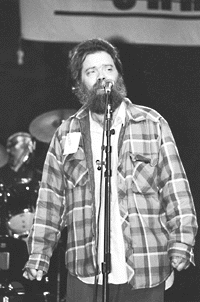 Roky Erickson, the year he was backed by Will Sexton, ’92-’93 |
Roky Roads
Moser: After the Big Boys incident and a slow third year, we decided to try andpair the True Believers and Roky Erickson for the 1985-86 show. To me it was
very symbolic. Roky is sort of the Texas version of the Velvet Underground. He
has the single most pervasive influence on Texas music on a local level, over
more decades, than probably anybody other than Doug Sahm. Meanwhile, the True
Believers were interesting because punk was gone and post-punk, which in Austin
translated into New Sincerity, was here and the True Believers were by the far
the best and most popular proponents of it. Later, we had Roky on the show
again with Will Sexton [1993].
Alejandro Escovedo: I remember we were rehearsing at Mike Stewart’s house and
Roky shows up with a guitar without a case and a screwdriver to change the
strings on the guitar. We finally ran through the songs and every run-through
was in a different key. Then, when it came to the show itself, we put on a
pretty decent show ourselves and Roky came on for “Two Headed Dog” and “Starry
Eyes.” But he wouldn’t stop playing the solo, and so we played, played, and
played and looked at each other in a panic… He wouldn’t stop and someone had
to finally come up and end it.
Will Sexton: It was an interesting concept. The great thing about the True
Believers show was seeing Roky with a band like that. When people are trying to
produce his records now, they always seem to go in the direction of the Dion or
Buddy Holly stuff. But I was always curious what it would be like had he gone
into the studio with a band like the True Believers, who come from the same
musical tenor as to where he was once heading. That was a glimpse at it.
Ray: With Will, Roky was standing there with his arms folded and somebody had
to finish the songs. But I think Will Sexton was the only guy that was ever
able to control him on stage, just bust him with a guitar to the back and say
“Hey Roky, you’re supposed to sing.” I preferred the Roky/Sexton set to the
True Believer show. Roky didn’t even know who the True Believers were.
Escovedo: I don’t think he knew who we were either. I don’t think Roky knew who
he was. And I do think a lot of people loved that idea of the True
Believers, a real rock & roll band, just going for it with Roky. It sounded
great. And Will’s set was cool because it seemed more together and rehearsed.
Yet, ours worked because we were kind of in the dark and so was he. It was one
of those strange moments.
Michael Corcoran: Roky was always a nice little show-off point, especially when
SXSW started and people began coming from out of town. People from New York and
Los Angeles were always freaked out just to see Roky sit at a table near them
backstage. Early on, Roky really helped set [the awards and SXSW] apart.
The SXSW Invasion
Black: Before 1987, we had done the show mostly on Wednesdays so all theclubowners could come. Then we moved it to Friday, and it was big enough and
important enough that all the music business people came. But with SXSW, the
show would have eaten up the whole night on a Friday. For SXSW that was
untenable. So we moved it back and it changed the event, and there was a couple
of rough years in there.
One of the things that happened was that you suddenly had a third of the
audience be out-of-towners. So then, you had a third for the music scene here,
a third for normal readers and clubgoers, and a third was the media and music
industry — not just Los Angeles and New York, but from across the country. It
changed the show a lot. But it wasn’t a tough decision to move the Awards. We
were making so many decisions at the time that it just made sense.
E.A. Srere: The move back to Wednesday just pissed us off, it was no small
grinding point of my teeth. Here is the Awards Show, the event they built the
whole thing around, and it gets pushed back to opening night… It’s always
chapped me. It got second-class status.
Corcoran: It seemed like the venue had more to do with it changing than the
people from out of town. At Palmer the sound is so bad. The Opera House didn’t
have tables and chairs, so it was more like a concert than an awards show. It
was weird too, because after you gave your speech you would just walk into the
crowd. But then again, with SXSW and the people from out of town, getting a
slot at the Award Shows is more important to bands. So I think the talent
caliber went up a little bit.
Don McLeese: Whoever headlines plays to a bunch of people’s backs — people
streaming out. It’s a lousy way to start your conference, if you’re getting so
bleary-eyed staying out there until two in the morning and then getting up
early to see the keynote speaker. A lot of people just opt to get the good
night sleep. I’ve always thought the Award Show should be at the end of SXSW,
so it can build to the Award Show rather than starting with this Austin
pat-yourself-on-the-back thing. That way, some people can stay around in town
if they’re interested and some can leave.
Black: We’ve thought a lot about moving it away from SXSW and making it more
Austin again, but there’s no real easy way to do that. Initially, it was an
abrupt period and I’m not going to argue with E.A. or Margaret. There was an
emphasis on SXSW a little bit over the Award Show. But we really used the show
to benefit SXSW, and I think if you look back now you’d have to argue the
strategy worked — the show benefited from SXSW and SXSW has benefited from it.
As such, I think the Awards Show has gained in prestige enormously in the last
four or five years.
Backstage
Ray: Like Margaret says, it’s not an Awards Show unless “there are 1,500 peopledownstairs and 1,000 out front.”
Srere: Backstage is the party, especially with SXSW starting up and all
the industry folks schmoozing. But from the regular industry people to the
clubgoers, people are there to see certain people in the show. And if you’re
there to see somebody in particular, you’re going to be out front. Then you’ll
go backstage in between. So everybody always gets a good seat for whatever they
want to see, because somebody else will move out of the way by heading
backstage. It just seems to rotate that way.
Corcoran: It’s a big dress-up night that you can compare to the prom for the
local music scene. So people kind of go out of their way to look good. And I
used to joke that every year there’s one guy with one of those tuxedo T-shirts.
But it’s also just sort of the one event that you don’t have to worry about
overdressing — and in Austin, a lot of the time, you do have to worry
about overdressing.
Monte Warden: I go to church every Sunday so I get to wear a suit once a week,
but most of the time none of us gets to put on a tie. So you get to play
dress-up. And I remember the first time I won [1984], as a 16-year-old kid. I
was dressed up, backstage, and got to meet Kim Wilson, Lou Ann Barton, and
Stevie Vaughan. What could be better?
Denberg: The show really does foster a sense of community. A lot of petty stuff
seems to fall by the wayside. It’s pretty rare to get everybody in one room
like that. But at Palmer, the show seemed like it was a lot more for the people
backstage. The energy seemed to dissipate out front.
Black: This is Austin and the schmoozing goes on everywhere. At Palmer you have
that long public hallway and it goes on there as well — with music people from
all over the country and the city hanging out and schmoozing. In the back of
the hall, and in the other hallways there’s all these people hanging out. So
the backstage is amazing because it’s the one place all year where you have so
much Austin music talent and national talent hanging out.
Layton: I always dread having to go to Awards Show, even the Grammys, but I
always have a good time once I’m there. It’s virtually a guarantee you’ll run
into a lot of people backstage that you maybe hadn’t seen all year. Especially
when — with Stevie — we’d be touring constantly, it was nice to come home and
catch up at the show, because while you’re gone so long you feel out of touch
with what’s going on in the scene here.
Bill Carter: For a lot of people in this particular business, especially once
you’ve been through a lot and get a little older like we are and a lot of the
people we know, you just don’t socialize nearly as much. A lot of the guys
aren’t in the clubs period, playing or not. So it’s a good chance to see
everybody. It’s almost like the holidays, going back to your hometown and
seeing the guys from junior high once a year. Then you see all the new guys and
check out what they’re doing and where they’re going, and it’s great to see
their excitement.
Srere: The thing about the show that I’ll always enjoy is the people that
continue to think they’re going to steal the show, either picking up an award,
being fools backstage, or even playing. It just doesn’t happen that way,
because no one person or band can be the most important thing at this show. The
only time you come across somebody who is the most important part of the
evening is when you have a Stevie Ray Vaughan, who’s big nationally. Then
everybody else is like, “Is he here, can we talk to him, can we see him?” But
there’s hasn’t been anybody like that before or since.
Denberg: In 1990, I remember seeing Stevie standing around with a stack of
awards. There’s a photo that the Chronicle ran. I was sitting with Two
Nice Girls backstage and for some reason we thought it would be cool to have a
photo of the band, me, and Stevie. Right as we approached, somebody else got
his attention and he was gone… which makes the show sort of an annual
reminder of how short life is.
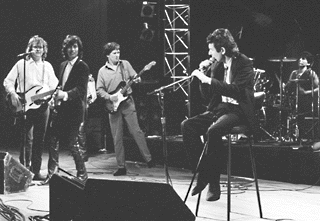 The True Believers with ex-Faces Ronnie Lane, 1987-88 Music Awards |
And More Music….
McLeese: To me, when the awards work best it’s because of the unexpected —like putting Roky up there and not really knowing how it’s going to turn out.
Or like P, where nobody had the faintest idea what it was going to be. It’s
these Once in a Lifetime things that can either be glorious or so embarrassing
you have to be there to witness it.
Carter: For P, I think we got together the day before, maybe once or twice, and
kind of made some shit up. I wouldn’t say wrote, but made up. It was kind of a
fun thing. We had all been here and hanging out, so we thought it might be fun
to try and play. It kind of amazed me that we did it. It wasn’t a band. [Sal
Jenco] wasn’t particularly a drummer — he’d played years ago or whatever. And
I’m a songwriter, not a guitar player’s guitarist. Johnny [Depp] can actually
play guitar better than I can, but he didn’t want to feature it at all and be
the actor-turned-rock-star for the evening. So just the fact that we actually
did it was kind of amazing to me. We weren’t really good, it was just fun.
Corcoran: One of the show’s all-time best sets had to be the True Believers
with Ronnie Lane and Richard Lloyd [1987-1988]. That’s when Paul Ray was
calling the True Believers assholes.
Escovedo: Paul Ray slagged us by saying that we should get the Assholes of the
Year Award — or something really rude. That was also the same evening that Joe
Ely decided to put on a Bruce Springsteen show, so it’s like three hours long
and we went on at something like 4:30 in the morning.
Corcoran: But Paul had really pissed them off, and they came out with a real
vengeance — pretty exciting.
Escovedo: But it was the True Believers reunion [1993-1994] show that really
stands out as special to me. Since it took place at SXSW, looking out into the
audience was like seeing the entire history of the True Believers before my
eyes. It was pretty emotional and wonderful. It sounded good and I was real
happy. I think even Paul Ray kind of enjoyed it. He used to say we sounded like
someone left the garage door open — which was great, the point, and what we
strived for.
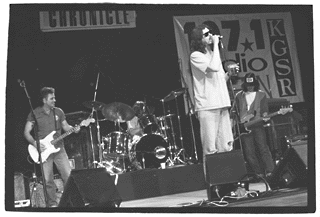 The show that featured P’s first public gig. (l-r) Bill Carter, Sal Jenco, Gibby Haynes, and Johnny Depp, 1992-93 Music Awards |
Winning
Black: What the Chronicle generally believes in is a variety ofvoices… the idea that thinking about things and entering into dialogue is an
inherently good thing. So the Awards are great because the critics shut up and
readers really get to choose who their favorites are. Sometimes there’s a
flurry that gets through, with stuffing or some silly votes, but if you look at
it as a body, you’re really amazed at how correct the poll is. More than anyone
else, it’s reflective about what’s going on in Austin music.
Bentley: The voting does seem to represent the year. But it’s kind of like
professional wrestling: If it’s not real, I don’t want to know.
Warden: When I won my first one as a solo guy, I didn’t know what it was for. I
certainly didn’t think it was Male Vocalist because of Malford [Milligan] or
Song or Songwriter because of Butch Hancock and Bill Carter, and it was Best
Singer so it was a real thrill. And we came by it honestly. I know back in
1983, at every gig we’d tell the Whoa! Trigger fans to mail in all they could,
and this time I don’t even think I sent a ballot in, so it felt good to come by
it honestly, without stuffing.
Corcoran: One time I was voted Worst Thing to Happen to Austin Music and my
girlfriend at the time mooned the audience. She said, “This is a message from
Michael Corcoran” and dropped her pants. It was weird because I got into a big
fight with her that night too, because she thought just because she mooned the
audience for me that I should leave when she wanted to leave. She was bored and
I’m always the last one to leave the Awards Show.
Carter: Stevie presenting Ruth [Ellsworth, Carter’s wife and songwriting
partner] and I with the Best Songwriting award for “Crossfire” is a moment that
really stands out for me for obvious reasons. The other thing about Ruth and I
getting recognition as songwriters is that we never tried to go out and win
votes in any way, so it was hopefully just people with common knowledge, who
knew of our songs and thought we’d written good ones. I’ve never been into the
vote-for-me thing because there are so many great songwriters that to vote for
the best is a strange concept.
Denberg: Winning means everything and nothing. It means everything because
you’re in competition with everybody you respect. And to think about all the
individuals filling out ballots is amazing. But that and a dollar will get you
a cup of coffee. On the other hand, the first time KGSR won I really think it
went a long way to help validate our radio station.
Jo Carol Pierce: I’m still speechless about the year I won some things. I was
speechless then and made a stupid little speech. It was a huge thing in my
life. It was an amazing thing to find out that people really did like my music.
I thought Troy Campbell and Mike Hall had just been wackos for liking it. I’ve
really benefited from the fact that if you have a buzz in Austin, you have a
buzz in the country. I’ve gotten to tour and have a great time because the
Awards Show appearance helped build that buzz. That [Across the Great
Divide] won, and I won as a songwriter is still the first thing on my
resum�. It sort of changed my confidence level. It makes me feel less
guilty about writing songs.
Guy Juke: I’d done the poster for the Awards Show for 12 years, and I won the
award for best poster for like the first five years. It was kind of
embarrassing and cool when my other friends started winning the award. But this
year, the ballot says “this category is in danger extinction.” It’s been great
that the posters have always been associated with the show and that an award
exists for the recognition of the poster scene. It means a lot, and if they
drop it, they’re going to have to answer to me.
Sexton: Every year there’s a few awards that really mean a lot. That’s the
great thing that kind of ingratiates the whole thing to me, seeing people whose
talent and work usually goes unnoticed get their due. It’s usually the older
local talent that so many of us have appreciated so long — the W.C. Clarks and
Grey Ghost types. To see those guys or other underrated guys like Butch Hancock
win gives the night meaning.
Ray: Ultimately, this is not the Grammies — they’re the Chronics. They’re back
every year, it’s chronic. We’re not supposed to take it that seriously because
awards are just pieces of paper. I’ve got stacks of pieces of paper like that.
They’re great, but don’t say much about what you’re going to do next or did
before. But the good part of it is that it’s real votes, not what Margaret,
Louis, and those morons at SXSW decide is happening. It’s the people who go out
and hear the music.
This article appears in March 7 • 1997 and March 7 • 1997 (Cover).