

photography by Arnie Levine
Times
are tough on Sixth Street, say both the clubowners and musicians. In fact, all over town,
big local draws are fading and young contenders are having trouble establishing
a following. Yet in the midst of what feels like a musical recession, one facet
of Austin’s live scene continues to prosper: The Party Circuit.
Only this isn’t your parents’ blue-tuxedo, Mel Torme-singin’ party circuit.
This is big business. A top-tier party act can expect $500-$3,500 a night, with
party legends like Jerry Jeff Walker or the Fabulous Thunderbirds walking away
with many times that. Nationally, even Los Lobos still take on wedding gigs.
But the party circuit isn’t just weddings anymore, either. Popular Talent,
Austin’s largest talent broker for parties, will book over 100 performances a
week during the holiday season alone.
“It’s a figure that often knocks William Morris agents out of their seats,”
says Mark Schaberg, Popular Talent’s owner. In fact, Schaberg’s operation is so
large that he oversees three divisions: Corporate, Club, and Collegiate. “And
then we’ll get a call from a guy who wants to propose to his wife and needs a
bagpipe player in his bedroom at 9am on a Saturday. We’ll set that up too.”
Still, the bulk of Popular Talent’s clients are looking for full bands and
because every party has its own needs for talent, there results a diverse
market for both cover and original artists — a market most bands don’t even
know exists. Generally, cover bands that primarily play parties and forgo club
exposure, like Duck Soup, the Argyles, Vince Vance & the Valiants, and
Memphis Train, tie up Popular Talent’s “Corporate” tier of party demand. While
these party circuit all-stars may lack press attention and a faithful club
audience on which to fall back, many also stand to outgross Austin’s most
popular signed and unsigned talent in any given year. Because 10 gigs a month
aren’t unusual — even discounting the busy wedding and holiday seasons that
can offer nearly twice as many gigs — the party circuit math is simple:
Figuring an average payout of $1,000 per gig, a band like Duck Soup can make,
at the very least, $120,000 a year.
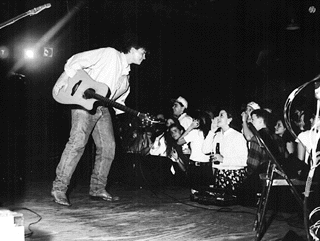 Jack Ingram entertains the “Southwest Conference” at La Zona Rosa last year |
looking for a piece of the party pie — even if it’s a smaller and less
consistent one. And judging by the success of 81/2 Souvenirs and
Storyville, the party circuit’s recent demand for original talent may be too
enticing for many to ignore. Initially, most musicians say they’re attracted to
party gigs because they pay far better than a similar night’s work in the
clubs, padding their club schedule with extra gigs that can double as
rehearsals. Yet increasingly, younger, original-material bands are looking to
parties as promotional opportunities to gain valuable exposure to unfamiliar
crowds. As such, the lines between club acts and party bands are not so clear
anymore.
Take for example acts like Jackopierce, Jack Ingram, David Garza, and MC
Overlord, all of whom, after extensive touring of the Southwest college
fraternity/sorority/campus events circuit, have built sizable club draws
anchored mostly by the crowds they picked up along the party circuit. “People
remember the bands that played their parties,” says Shaberg, “so there’s room
for a more personal and loyal following that can develop into a full-fledged
fanbase.”
And at the college level, it’s all about establishing a word-of-mouth
reputation. So, while acts like Corey Morrow or Banana Blender Surprise prove a
string of solid college shows can impact an act’s subsequent club dates, the
word-of-mouth on the parties themselves can be equally powerful. Just last
month, Schaberg organized an event for UT’s embattled Silver Spurs
organization, which sold out the Austin Music Hall for the unlikely bill of El
Vez and Coolio. The general public had no idea the show ever happened. How were
the tickets sold? In class, student to student.
Schaberg says it doesn’t take a Grammy winner like Coolio to entice the party
talent buyers, because even local acts like Mr. Fabulous, the Lucky Strikes,
Chris Wall, and Sister 7 have become high-priced party draws based on their
reputations as already established local club successes. “If you’ve got a
little buzz in the clubs, there’s naturally more recognition and more
requests,” says Schaberg. “And for the college kids, it’s almost a status thing
for them to go out and say to their friends or the rival fraternity that they
had the Nixons, Jackopierce, or Sister 7 play their jungle party.”
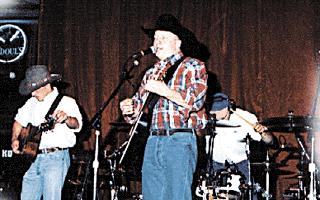 Corey Morrow |
Back to School
These days, for on-campus bragging rights, nobody beats Jack Ingram. Forfraternity parties, the country singer-songwriter is now at the level that he
can basically name his own price — although he’s scaled back his party efforts
considerably in order to concentrate on a brisk regional club business. In
fact, Ingram’s sitting out this holiday party season altogether, choosing
instead to record his major label debut in Nashville with producer Steve Earle.
For many, Ingram’s rise is proof that the local college party circuit can
create national stars. According to Ingram, however, the trip from UT’s Delt
House to Nashville is more complicated than it looks.
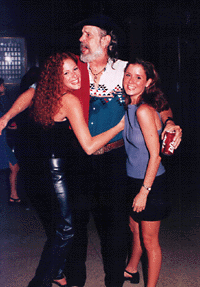 Rusty Wier and fans |
to play their parties,” says Ingram, a 1993 Southern Methodist University
graduate who has since settled in Austin. “I’d do it because the idea was to
just get out and play in front of people and get things started.”
Soon enough, Ingram’s college audiences began to support his occasional club
outings — although in order to pay his band, he was dipping into his party
circuit slush fund. “I’d made it a rule to myself early on that I’d only play
the party gigs until I could get the club shows running on the type of level
that they could support myself and the band,” explains Ingram. “So we’d play
the fraternity parties, doing three-show weekends by traveling to something
like Waco, Austin, and College Station. For a while, I’d play three parties,
then two parties and a club, and then two clubs and a party. Eventually it
wound up as three club dates.”
Today, Ingram only considers playing what he deems “heavy duty” parties,
although he admits that the fans he’s picked up over the years of “Southwest
Conference” fraternity touring still comprise the bulk of his following. But
even with a crowd that’s stayed the same, Ingram says there’s a noticeable
difference between the college party and club atmospheres. “You learn real
quick that you’re not an artist at a party,” says Ingram. “You’re the band.
It’s like being at a club that doesn’t care about the band and is solely
concerned with selling beer. I asked myself if this was really what I wanted to
keep doing. Would I rather be stuck in a corner with people banging into my
microphone or be on a real stage?”
Ingram chose the latter, expanded his touring base and signed with MCA after
his three independent releases sold 30,000 units combined. And therein lies the
crux of Ingram’s game plan: Convert party crowds to club crowds, and club
crowds into record buyers. “It was everything,” Ingram says of the sales
figures. “The labels saw my sales and that was it. Whether these people came
from the colleges or not wasn’t important. They didn’t care where I’d picked up
that kind of fanbase — and I didn’t either. At the shows they sing along with
the songs, and then they take the records home and listen. End of story.”
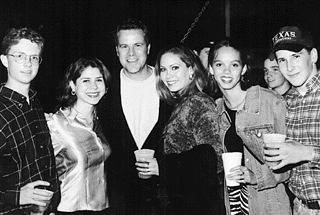 Robert Earl Keen and his following |
label signing, as the party gigs become financially essential to buying time
between records or full-blown tours. For Soulhat, who toured the Southern
college circuit fairly extensively in 1993, playing college gigs on the road
became far more important than playing similar parties in Austin. “We were
lucky enough in the clubs at home that we didn’t need the frat parties here,”
says former Soulhat guitarist Bill Cassis, now a member of Papa Mali & the
Instigators. “But elsewhere they became useful for tagging certain dates
together and allowing us to logistically tour longer and further.”
And perhaps because bands like Soulhat and the Ugly Americans penetrated so
much of the Southwest by consistently touring clubs, and stringing together
private parties when necessary, booking agents say there’s a demand for Austin
talent outside the city limits that’s reminiscent of France’s obsession with
all things Texan. “In the collegiate market, we do a lot of stuff for schools
like SMU, Baylor, and Texas A&M,” says Schaberg. “And it winds up as a
great asset being from Austin. They like calling here and being able to say
they’ve got an Austin band playing their event.”
In turn, original bands playing the party circuit like the exposure to
out-of-town crowds that could develop into return business on their next club
tour. Scott Robinson, whose Robinson/Wood outfit manages three of the college
circuit’s biggest stars in Jackopierce, Vertical Horizon, and Sister 7, says
even the occasional college show can add to what he calls a band’s “capture
rate.”
“Bands without substantial radio or press are playing in search of a
word-of-mouth buzz,” says Robinson, who estimates that 70-80% of his artists’
mailing lists are comprised of college students. “And with the college shows,
there’s definitely a capture rate of somewhere between 30-50%. Even if only 20%
come back, that’s 20% more people you’ve got on a mailing list to sell
merchandise to and alert about shows when you get back in their town.”
It’s My Party
According to party circuit veterans, the capture rate on the corporate andwedding level is tougher to calculate, mostly because the audience is typically
a less homogenous group. As such, in the band selection process, variety often
takes precedent over club hype. “Very rarely does someone call and say they
just want a great original band,” says Schaberg. “More often, they’ll have in
mind something specific they’ve seen in the clubs, or ask for something like a
great R&B band with horns.”
Yet, to further blur the distinction between club and party circuit acts,
R&B bands with horns also happen to be quite popular in the clubs right
now, with acts like Joe Valentine, Memphis Train, and the Atlantic Soul Revue
proving good local draws. Similarly, the recent wave of lounge/swing acts like
the Lucky Strikes, 81/2 Souvenirs, and Mr. Fabulous have also become
hot properties for the corporate and private party interests. The common
thread, say booking agents, is that groups of this ilk are all about party
tunes and party delivery.
“I think people are moving away from the variety band,” says Craig Marshall of
the Lucky Strikes. “Austin’s a cool enough place that people realize the lounge
movement they enjoy at the Continental Club could also be perfect for their
weddings. And what we’ve ultimately found is that the types of parties we play
and the club gigs we play tend to share an audience demographically.”
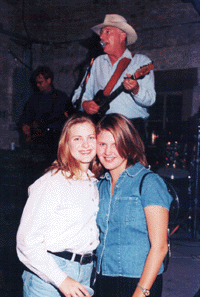 Jerry Jeff Walker and fans |
runaway party hit, says that even with similar audiences, the key is not being
lulled into a false sense of security by the familiar faces. “The show has to
be different at a party,” says Lee, whose band will perform over 20 party
circuit gigs a month this season — sometimes with two shows a day on the
weekends. “At a party, you’re part of an event, not the event itself like at a
club. At a wedding, the bride and groom are the stars of the show. At the
casino parties, we’re a bigger part, but you’ve got to account for the
gambling, mingling, and dancing elements. Rather than hit them over the head
with your show, you want to start slowly and work to a climax at the end of the
night. At a club, you’ve got to be on top of your game from the start.”
But even at the most conservative weddings, where there may be no end-of-show
climax, the Lucky Strikes’ Marshall says the anticipation of a big payday is
often comfort enough to get a band through the night — and looking forward to
reinvesting that money in more creative career moves. “We can afford to do a
real low-paying but cool showcase because we play the parties,” he says. “Or we
can go to another city and basically break even because we’ve financed the trip
with party money. So it’s nice to be able to pick a city we want to develop,
like San Francisco, and not worry about going home poor by having to play the
freebie gigs we need for exposure. For an original rock & roll band, it
might be more of a struggle.”
So what about the plight of original-material rock & roll bands?
Generally, say the booking agents, rock acts fare better in the college
environment than the corporate and private scenes. So much so, in fact, that
these musicians have always been an integral component of the party circuit by
moonlighting in cover bands. Of late, Paul Minor has become a prime example of
an artist comfortable riding the fence, as the leader of his own Superego and
as part of the Argyles — one of the wedding circuit’s most successful cover
outfits. Minor says his share of Argyles’ money goes directly into financing
the Superego, which, thanks to the subsidy, can afford to play the Rock &
Roll Free-for-All at Hole in the Wall for the exposure and produce both
a quality website and CD.
“By playing in a cover band, I can afford a lot of things I couldn’t before,”
says Minor, who admits the Argyles money makes it less imperative that he book
$50 gigs in Houston. “But when I’m playing out of town with the Argyles, I
always carry a few Superego discs with me. Since the shows are usually over
early, I can go out into a new city and try and get Superego gigs in person.
I’ve got to always think about the Superego, because I realize that the money
and comfort level from the Argyles can make for one of those velvet ruts, where
it becomes all you’re doing creatively.”
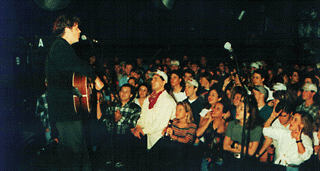 Robert Earl Keen |
All Work and No Play?
According to musicians, falling into that creative rut has traditionally meanta high turnover in the party band ranks. Add the perception that party crowds
are less appreciative than clubgoing crowds and it’s clear the party scene is
not without its detractions. Even Ingram has his doubts about the party
circuit’s long-term viability, claiming now that he’d rather play for 200
clubgoers that appreciate his songs than 2,000 party guests focused on drinking
beer and meeting women. “But I learned early on that getting pissed at your
crowd isn’t going to change your crowd,” concludes Ingram.
Conversely, a band’s club audience can also be turned off by an influx of fans
a band has made on the party circuit. “The fans you’ve picked up at parties are
definitely noticeable,” says Cassis. “It’s a fine line, because the so-called
`music lovers’ get offended by the amount of fraternity guys or special
interests. But we weren’t too picky because whichever group they’re from,
listening to the music once they got to the show was going to be up to the
individual anyway.”
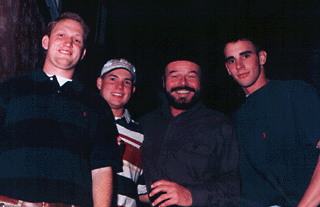 Chris Wall and fans |
involves having to walk into a disorganized party and figure out who’s in
charge and who’s doing the paying. And because most parties don’t come equipped
with their own sound systems, most original artists at college parties also say
they’ve learned to dread gambling on the quality of sound on a rented system.
As such, most of the steady-working cover bands and some of the original
outfits that play the corporate and wedding circuits often buy and carry their
own P.A. — which improves sound but can lower a band’s profitability. “The
money’s good,” says Minor, “but by the time you’ve loaded equipment, driven
across the state, played and slept off the trip well enough to get back into
real life, it can work out to as little as $10-12 an hour.”
But even after the math, the key to the party circuit may just be that it’s
steady work — especially in Austin. With a collegiate demand for parties
during rush weekends, football season, and the holidays, there’s plenty of
opportunity to reach a young crowd with the time and disposable income for a
busy clubgoing nightlife. Add in the influx of young professionals moving into
town — usually with big companies that also host an array of parties,
banquets, and cocktail hours — you have a solid base for parties and weddings.
And steady work, says Marshall, means steady accessibility to new faces, even
in a live music recession. “Because we’ll so often find clubgoers and sell CDs
from the business at parties, the party circuit is a good place to be,” he
says. “Parties can be more than about background music, or even the money. We
get more out of it than you’d think….”
This article appears in November 29 • 1996 and November 29 • 1996 (Cover).