

by Jim Caligiuri
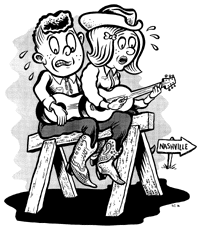 illustration by Roy Tompkins |
alternative country panel at 1996’s year’s South by Southwest was clearly no ordinary
panel. Instead of attracting a scattered, half-interested audience busy
perusing their showcase schedules for that evening’s buzz bands, this S.R.O.
crowd, which spilled into the hallway, was bristling with energy. The air was
electric.
The best part wasn’t even the panel itself, which was interesting yet less
than scintillating, but rather that everyone in the room seemed united in one
cause — making sure this music actually broke through to the masses this time.
Musicians, label heads, publicists, journalists — it was a gathering of the
tribes with lots of smiles and knowing glances passed around. That night at the
Split Rail’s alternative country showcase, you couldn’t get in after 9pm even
with a badge. It looked as if the day we’d all been waiting for had finally
arrived. Twangcore/Americana/No Depression/insurgent
country/roots-rock/y’alternative — whatever you wanted to call it — was, at
last, the next big thing. The buzz was deafening.
Nine months down the road, however, and the roar that was heard that day has
quieted some. No act associated with the scene has broken through to superstar
status and is either filling arenas or selling anything close to millions of
albums. Talking to a few of the movers and shakers involved in the scene, you’d
gather that no one is worried — yet. But combine that with the fact
that album sales are, in fact, low and that several labels involved with the
genre are either closing up shop (local indie Dejadisc folded in November) or
are on the brink of extinction, and some concern is apparent.
One gauge of the genre’s health is The Gavin Report‘s “Americana”
chart. Based in San Francisco, this influential weekly music trade magazine
caters mostly to radio executives and record companies, containing a wide
variety of charts — jazz, rap, metal, country, alternative — which are based
on national radio airplay. Competition is fierce among record companies to try
and get their new releases on these charts, playing on the age-old idea that
getting your records played on the radio translates into record sales.
About two years ago, Gavin debuted its Americana chart, the brainchild
of its editor Rob Bleetstein, formerly of Austin, where he worked with Robert
Earl Keen, and Jon Grimson of Nashville, who worked for the alternative
department of Warner Bros. and now owns an independent radio promotion company,
Counterpoint Music Group. Designed to track airplay of the type of country
music that’s played rarely, if at all, on other formats, the Americana chart
quickly filled up with Austin acts like the Derailers, Dale Watson, Kelly
Willis, and Don Walser, as well as lots of singer-songwriter types: Greg Brown,
Steve Forbert, and Michelle Shocked were all on a recent chart. At one time,
these artists were a mainstay of the “Triple A” format (Album Adult
Alternative), but they’ve fallen into disfavor there and found a niche at
Americana.
“It’s definitely growing,” says Grimson about the chart. “The number of radio
stations that report to the chart has basically doubled from when we started it
in January of 1995. I think that Americana is happening right now because of
the failure of the mainstream country format to address the full range of what
country music is today.”
Darrell Anderson, director of promotion at Hightone Records, whose roster
includes Dave Alvin, Dale Watson, Johnny Rodriguez, Big Sandy & His
Fly-Rite Boys, and Gary Stewart, sees another side. “To a large extent, of the
75 people that report to the Gavin chart, clearly half of those people
had been playing that kind of music for quite a while before there was a
chart,” he says. “The only thing that’s changed is that they’re getting worked
on records more. So all of a sudden, there’s a lot more product that they have
to pay attention to.
“To a certain degree, it’s had a negative impact on me because there’s a lot
more people out there deciding that the folks that have always supported my
label just because I make good records, now have to play the game. So some of
my records don’t get as much attention in some places as they used to.”
Rounder Records and Sugar Hill Records are both big supporters of the chart,
which makes sense since both labels have large rosters of folk, bluegrass, and
roots-music artists (Peter Keane, for example, records for Rounder, while the
Bad Livers are due to release their Sugar Hill debut early next year). To these
labels, Hightone’s bane is their boon. “I look at it as a tool,” says Sugar
Hill’s Bev Paul. “If one of my artists is on the chart, I can use it when I
talk to retailers to try and get them to carry my records. In that way it
definitely has had a positive effect.”
Leslie Rouffe at Rounder agrees. “Touring-wise, it’s opened up markets to
artists that may not have gotten in before,” she says. “It’s a growing process.
The Americana format just gives the press, retail, or venues another reason to
deal with this type of music.”
One problem that some in the industry have with the chart, however, is the
inconsistent airplay the music gets at some of the stations that report to it.
Although an acknowledged problem due to the eclectic nature of public and
non-commercial radio stations that make up the bulk of its reporters, Grimson
points out that a new, commercial, 24-hour Americana station in Dallas is
scheduled to go on the air in January. Being the first full-time Americana
station, it will not only add credibility to the chart but perhaps, with
success, also lure other commercial stations into the fold. “No one’s going
into the format, thinking that they can be the ratings leader,” Grimson says.
“But what’s the point of being the fifth-rated `Hot Country’ station in
Dallas?”
Mike Crowley, manager of Jimmie Dale Gilmore, Dale Watson, and Matraca Berg,
reacts to this news with a cautious eye. “Americana is still a science
project,” he says. “The news of the Dallas station is exciting, but they need
to add a lot more of those types on the board to make it really work. Dale
Watson’s done 150 dates this year. He’s gotten good press and gotten
respectable action on their chart. He’s worked his butt off. But he hasn’t sold
very many records. If they say that Gillian Welch selling 40,000 albums is a
success for the format, we’ll all go broke thinking we did really well.”
To be fair, selling albums is not just a problem for alternative country
labels and their artists. Every label and retailer in the country — big and
small — has complaints about slow sales and massive returns of unsold product
in 1996. Meanwhile, the Soundscan numbers for Americana-type artists show sales
have not been brisk:
* Jimmie Dale Gilmore, Braver Newer World (Elektra) 26,000
* The
Derailers, Jackpot (Watermelon) 6,000
* Don Walser, Texas Top
Hand (Watermelon) 7,000
* Dale Watson, Blessed or Damned (Hightone) 4,000
* Rig Rock Deluxe (Diesel Only/Upstart) 4,000
*
Gillian Welch, Revival (Almo) 38,000
* BR5-49 (Arista Nashville)
37,000
* Junior Brown, Semi-Crazy (Curb) 70,000
* Willie Nelson,
Spirit (Island) 84,000
* Old 97’s, Wreck Your Life (Bloodshot)
2,100
* Kelly Willis, Fading Fast (A&M) 1,000
* Steve Earle,
I’m Alright (Warner Bros.) 80,000
* Texas Tornados, 4 Aces (Reprise) 20,000
* Waylon Jennings, Right for the Time (Justice)
16,000
* Kimmie Rhodes, West Texas Heaven (Justice) 4,000
Heinz Geissler of Austin-based Watermelon Records explains: “There’s an
extremely bad climate in the music business in 1996. The whole mess started
three or four years ago when the pipeline was made artificially bigger with
Best Buy opening 50 stores a year. Suddenly there was all this new shelf space
and they needed product to fill it. As long as Best Buy was opening stores,
they would shuttle product that didn’t sell from one store to the next one to
open in the chain.
“When they stopped opening stores they realized that this stuff really
doesn’t sell, so they decided to send it back to the labels. Back then,
everybody wanted to sell into the pipeline. We were all delighted by the
orders, but now the pipeline is flushing it all back. I don’t think it’s a
particular problem for labels who put out one type of music. Really, it’s the
music business in general.”
It should be noted that most of the albums on the Americana chart are on
independent labels that have modest sales goals compared to the major labels
who need to sell millions to keep themselves in limos and Italian suits. As
Rouffe of Rounder says, “Yeah, we’ve scanned around 17,000 of the last Cheryl
Wheeler record, but we considered it a success.” Also, Soundscan should not be
considered the final tally on sales. For most of these labels, direct sales at
shows, mail-orders, and units sold at smaller stores can add up quickly. These
sales are not counted by Soundscan, which covers a vast majority of record
retailers, but only the largest stores, which often cater to the general public
but not necessarily to the people who are enthusiastic about what is still an
underground scene.
There is some hope, though. Dallas’ Old 97’s have recently signed with Elektra
while Raleigh, North Carolina twangcore outfit Whiskeytown, has signed with
Outpost, a Geffen affiliate. Both groups played at that Split Rail showcase
during SXSW, and as Chris Roldan of local, independent radio promotion company
Jacknife Enterprises notes, “One indicator of whether or not something is
happening is if the major labels are going out and signing these bands.
“You have underground press, college radio and scenes in major cities, and
that’s definitely happening,” continues Roldan. “You have (the magazine) No
Depression, which is the Maximum Rock ‘n’ Roll of the genre. Then
you’ve got all these cool indie releases getting airplay on the hipster college
radio shows. We’ve seen more and more of these specialty shows pop up on
college radio which have a good listenership. Then there are scenes in Chicago,
San Francisco, St. Louis, and even in Nashville. All those things lead to
major-label interest. So, taken as whole, the scene is moving.
“I don’t think that record sales are the best indicator of what’s going on. If
you go to a Son Volt show and it’s sold out or if you can read about any of
these artists in the media and if the bigger labels are getting ready to expose
them to a larger group, it’s showing all the signs that it’s about to happen.”
Since Roldan mentioned No Depression, who better to talk to than
longtime roots enthusiast and former Austin scribe Peter Blackstock, who edits
the alternative country mag from his home in Seattle? After all, there’s
probably no one in the country who’s closer to the pulse of what’s really going
in the scene.
“We printed 6,500 copies of our latest issue, which is a big step up from the
2,000 we started out with for our first issue a year ago,” says Blackstock,
knowing that’s a tremendous amount of growth for any upstart publication. “But
it all depends on your perspective,” he continues. “If you go into this
thinking that selling a couple thousand records is a good start — and I think
some of these bands are doing that — that can be considered successful
depending on what your goals are. Still, I don’t think that record sales at all
indicate that this is going to be some big commercial thing.”
And are there people at the major labels who see alternative country as the
next big thing? “I think there are,” affirms Blackstock, “and I think those
people are making a big mistake. If they want to sign those bands because they
believe in the music and are willing to wait and see how it sells, that’s cool.
But if they go in signing it because they believe it’s going to sell 200,000
records, then they’re doing it for the wrong reason.”
None of the artists associated with the genre have ever sold a large quantity
of records without major media involvement. Fringe country artists like Lyle
Lovett, Mary Chapin Carpenter, Alison Krauss, and Dwight Yoakam have retained
their integrity while collecting gold and platinum records. But they’ve also
been plastered on magazine covers, gotten commercial country radio play, and
made appearances on the late-night talk shows. Meanwhile, folks like Lucinda
Williams, Jimmie Dale Gilmore, Kevin Welch, and the Wilco/Son Volt/Uncle Tupelo
axis have had influential careers without moving much beyond 100,000 units.
Then again, the latter artists have also been mostly limited to non-commercial
radio play, the occasional magazine piece, and underground/grassroots-type
admiration.
Finally, no one to whom this reporter spoke could answer the question of why
there isn’t an Americana station in Austin — an amazing fact considering this
city is seen as a hotbed for the music on the national scene. The anticipated
Americana station in Dallas will be a big test, one that will be watched
closely by the music community not only in Nashville, where radio is king, but
by radio programmers nationwide. Combined with upcoming releases from Son Volt,
Lucinda Williams, a reconstituted/renamed Jayhawks, and the Bottlerockets —
not to mention the recently released Wilco double CD — the next year is marked
as an important one for alternative country.
So, was this year, to borrow a phrase often used by noted alternative country
producer Eric “Roscoe” Ambel, just “the roots-rock scare of 1996”? Probably.
But it will be very interesting to see how 1997 shakes out.
This article appears in December 27 • 1996 and December 27 • 1996 (Cover).