Marshall Allen is 92 years young and remains as sharp as the notes that explode from his alto saxophone. The Kentucky native joined the legendary Sun Ra Arkestra in 1958 and has been steering the ship ever since his mentor (and the band’s namesake) died in 1993. Sun Ra, of course, remains one of the most innovative and enigmatic artists who ever lived.
While Duke Ellington and Count Basie became global royalty, Sun Ra – born Herman Poole Blount in Alabama, 1914 (or on Saturn during an unspecified millennium, take your pick) – cloaked himself in the name and imagery of the Egyptian god of rays. Endless albums such as The Nubians of Plutonia (1966), Space is the Place (1972), and Celestial Love (1982) outline an astro and Afrocentric philosophy inextricably linking the black experience to the spaceways.
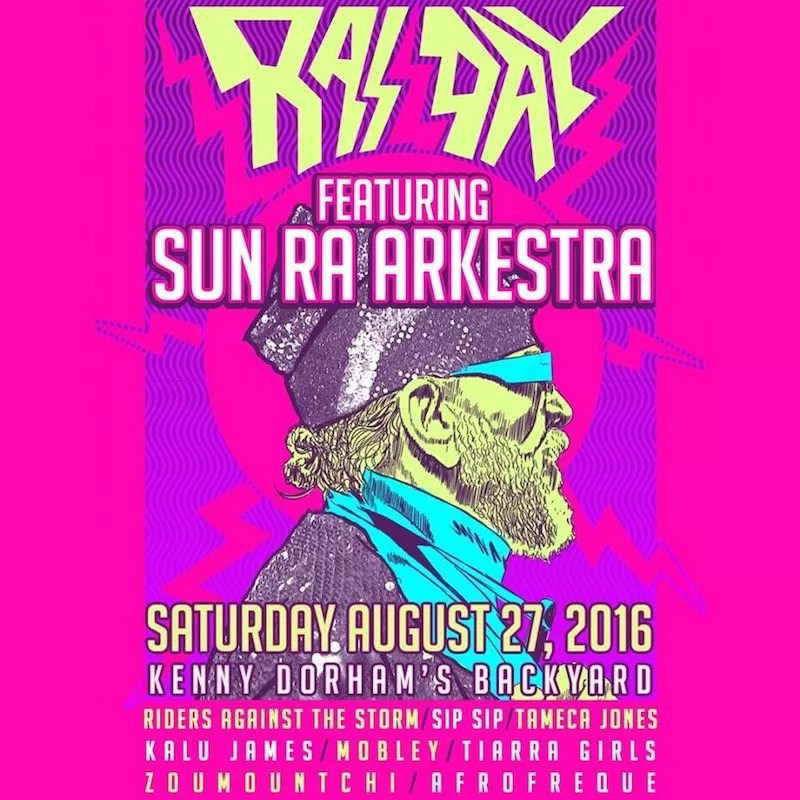
The Arkestra touches down locally this Saturday for RAS Day, the third annual festival lovingly reared by married hip-hop duo Riders Against the Storm. The family-friendly day celebrates the vibrant, diverse, and creative community that the pair of Chaka and Qi Dada have cultivated since arriving locally in 2010. Allen and the Arkestra constitute an intergalactic get for Riders, RAS Day, and Austin itself.
Austin Chronicle: I’m reaching you in Philadelphia, is that right?
Marshall Allen: Yeah, I live in Philly, on the outskirts – still in the city, but about six miles northwest of downtown. It’s called Germantown.
AC: The same house the band lived in back in the day?
MA: Same house. It’s the Sun Ra house.
AC: That was originally owned by your father, right?
MA: Right. Sun Ra needed a place to rehearse and house the band. He didn’t have a house or nothing, so my father sold it to him. For $1! He was helping the band. We didn’t have much money, so he said, “Alright, I’ll sell it to you for $1, so you can rehearse and build the band.”
It’s a three-story row house, so it had enough rooms in it.
I joined the band in 1958 in Chicago. We were based in Chicago in the Fifties. Then we stayed in New York from about 1961 or 1962 until 1968. We had to move out of the place we were in, so we went to Philly. I didn’t really want the house, so I let Sun Ra have it. It was a nice house in a nice neighborhood. We’d rehearse every day, 24 hours a day, so Sun Ra could get his music right.
AC: What did the neighbors think of that?
MA: They had to get used to us, but it didn’t take very long. People liked the music. All the kids loved it, everybody did. So we didn’t have no problems.
AC: And how many of you actually lived there?
MA: There was about six guys living in the house, the nucleus of the band.
AC: There are a couple of Austin connections to the Arkestra that most people probably aren’t aware of. Late Austin trumpeter Martin Banks spent a number of years with the Arkestra. What can you tell me about him as a player and as a person?
MA: Martin Banks was a good trumpet player. Sun Ra liked him. He lived in New York for a while and then moved back to Texas. Every time we’d play, when he was there, he was in the band. He played in the band for quite a few years until he passed. He was still in the band when he passed. He moved back home, but whenever we went on the road, if we needed a trumpet player, we’d call Martin Banks.
AC: Another local tie is Chandra Washington, an Austin artist who has danced with the Arkestra on and off over the years.
MA: Yeah, she’ll probably be down there with us when we come. She dances well. I had her on tour with us in Europe when we were playing with a 27-piece band with strings and stuff. We had two dancers and she was one of them. Sometimes she’ll sing, too. I usually use dancers and I always call her when I do.
AC: How did you first become engaged with music? When did you know that would be your life’s work?
MA: I joined the band in 1958, and when I got there I knew that was for me [laughs]. I’d been looking and running all over, and playing with other people, but this is when I said, “Wow, this is it.” I just had that feeling. I wanted to be in this band because it sounded so nice.
AC: Sun Ra is one of the most fascinating dudes who ever walked the earth. How did you first connect with him and what was it like to be in his orbit on a day-to-day basis?
MA: I came up when Duke Ellington and all them great bands were there. They all had different styles. Sun Ra would use dancers and singers, even comedians sometimes. It was like a show band, so we played all kinds of music and that’s what I liked about it.
We had a vast repertoire of different music – blues and everything. He had the musicians singing and dancing with their horns and playing the music, too. We used colors and lights and electronic instruments, and when we didn’t have electronic instruments, we’d have to duplicate those sounds on our horns because he was talking about futuristic things.
It was a showcase of the history of music, really. We’d play some of that old stuff from the Twenties, Thirties, and Forties right on up. He’d play showtunes, Gershwin, jazz, rock, all kinds of music. He was always so busy.
AC: And he was as much a philosopher as he was a bandleader.
MA: He wanted us to learn about the Bible, about the history of the planet, about ancient Egypt. He’d want to talk about other worlds and going to outer space. He was interested in us knowing all of those things. You had to tune up your mind and adjust yourself to learn all these things.
I’d ask something about music and he’d tell me something about the Bible. He’d want us to learn about all this stuff, and now I see why. So you can understand, know the history, and play the music.
He was about the space age, and we’d do all these different space sounds. In the old days we weren’t used to that. We were used to playing just straight music, but he had us playing all kinds of things against each other with all kinds of instruments. He was a great composer, too. So I’ve been trying to carry on that tradition.
AC: Did everyone in the band buy into the “Space is the Place” philosophy?
MA: Some people devoted their whole lifetime to that and believed. Some people believed some things but had other beliefs, too. Sun Ra’s interpretation of the music is what might get them, not whether or not they were good musicians. It was how you interpret it and the meaning behind playing. Some musicians found it difficult, because they’d play it straight and Sun Ra wanted them to play it crooked.
Sun Ra was such a great composer. He was good at knowing your personality and your potential. He was one of those spirit people who knew what to give you, and what to write for you, and how to get the best out of you. Everywhere we go, we play the vibrations of the people who live there. We have something for everybody. I’ve never been in another band where there was a leader like that.
That’s how I got stuck. I couldn’t get away. Every time I thought I knew something, I didn’t. He’d come up with something else. Some people never get a person like that in their life – a great teacher, a philosopher, an innovator. I had to live and eat and sleep with it, and play what he was trying to picture in my mind to play.
AC: As a bandleader, is your style different from his?
MA: I follow his way of doing things. I stayed in the band so long it just comes automatic. Now I put some of my things in there, too, but it still sounds like Sun Ra. You’re always influenced by who taught you, you see?
AC: You once said that Sun Ra taught you how to translate spirit into music. Can you elaborate on that?
MA: Right, because I wasn’t playing the balance that he was talking about. I was playing by memory and with my head. I had to play with the spirit. To play his music, you had to play from the spirit the way he wanted. The spirit you don’t know, you just do it. If you activate your spirit and what you know, put them together and then you’ve got it. He said it was a planet of duality, which it is.
It was about doing all the things I wasn’t thinking about doing in music. I would learn everything correct, but that was from the head, from memory, so I had to put the two together in order to accomplish the mission. It was funny, he’d say, “You play nice, just not what I want.”
And I’d say, “What does he want?” He wanted me to play without hesitation.
It was hard, but you don’t give up. You had to keep going until you found an answer. When you play for people, you have to enlighten them. If you activate your spirit, you can activate somebody else’s spirit. It’s a long story, but it’s real.
AC: When the whole band is playing from the spirit, what kind of energy does that spring and how does that transform an audience?
MA: You don’t get tired because energy transfers from person to person. It goes right on through the band and you play things that you didn’t know you could play. Vibrations. It gets to the point where you don’t have to write it, you can just play it with the spirit without a note in front of you. I couldn’t understand that. He’d create a beautiful arrangement without a note in front of him.
AC: The Arkestra’s music can be full of swing one moment and chaotic and dissonant the next. Obviously you like to challenge the audience.
MA: Your ear is like a harp. You can wear out one part of the harp. If you just stay in the middle, you’ll wear it out. If you stay at the bottom, you can wear it out. Or you can go all the way from the top to the bottom. In music, it’s the same way.
When you go where you’re not used to hearing, it frightens you. If you’re used to hearing all kinds of sounds in the universe, you can decipher it and it doesn’t shock you. You understand that everything is here, but you don’t hear it all and you don’t know it all.
Music is like anything, it can be dangerous and it can be helpful. It can make you do good things, it can make you do bad things. Sound can build and sound can destroy. It all connects. Better music for a better world. You play the music to create a better spirit for yourself, which you can give to others.
So we’re coming down there to try and enlighten the young people. We were playing music in the Fifties for the 21st century. Well, the 21st century is here. We’ve always stayed ahead.
AC: What’s the secret to your health and longevity?
MA: The secret is play the music for your well-being first, in order to give somebody else something. If you are well-being, you can give some to others. I’m 92 years old now, so I’ll be 102 playing for my well-being. As long as my well-being is doing well, I’m doing something right.
Otherwise, I just do what other people do – eat, sleep, and take care of yourself the best you can. I don’t worry a lot. I study the music and I don’t have no ego about that. When you’re around other people, they feel that. They can see it and feel it. That’s what you call vibrations. You get around some people and get bad vibrations. You get around some people and they inspire you to live better.
That’s what I’ve learned, and I’m using music the best I can to inspire and help people and myself. Play from your heart and be sincere. If they can get some of that, you’ve accomplished the musician’s mission – to enlighten the people and inspire them.
This article appears in August 19 • 2016.