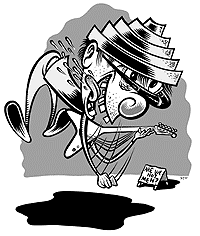
 illustration by Roy Tompkins |
“experts” seem to believe that Marshall McLuhan’s vision of a global-mediated village came true a long time
ago. Paraphrased, McLuhan’s theory stated, more or less, that thanks to the
mass media’s successful invasion of every aspect of daily life, there are no
longer differences between communities. We wear the same fashions, consume the
same food and drink, kill our leisure time identically with the same books,
movies, television shows, and music. We live in a homogenized mass-community,
each city inseparable from the last.
Many “experts” are wrong. Need evidence? Next time you phone or write a friend
in New York, Chicago, Seattle — wherever — just ask ’em the last time they
attended a Hoot Night. You’re virtually guaranteed an instant, “What the hell
is that?!” Kinda like Shiner and decent barbecue or Mexican food, the
Hoot Night — that glorious, sloppy tradition in which a bunch of musicians
gather to play anyone’s music but their own — is completely indigenous. And to
think it all began with a pilfered sleeve note:
“`Hootenanny’ is to folk music what `jam session’ is to jazz, namely a
gathering together of all sorts of people — celebrated performers, amateur
singers and pickers, and sing-along, hand-clapping devotees. The meeting ground
is simply a vigorous love for folk music.
“The Hootenanny was a necessary invention of the late 1930s: The `Hoot’ was
a completely spontaneous, unrestrained event, and consequently produced many of
American’s greatest folk artists and songs.
“Today, folk music is practically in the Big Business category and the word
`Hootenanny’ has even made Webster’s. Accordingly, Hoots are liable to take
place anywhere — the basement, a nite club, or the Modesto after a concert —
and now on a record. Luckily for all of us folkniks, the essence of the old
Hootenanny — its immediacy, variety and incredible excitement — still
remains.”
Most people know those words from a 14-year-old Replacements album,
Hootenanny. Very obviously cribbed from some early, Sixties-vintage,
10-cent folksploitation album one Replacement or another had stumbled across at
some long-forgotten garage sale, thrift store, or whatnot, those words
nevertheless planted a germ in the mind of Michael Hall.
Talk to virtually any insider of the day and they’ll uniformly point their
finger at Hall and insist he was the Father of the Hoot Night. Brent Grulke,
then Hall’s roommate, vaguely recalls Hall poring over those Hootenanny liner notes, stroking his chin, and letting out a fairly classic noise:
“Hmmmm….” That “hmmm” apparently couldn’t have happened at a better time.
“They came at the time when I had left the True Believers,” says Alejandro
Escovedo, who claims the early Hoots were partly responsible for getting him
back into playing music. And he wasn’t the only local musician who felt adrift:
“A lotta things had changed at that point,” he explains. “The Beach was no
longer. That Austin Beach scene, all those bands like Zeitgeist and the Wild
Seeds and Doctor’s Mob had all kinda broken up and moved on. So there was this
void there. I think it was Mike Hall and some other people that started having
Hoot Nights. It was just a cool way to kinda while away the evening.”
The first Hoots appear to have been organized at the Continental Club, at a
time when the South Congress venue still left its doors open to underground
talent. Once the Continental closed, however — later reopening as a more
roots-oriented operation — the Hoots switched location to Big Mamou, then to
the Cannibal Club. Originally, the gatherings were more of a literal hootenanny
in the traditional sense: A loosely-structured event where you showed up with
your acoustic guitar or whatever kind of axe you chose to pluck, strike, or
blow, added your name to the sign-up sheet, then waited your turn to take the
stage. As producer/musical-man-of-all-seasons Spot puts it, the original Hoots
swung the focus away from singer-songwriters and more towards musicians
inclined to pick up a Fender Strat. “It was a chance for the electric musician
community to find a new mode of expression, one that was more
acoustic-oriented.”
“The early ones were a helluvalotta fun,” chuckles Spot. Having hosted a
number of the Tuesday night Cannibal Club Hoots, the local punk rock legend has
some vivid memories of the backstage scenes being even more interesting than
whatever was unwinding onstage, as two or three people would jam on shared bits
of repertoire in the alley behind the club: “Oh, do you know this tune?” “Yeah!
Cool!” “Hmm… why don’t we go sign up?” Sometimes bands would even be formed
out of this experience: One precursor to the Bad Livers, the Barnburners, arose
from future Liver Danny Barnes showing up to one Hoot with his banjo and
locking horns with local musical mainstays Rich Brotherton and J.D. Foster on a
few bluegrass tunes in one such backstage scene. Spot laughs that Barnes claims
the Barnburners “must’ve played 20 gigs after that first Hoot before they ever
organized a practice!”
Escovedo was similarly lackadaisical in his preparations for Hoot Nights. “We
would try to learn the songs that day or something. I remember we had a
practice here at my house and did a version of Al Green’s `Take Me to the
River.’ I think I played it with guitar, synthesizer, and violin or something.
It was pretty strange.” (Escovedo also recalls a few of his now-standard
originals germinating from spontaneous Hoot Night jams, including
“Gravity/Falling Down Again.”)
The Hoot Night became so popular, in fact, that local radio personality Jody
Denberg began organizing Radio Hoots as a deejay on FM powerhouse KLBJ. Rather
than following the usual rules, though, Denberg would book the participants
ahead of time, basically making the exercise a reason to group together Austin
musical luminaries such as Joe Ely, Timbuk 3, and Escovedo on the air.
Innovator Michael Hall then set another precedent when he organized the first
Hoot-with-a-theme, this one being an all train songs affair. Soon, theme Hoots
ruled the game, either as topical ones (ala the Train Songs Hoot, or the
Seventies Hard Rock Hoot, with lovingly sloppy renditions of your favorite
Z-28-and-a-hash-pipe classics performed by the locals) or in salute to bands
both classic (Led Zeppelin, Ramones, etc.) or dubious (“Yeah, there was
probably an Archies Hoot Night,” sneers Escovedo). Spot feels said development
may have killed the original Hoot Night spirit — “or, at least made things
less interesting.”
It wasn’t long before acoustic guitars had to make room for full-on electric
bands, being either established ones or ad-hoc outfits assembled for the
occasion. Long-lived garage pop darlings Pork actually made their debut at a
Hoot Night, with Spot playing a minimalist drumkit consisting of pieces which
had once done time in the original kits used by the earliest line-ups of Black
Flag and Redd Kross.
Brent Grulke recalls the one-night outfit he assembled for a Drug Songs Hoot
at the Cannibal Club called Mighty Dope Rig, consisting of Grulke and several
once-and-future members of the Wannabes and Sincola, among others. Future
Sincola guitarist Greg Wilson apparently had just purchased a beautiful blonde
Telecaster, on which he scrawled the word “Dope” just for the occasion.
Grulke smirks that Wilson resultingly “became a dope” when he realized the
marker he’d used to decorate the guitar was indelible, making the “Dope” designation a permanent one.
Meantime, Mighty Dope Rig’s sole goal was to walk on and play Neil Young’s
“Cinnamon Girl” (“which isn’t even a dope song!”) at quarter-speed with as much
volume as the band could muster. Cannibal owner Brad First’s expression
dissolved into one of complete horror behind the mixing desk once he realized
there was no way his P.A. could compete with the onstage decibels. “There was
an audience,” Grulke adds with some pride, “until we started playing.”
Like any other good thing, the Hoot Night succumbed to old age and eventual
death, or at least suspended animation. “It eventually became a rote exercise
by the end,” agrees Grulke: “It became like the box-set phenomenon. Once you’ve
run out of the good bands, soon enough even the bad bands get box sets. Well,
they also got Hoot Nights.” Indeed, it’s hard to sink any lower than “Jesus
Christ Superhoot,” a full-blown production of the infamous rock opera organized
by Glass Eye’s Kathy McCarty and cast with local rock scene luminaries. By all
reports, it was a very good production. But Andrew Lloyd Weber?!!!
“I can’t remember what my role was,” laughs Escovedo. “I think it was as one
of the Three Kings — that was Gretchen Phillips, Steve Chaney and myself. I
couldn’t remember my words to save my life, and of course the bottle of Jack
Daniels we had backstage didn’t help! I didn’t really know how to prepare for
this part. I’d never even seen Jesus Christ Superstar, y’know? It
was just one of those things I always thought was kinda lame.
“I can’t remember the guy’s name — he used to be the bass player in the Wild
Seeds — but he played Jesus and he was amazing. He was like an opera singer or
something. So, he was into it, and there were all these other people like Kathy
McCarty and all these people who had their thing down. And of course, I came
out with, like, a leather jacket, tight jeans, cowboy boots, no shirt and lots
of eyeliner. That was my contribution to the musical. I flubbed my lines — I
think somebody had to sing them for me, maybe it was Steve Chaney.”
Escovedo laughs. “It was pretty hilarious.”
Once the Cannibal Club closed, Hoots would occasionally be staged at the Hole
in the Wall. One of the last Michael Hall-hosted ones was the “Cross-Dressing
Hoot,” which saw many grown men who probably know better giving in to a
long-buried Uncle Miltie fetish. The past year or two has even seen a mutant
rebirth of the Hoot Night: It’s now a rare special event, always along a theme,
with bands pre-booked and arranged in a preset order and playing on shared
equipment, the proceeds usually going toward some worthy cause or other.
When a former member of my band the Hormones and the Cryin’ Out Louds,
guitarist Tim Hayes, sustained hand injuries that resulted in hefty medical
bills upon his relocation to his native Seattle, a Devo hoot night was
organized in his benefit. The evening succeeded beyond anyone’s expectations,
capped with appearances by touring Devo-tees Clawhammer and the Oblivians, and
raised several hundred dollars for Hayes’ wounded hand (and bank balance).
According to Hole in the Wall booker Debbie Rombach, it was also the second
most successful evening in the club’s history. That Hoot was even further
outstripped by last month’s Ramones Hoot, which raised over $800 for Blue Santa
and saw every permutation of the Ramones aesthetic, from Lounge Ramones (Ms.
Xanna Don’t with a member of King Cheese) to Junior Brown Ramones (Spot, of
course) to Transgender Ramones (Handful).
As Spot and Escovedo both bemoan, the original spontaneity of the Hoot Night
is gone, but Michael Hall’s idea still exists. It’s just warped worse than that
Yes record you threw in Mom’s oven. Not a bad thing, just a different thing,
and one completely unique to this area. (Escovedo thinks Hall may have tried to
import the idea with him when he migrated to Chicago, but doesn’t know how it
went over.) All this from a tongue-in-cheek punk rock record sleeve? Hey, as
Spot puts it, “Why plan something when a bad idea can accomplish so much more?”
[Portions of this article originally appeared, in a different form, in
Slant magazine, available through Urban Outfitters.]
This article appears in January 17 • 1997 and January 17 • 1997 (Cover).