

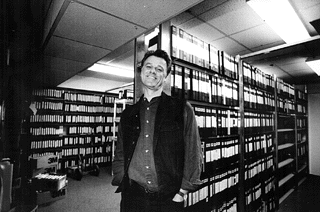
 Artistic Director Tim Hamblin |
disaster flick re-running on TNT will star George Kennedy, and if you flip on
the Austin Music Network, you’ll see footage from the Austin Acoustic Music
Festival.
Tim Hamblin, the artistic director at the Austin Music Network (AMN) admits in
delicate terms that “our programming is now at the stage where it’s more
sterile at the moment,” and in more brutal language that “it hurts me to switch
it on and to think, `Goddamn, this shit again?'” And Kent Benjamin, former head
of programming at AMN claims, “I stopped watching it about six months before I
left because I thought it was boring.”
So what’s on the network that’s so dull? Well, everything. Rock, pop,
punk, jazz, acid jazz, lounge, techno, blues, country, conjunto, folk,
industrial, Tejano — even some old New Wave videos. Most of it’s from Texas,
some of it’s national. It’s indie, and major label. There are locally produced
live shows, and clip shows of both big names and no names. Okay, it’s not all
dull, but rather part of the problem may be, as Benjamin notes, “you can make
yourself so broad and diverse that you end up appealing to nobody.”
AMN actually does an admirable job of giving equitable exposure to a broad
range of music. Yet if you watch for any given length of time, you begin to
notice a disproportionate number of shows and clips coming from a small number
of events. Redundancy settles in quickly. The band may change, but the song
remains the same.
On the flip side, unless you put yourself through some prolonged watching,
you’ll never become familiar enough with the schedule to know where to find
shows you might deem worth watching. AMN does have a grid where it tries to
program certain shows in certain fixed time slots, but there are few places to
get the listings. The best place to get them was once the Chronicle, but
when the channel went 24 hours, the listings got too long and had to be cut
from the publication.
They do appear in the Austin-American Statesman, but in the weekly
television supplement Show World, not in the Gen X catch-all
XLent where you might expect — and it’s not even a complete grid. There
are listings on the Internet, but that obviously requires a computer and an
Internet link. Finally, three times a day, AMN itself runs a banner with the
day’s programming on it, which, interestingly enough, entails the viewer
watching the channel simply to find out what to watch.
Probably the biggest reason the programming isn’t very good right now is
because the person programming the channel readily acknowledges that she’s not
very good at the job. Says current Program Manager Ester Matthews: “I don’t
think I’m that good at it. I have an accounting background, so I do things by
the numbers… I do have a lot of interest in music, but I don’t pay that much
attention to performers, the names of songs. I enjoy singing and I enjoy
listening, but the specifics of it escape me. I’m hoping not to have to do it
in the near future because that’s really not my expertise; but we’ve lost a lot
of staff in the last year, so I’ve taken on that job with the intention of
passing it along to another employee at some point.”
The program manager isn’t very good at programming because that’s not the job
she was hired to do. Matthews was once former councilmember Max Nofzinger’s
aide, and when he stepped down, she was reassigned to AMN as what she calls
“kind of a media communications coordinator,” helping market the channel and
acting as a liaison between the network and the city’s many commissions and
sub-committees.
But after South by Southwest last year, approximately six months after
Matthews came on board, Kent Benjamin quit and his duties got reassigned. Three
months after that, original manager Ronnie Mack left, and his duties also got
reassigned. Ultimately, Matthews took over the management and the
programming of the network, and went from having authority over nobody at AMN
to having authority over everyone. On top of that, just after she took over,
AMN went to 24 hours continuous broadcasting. In a short span of time, AMN lost
two crucial members of an already small staff and became a much bigger
endeavor.
Departures, expansion, amorphous job descriptions; AMN is definitely still a
work in progress. And as with any situation such as this, there have been
problems: internal conflicts, friction with other city departments, and
resource deficiencies. Some of these problems are the result of personal
differences down at AMN (the offices are housed in the basement of the City
Council chambers), but many of them are simply a result of how the network came
to be. Explaining the latter, then, obviously requires a brief history
lesson.
Most people involved with
the creation of the network credit either or both Tim Hamblin and Hank Sinatra
with the original idea for AMN. Sinatra actually ran for mayor at one point
with establishing a local music channel as one of the items on his agenda.
After finally gaining approval from the city, the project almost faltered
before it ever happened. The network was originally awarded as an independent
contract to what was called The Austin Music Channel Company, yet after several
months, it became evident that the Music Channel Company was the wrong choice.
The city decided to terminate that contract with the head of the company and
make a settlement.
After that, the idea of the network as an independent contractor was dead. The
city then took control and made Ronnie Mack, who had been on the board of ACAC
(formerly ACTV) with Hamblin and Sinatra, the new project manager. According to
Mack, “The reason it got under the umbrella of the city was basically to
salvage it. They didn’t think if they went through the [request for proposal]
process again, that the music network funding would hold up — the support from
council and everything. So, we basically had to prove the concept real fast.
And quite frankly, I didn’t think they thought we could get it on the air. At
that time people were probably thinking, `Well, let these guys give it one last
try and if they don’t make it, we’ll put it all to bed.'”
One last try meant only 45 days to get the channel on the air. Mack hired
Ingrid Weigand as operations manager in charge of production (shooting material
and getting it edited, etc.), Kent Benjamin as head of programming, and later
added Hamblin as artistic director; Sinatra was originally going to be a
sub-contractor doing productions, but at least partially due to personal
conflicts, he decided not to work with the network. Those four principals —
Mack, Benjamin, Weigand, and Hamblin — had to “go in and do the impossible,”
says Mack. “There was no time to sit around and dream up how we’d like [the
network] to be. We had to make it happen or it wasn’t going to happen at
all.”
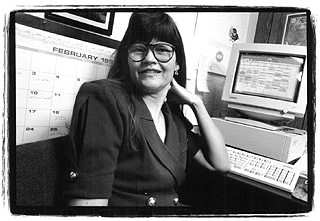 Program Manager Ester Matthews |
one; AMN was paired with Country Music Television (CMT), a combination which,
as Hamblin puts it, some thought was an attempt to “make us fail.” The
arrangement was that AMN would interrupt CMT nightly for four hours. Hamblin
recalls checking the AMN request line and hearing messages left by angry
country music fans, inquiring with the use of colorful language as to why their
Brooks & Dunn had been pre-empted in favor of local, and to them, unknown
musicians whose weird looks obviously justified the questioning of their
sexuality.
Eventually, AMN received its own channel (15), expanded to six hours, and
finally went round-the-clock last August as part of the city’s cable agreement.
Theoretically, AMN is funded by Time Warner Communications (formerly Austin
CableVision). Through their cable franchise agreement with the city, Time
Warner Communications puts $3 million annually into the general fund, from
which AMN draws its annual budget of $290,537. Therefore, it’s the city, not
the cable company, that decides the fate of the network. “You have to be really
careful with the network and the city,” says Matthews. “We’re still called a
pilot project. One councilmember can get mad at us and we are gone out of the
next budget.”
Don’t see much rap on AMN? Well first, there isn’t much of a local rap scene
to cover; but more importantly, because it’s a city division, the network has
to be smart about not airing anything overtly offensive, especially during the
daytime, lest some irate mother calls a councilmember asking why a city
organization is broadcasting a video with homeys sporting “gatts” and using
catchphrases like “Yo, bitch” or “mothafucka” while her impressionable child is
watching. That would be bad for the network.
Being perceived as expendable by the organization that controls your fate,
however, has far greater limitations than those resulting from the fear of
offending the wrong people. It makes asking for more money almost impossible;
and much of what stymies the network can be traced back to resources, or a lack
thereof. Consider what the AMN faces in trying to produce a local show.
For one, AMN has only one
camera. Let’s repeat that: AMN has only one camera. Try running a
production company that films live music with one camera. It can’t be done —
at least not well. AMN does have access to ACAC equipment, particularly the
multi-cam, which is used for doing concert tapings, but there have been slight
problems with the sharing of equipment; items have gone missing or were not
adequately maintained (at times equipment usage and other production squabbles
have caused serious friction between ACAC and the AMN). Moreover, AMN is just
one of several local institutional users of ACAC’s equipment, so they don’t
necessarily have it at their disposal either.
After procuring the equipment and making sure that everything is functioning,
it takes about four hours to set up and an hour to break down the stuff, making
it much more cost/time/resource-effective to shoot a longer event that’s going
to give you multiple bands rather than shooting a live performance by one or
two bands. That explains the abundance of Austin Acoustic Music Festival,
Armadillo Homecoming, and Austin Chronicle Music Awards show footage.
These are opportunities to get large numbers of bands without having to go to
multiple locations and repeatedly making the fixed five-hour time investment.
Never mind that they are shown over and over; these are programming bonanzas.
So, you’ve overcome your equipment problems and you’ve captured a plethora of
performances. Now, the footage has to be edited. AMN has but two editing
systems, both of which are borderline obsolete, and both of which are
Amiga-based. That’s Amiga, as in the computer company that no longer exists,
which is crippling because it’s not compatible with Mac or PC. So there’s no
tech support, no spare parts, no nothing. One system went down last July and
was inoperable until October. For that time, AMN was reduced to the one editing
system that’s only capable of editing clip shows; hence developing a backlog of
footage like the Women in Jazz series and Rock the River Clean, in addition to
the still unedited footage from the Acoustic Music Festival. (What you’re
seeing on the channel, by the way, is footage from 1995.)
Yet, even though the editing equipment is nearly outdated, it’s still more
advanced than what most beginners can handle, and beginners is mostly what AMN
employs thanks to the city’s pay scale, which doesn’t compensate network
editors in line with what the industry pays advanced editors. Therefore, it
takes a bit of a time investment to get new editors to a point where their
learning curve flattens out. Once they get to that point, however, they’re
financially better off working elsewhere. To make matters worse, there’s been a
high turnover of editors recently, and time spent training new editors has been
virtually wasted.
Many of the problems could be alleviated if the network had — everybody’s
favorite panacea — more money. But, if AMN is a “questionable division”
because “the city council can’t necessarily see the benefit that the network is
creating for the musical community,” as Matthews asserts, how can AMN possibly
expect the city to buy them better editing facilities or a multi-cam set-up or
even just increase the operating budget?
Theoretically, the network has the ability to make money on its own, a
potential that obviously means not being financially dependent on the city. By
hiring themselves out to do production work for record companies and bands —
concert videos, electronic press kits (EPKs), etc. — the network could
conceivably generate the money they need to get off the public dole.
Here’s how it would work in the best of all possible worlds: The network would
get a call from a label, perhaps Almo, saying something to the effect of,
“We’ve got Gillian Welch playing Austin in a month. Could you film the show and
put together a concert video for us?” The network would say, “Love to. That’ll
be X thousand dollars, please.” They would then shoot the gig, edit the
footage, and hand over the finished product to Almo. AMN would get paid, and
here’s the bonus, have additional material for programming. Voila! Instant library.
It sounds like a wonderful solution. You solve programming and money problems
simultaneously. Sadly, this scenario doesn’t happen very often; AMN generated
around $6,000 last year. The reasons it’s not happening are two: First —
surprise — is a lack or resources. See, Austin is the operative word in Austin
Music Network. The general goal of programming, although unwritten anywhere, is
to have the content at about 75% local or Texan, and the rest national.
If AMN editors are spending time on material for record companies, they’re not
spending time editing footage for local bands. As it is now, there’s a backlog
of local productions to be edited and editing time is already at a premium.
Because programming is so Texas-centric, if the network is offered the chance
to do, say, an interview for an EPK with a non-Texas artist, they’ll probably
pass and lose out on the money. Sometimes, it isn’t just the cash but the coup
AMN misses out on; the departed Benjamin claims the network balked on the
chance to do the very first Oasis interview this side of the Pond.
Second — surprise surprise — AMN’s being a city division also hinders doing
productions for profit. Without their own multi-cam, AMN would have to use
ACAC’s, but ACAC equipment is not supposed to be used for any kind of
commercial venture. There are other legal issues, such as copyrights and other
artist rights, the city isn’t used to dealing with which make doing productions
difficult; and there could be more legal land mines to navigate once privately
owned businesses began thinking that a publicly funded organization was taking
work away from them.
So, yes, because AMN lacks equipment, they have difficulty doing the very
things that might get them the money to acquire better equipment. Furthermore,
because AMN is a city division, they have problems doing the other things that
keep them from being a financial drain on the city. Isn’t it ironic?
Aside from the legal
and equipment hurdles, AMN just hasn’t marketed itself very aggressively for
doing production services. Marketing the channel was part of what Matthews was
brought on board to do, but with Benjamin and Mack leaving and the network
going 24 hours, little things like programming the channel kind of got in the
way of Matthews’ doing any marketing.
In fact, Matthews saw the expansion as a prerequisite for marketing AMN. “I’ve
always felt like it was more important to get us to 24 hours than it was to
market the channel because I thought that we needed to be 24 hours before we
could really market the channel,” says Matthews. “But I’m sure there are some
in government that thought we should be trying to make money.”
The reality of the situation is that the financial/resource problems aren’t
going to be cured anytime soon. Being 24 hours is taxing in a way that being on
the air only four or six hours wasn’t, and Matthews is the only manager who’s
ever had to deal with the inherent increase in demands. Institutional
limitations, however, are not the only things affecting programming.
Personal differences have caused problems at the network since day one.
Remember, this was the reason that Hank Sinatra, the man some credit with
originally conceiving the idea of the network, opted not to work with AMN as a
production sub-contractor. Even the most basic procedural philosophies have
caused internal strife at AMN — thereby influencing what ended up on the
air.
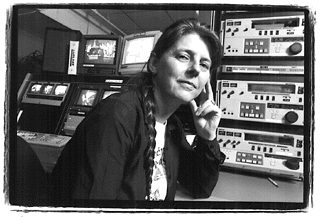 Operations Manager Ingrid Weigand |
approached things from the standpoint of “if you shoot 60 hours of the Acoustic
Music Fest and you know you’re not going to get them edited for another six
months…. What I would say to serve programming is `Let’s go through there and
pick out three or four of the hot bands. Edit that material first and get that
on the air.'”
It makes sense. If a band’s starting to generate a buzz, they want all of the
exposure they can get while people are still talking about them. Heck, with the
turnover rate in this town, in six months the band might not even be around
anymore. Currently, at AMN, six months can be one of the shorter waiting
periods. Yet, Mack claims that hurrying the process along often met up against
“that certain person [who] would argue against you, maybe put up walls and
scream and holler, that that would be an unreasonable proposal.”
Even though Mack left last summer, that exact conflict still lingers. On
December 8 and 9 of last year, AMN set up two nights at Stubb’s specifically
for the purpose of getting footage of local bands that they didn’t yet have,
Earthpig, the Adults, etc. There were 11 bands total. The event was called
“Soon to be Seen on the Small Screen.” The performances were great, the
production — the lighting, the sound, the footage — was one of the best AMN
had ever done. Everybody was generally pleased with the way things came off.
Hamblin, the artistic director, was anxious to get some of the material on the
air. “I wanted to get stuff on the next week,” he says. “What I tend to do is
say, `Let me take a single off and get one edited.’ I haven’t been allowed to
do that yet. I’ve been told I can’t get the tapes. I’ve made the strongest
requests that we get this out as quickly as possible, because I wanted to get
some out for Christmas; even one song by each band could have easily been
gotten by Christmas. But I was told that was not possible. It wasn’t going to
be edited until the middle of January.”
Although the production’s title carried the name “Soon,” Ingrid Weigand, who’s
in charge of production, which includes editing, thinks Hamblin may have been
expecting a little much. “I’m surprised Tim said that because he knows things
don’t happen that fast,” she says. “Tim is normally really eager. As soon as he
sees something he wants… I cannot stop editors from their assigned jobs and
give them something new every time Tim sees something.”
Wouldn’t it be easy and basically non-time-consuming just to take one
song out of each performance and get it on the air, maybe put it in New Vids
on the Block, the show comprised of, oddly enough, new videos? Yes, but
unfortunately that’s kind of a policy sticking-point. According to Weigand, “We
do not put raw footage on the air. And by the time I have an editor go log the
show and edit one or two cuts just as a single, I might as well spend the five
or six extra hours to get the whole show out.”
This is one of the most hotly contested procedural differences at AMN.
Weigand just isn’t going to put local footage on the air, playing next to
national, major label, big-budget videos unless it also looks professionally
done. “When you throw raw footage on the air, I think there’s no faster way of
ruining a reputation,” says Weigand. “I’m trying to be more careful that, if it
goes on the air, it looks good. If you just grab raw footage and throw it on,
it does give you the immediate satisfaction of getting something on the air
that got shot two weeks ago; but I don’t need the call from the artist, and
there are some artists in this town that will call and say, `What did you pick
that song for?'”
Another part of airing delays is that AMN generally edits footage in the order
they receive it; because the one editing system used for doing live shows was
down for several months, the network developed a huge backlog of unedited
footage. So, AMN’s priority was to finish off, yes, more of that Austin
Acoustic Music Festival footage before doing the “Soon to be Seen.” By
controlling what gets edited when, Weigand has a tremendous impact as a de
facto programmer. These factors cause a considerable slowdown in turn
around time, but according to Weigand and Matthews “Soon to be Seen” is
actually not even behind schedule.
“When we did it,” explains Weigand, “we said that we should start running them
in January. And the first one is going to go on in January.” Technically,
that’s true. One — precisely one — of the performers, Jake Andrews,
got aired in January, and that was on the very last day of the month (the next
segment is scheduled to hit the air in mid-February). Does the 50-day
turnaround to get one of the 11 bands done constitute “soon”? That depends on
perspective. For Hamblin, it’s frustratingly slow because he’s anxious to get
new programming on the air. Given past performance, however, it’s quick work.
Again, that Austin Acoustic Music Festival footage that just got finished in
December was from 1995. In fact the “Soon” part of the “Soon to be Seen” series
appeared in the moniker only because, according to Matthews, “I made up the
title of that concert. And I did it because no one else came up with a title,
and I like alliteration.”

|
literary device, however, isn’t even the pinnacle of the ridiculousness.
Remember, Matthews acknowledges that she isn’t that good at programming and
that, paraphrasing, the specifics of music escape her; but it isn’t just her
being out of touch that affects programming.
AMN is broadcast from Time Warner, not from the network’s studios as it once
was it the early days. That means the tapes of all the shows to be broadcast
have to be taken to Time Warner at least three days in advance of their airing
date. In order to conform to this requirement, AMN makes deliveries of tapes
two times a week. They box up the tapes, take them upstairs, drive them to Time
Warner, and unload them. This is a job Matthews once had. Now that she’s
programming the channel, that’s one of the factors she claims has to be taken
into consideration. In other words, minimizing the number of tapes that the
person who has to take them to Time Warner is part of what determines what ends
up on the air — even though it increases repetition and decreases flexibility
and variety.
Remember, again, that Matthews only has the power to program because the
original manager, Ronnie Mack, and programmer, Kent Benjamin, left the network.
And rather than hiring new people for each of those positions, the
responsibilities just got reassigned — leaving Matthews little time for the
marketing job she was originally hired to do. And why did those people leave?
Mack claims it was never his intention to stay indefinitely, and when a
position opened in the city’s Information Systems Department, working on the
new, high-speed fiber-optic network — something that’s very much in line with
his expertise — he jumped ship.
According to Matthews, though, Mack may have overstayed his usefulness to the
project. Of Mack she says, “Ronnie was able to set up the network very well, he
knew the technical end of it, but he couldn’t manage people. What he did was
tell everybody what they wanted to hear. So it was turning into a big
fiasco.”
And why did Benjamin leave? He claims he committed to Mack for about six
months — just to get the thing off the ground. Original intentions aside,
according to Mack, “Kent got frustrated a little early on…. There were some
personality conflicts between Kent and at least one particular person that were
real hard to resolve. Kent resolved them by just leaving.”
Heck, Benjamin himself admits that. “I never had a job I hated so much, and it
was the people.” A couple of people hint that his leaving was the biggest blow
to the network’s programming. Benjamin is a living library of music, who was
very much in touch with the local scene and very much aware of what AMN both
had and didn’t have, as well as of what had and hadn’t been shown recently.
Hamblin flat-out confesses that “his skills are sorely missed.”
Of the four people primarily responsible for getting AMN on the air, two have
left and two are still behind, although one, Hamblin, suggests that he’s
feeling anxious over the changes. “I’ve stressed my concerns to my boss that we
need to get the channel back on course and get a fairer mix,” he says. “We
don’t need to edit everything in the sequence we get it, and I try to
diplomatically give the complaints. All I can do is say to Ester, `I think we
should do this. This is a priority, that isn’t.’ She decides what she decides;
and I have to respect that.”
For her part, Weigand sees the personal problems as minor. “I do think
whatever personality conflict there was, wasn’t really any different from any
other creative thing I ever been involved with before,” she says. “One thing I
might say about some management styles was that the creative differences
weren’t always handled to where everybody could work it out and then agree on
something and then follow up. On the whole, though, I don’t think it was
anything totally unusual.”
It probably isn’t anything “totally unusual.” In many ways, the network
differs little from any other work place where employees don’t always have the
necessary tools for doing the job as best as it can be done. AMN, however, is
unique in that there’s nothing else like it in the country. Almost all those
involved, even the departed, made it clear that they are amazed that a
municipal government would make that kind of commitment to the arts. There are
also many things AMN should be credited for accomplishing, r�sum�
highlights that could help cement it as a permanent institution.
They were able to broadcast the Armadillo Homecoming show live both on channel
15 and feed it out on satellite so that anyone not fortunate to live in Austin
could pick it up. Also, after striking a deal with Channel 6 (you know, the
station where you can watch your city council at, uh, work) to use their
facilities, AMN has recently begun doing a live show on Friday nights. Better
yet, twice a week, on Sunday and Monday nights, AMN also airs its most popular
show, Check This Action, a half-hour show that runs down everything
happening in the Austin music scene during the upcoming week.
The point of the show, as it was originally conceived, was, in Mack’s words,
to “bring back that old feeling in Austin where there was this musical magic
happening out there and you felt like if you were sitting at home you were
missing it.” CTA‘s two hosts, originally Tara Veneruso, who now hosts
live show, and the Chronicle’s Margaret Moser, succeeded, but only up to
a point.
In the beginning, CTA was supposed to be a show that came on every
evening, but again, AMN just doesn’t have the resources to do that. As it is,
CTA is done in the network’s cramped quarters with just that one camera.
To give you an idea of what the spatial limitations are like, when taping
CTA, nobody can edit because the editing bays are adjacent to the “set”
and the spillover noise would end up on the tape for the show.
So, despite the fact some things come off well, nothing comes off easy at the
Austin Music Network. Nonsensical programming decisions as well as inter- and
intra-office tensions that have led to loss of valuable employees compound the
difficulties of just being underfunded and understaffed.
Nevertheless, AMN continues to survive if for no other reason than some
people’s determination to see it survive. Says Hamblin, “I’ve worked a long
time to do this, and I want to make it work however it can work. Sometimes I
understand the city compromises and I don’t want to upset the city. I think
this is a great deal. I think it can get a lot better. And I think if we get
the chance it will definitely improve. But there are definitely these teething
problems that are going to last a long time.”
This article appears in February 21 • 1997 and February 21 • 1997 (Cover).